

A bottle leaving a rinse station may need its outer surface dried before labeling. A washed metal part may need water removed before packaging. Both jobs involve air blow-off, but they don’t necessarily need the same air delivery arrangement.
An Industrial Air Knife directs a thin, continuous sheet of air across a surface. It can remove surface liquid or loose debris without a wiping tool touching the product. The first selection question is the area that needs treatment: a broad band, a small feature, or several surfaces facing different directions.
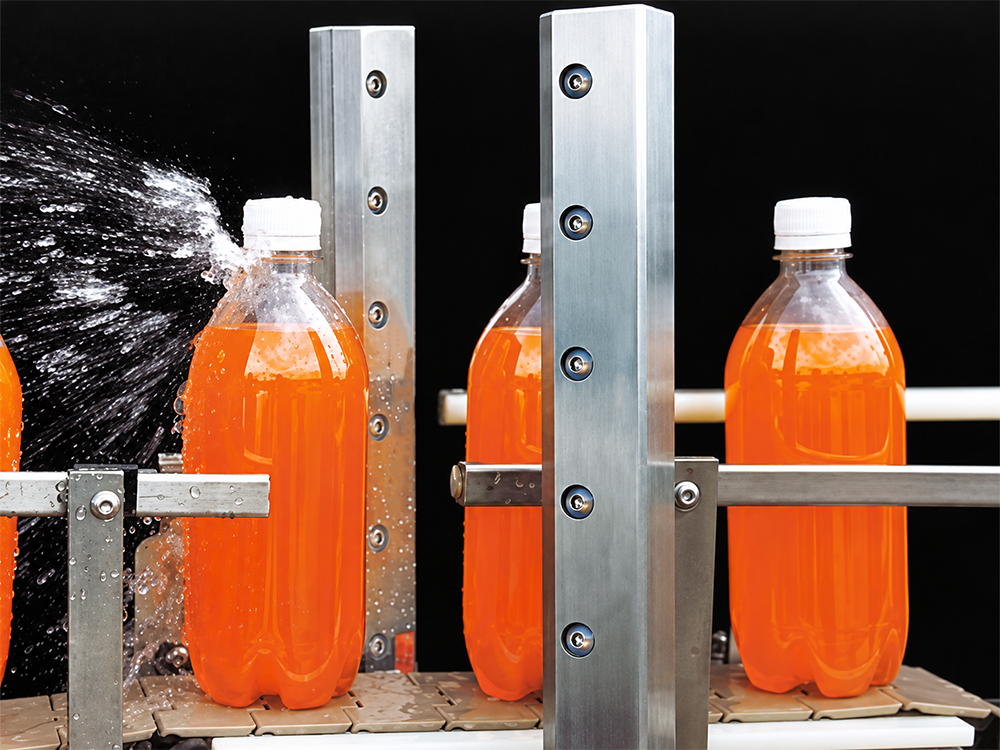
A typical linear air knife has an air inlet, an internal distribution chamber, and a narrow outlet running along its length. An external air source supplies the chamber, and the outlet shapes the discharge into a sheet-like stream.
The knife itself is an air delivery device. A working installation also needs a compatible air source, connecting pipework or hose, and mounting hardware. Depending on the process, it may need filtration, controls, an enclosure, and liquid collection.
For a moving product, the airflow acts on each exposed area as it passes the outlet. This makes a linear air knife worth considering when the task calls for continuous coverage across a conveyor or material width.
Air enters the internal chamber and leaves through the restricted outlet. The pressure difference drives the flow, while the outlet geometry determines its direction and initial pattern.
Air knife outlet designs vary. Check the working principle and supply requirements of the selected model rather than assuming that all air knives use the same internal geometry.
At a wet surface, the airflow transfers momentum to the liquid and pushes it toward an edge or drainage route. For surface-water removal, the main task is to displace water rather than evaporate all of it. This is why a blow-off process can operate without a separate heater.
Removing visible droplets does not establish that a part is dry inside a hole, beneath an overlapping feature, or within an absorbent material. Define the required result before deciding whether air blow-off is sufficient.
The air source must match the knife
Blower-fed and compressed-air-fed knives belong to different system designs. A blower-fed installation uses a blower selected for the required flow and pressure. A compressed-air knife uses a compatible compressed-air supply.
Don't assume the air sources are interchangeable. Confirm whether the selected knife is designed for a blower or compressed air. For a blower-fed system, check the proposed operating point against both the blower performance curve and the resistance of the air delivery system.
The practical implication is simple: select the supply and outlet together. A pressure reading alone does not establish that the system can deliver the required airflow.
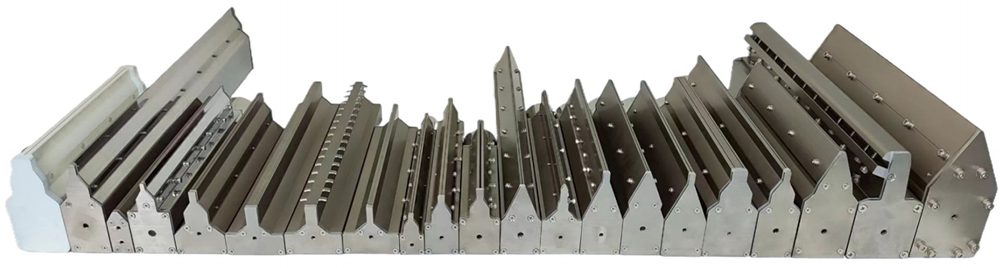
Removing surface water before the next operation
Common uses include removing rinse water from bottle and can surfaces before labeling, date coding, or packaging, as well as removing surface liquid from washed components.
Set the acceptance condition around the next operation. For a labeling trial, inspect the actual label area and check the resulting label application. For a washed component, include recesses and edges in the inspection instead of checking only the broad face.
Clearing loose debris from a surface
Air knives can blow loose machining debris or other particles away from exposed surfaces. They don’t collect the displaced material by themselves.
When evaluating a cleaning arrangement, include a destination for the debris. Moving particles from one product onto the next is not a successful cleaning result. If material remains attached, investigate whether adhesion, oil, moisture, or static charge is involved before increasing the air supply.
Supporting cooling, coating control, and film handling
Air knives can also support surface cooling, removal of excess applied coating, and film handling. Each application requires an airflow arrangement suited to the material and process.
These uses need different acceptance checks. A coating application should be judged against its coating requirement; a cooling application against the required product temperature. Equipment suitable for removing rinse water is not automatically suitable for controlling a sensitive coating.
The industry name is a starting point. Product shape and the next process step provide more useful selection information.
Food and beverage packaging. Remove water from bottles, cans, or package exteriors. Which surfaces must be dry for labeling, coding, or packaging?
Metalworking and parts washing. Remove rinse liquid from washed components. Can air reach the areas that retain water?
Plastics and rubber processing. Remove surface water after washing or cooling. Does the shape need airflow from several directions?
Electronics manufacturing. Remove surface water in suitable board or component cleaning processes. What cleanliness, moisture, and handling limits apply?
Sheet and panel processing. Blow water from broad exposed surfaces. Does the arrangement cover the working width at production speed?
Cable, wire, and extrusion production. Remove water after a cooling trough. Is circumferential coverage needed instead of a single flat air sheet?
An industry application does not establish suitability for every product in that industry. For cable and wire drying, check whether the air delivery arrangement reaches the required surfaces around the moving product.
For an initial supplier discussion, send a product drawing or photographs showing the wet areas. “Dry a plastic part” leaves more uncertainty than identifying the surfaces, water traps, orientation, and required output condition.
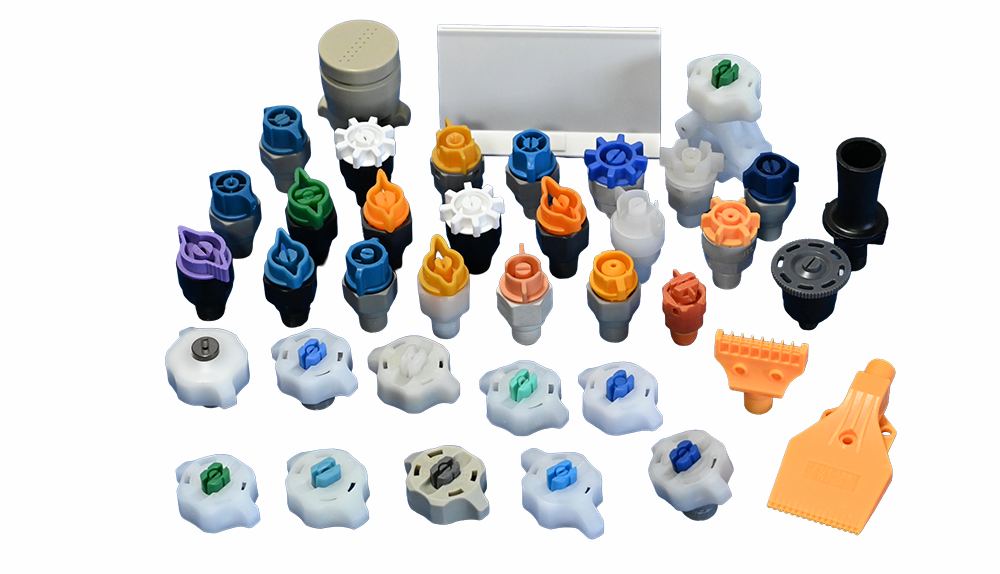
The distinction is mainly the delivery pattern and how it fits the target.
A linear air knife provides a continuous discharge along an elongated outlet. An air nozzle provides a discharge pattern determined by its individual geometry. Nozzles can be round or flat; some produce a broad stream. It’s inaccurate to describe every nozzle as a narrow point jet.
Use the following as a starting point for comparison, then check the actual airflow pattern and installation.
What area needs treatment? Air knife: A candidate for a continuous band across a surface. Air nozzle or nozzle array: A candidate for selected locations; flat nozzles can also cover wider areas.
Where must the air be aimed? Air knife: Suits a defined line of coverage. Air nozzle or nozzle array: Separate nozzles allow different aiming directions.
What happens on a complex shape? Air knife: May require additional knives or product reorientation. Air nozzle or nozzle array: Multiple nozzles can target separate features, provided there is access.
What should a trial verify? Air knife: Effective coverage across the required width. Air nozzle or nozzle array: Coverage at each target and between adjacent jets.
Consider a hypothetical washed panel with a small recessed corner. An air knife may address the broad face, while an additional nozzle targets the recess. The trial should determine whether that second outlet improves the result.
Neither option is automatically cheaper to run. Compare the complete arrangement at the same production rate and required result, including air supply demand and operating time. Comparing a short nozzle pulse with a continuously operating air knife would describe different duties.
Start with the product and the required condition after treatment. Prepare:
Product dimensions, orientation, and the surfaces that need treatment.
The liquid or debris to be removed, including where it collects.
Conveyor speed or available treatment time.
Available mounting space and existing air supply information.
A defined acceptance check, such as inspecting an agreed area for residual droplets or validating the next operation.
Ask the supplier to propose the airflow arrangement and explain what evidence supports it. For irregular parts, a sample trial can resolve questions that a product photograph cannot.
During the trial, record outlet position, angle, air settings, line speed, and the observed result. Check the difficult surfaces and repeat the test across the product sizes the line will handle.
If water remains in one location, inspect access and drainage before raising pressure. If the result changes across the working width, check coverage and air distribution. The useful outcome is a repeatable process condition that meets your requirement at production speed.
Need a custom air knife solution? Send us your application details, material requirement ,or air source type . Our engineering team will help you select the right model.

Shenzhen Qixingyuan Machinery Equipment Co., Ltd.
info@airknifecn.com
Building 8, Wanfeng Third Industrial Zone, Xinqiao Street, Bao'an District, Shenzhen, Guangdong, China


