
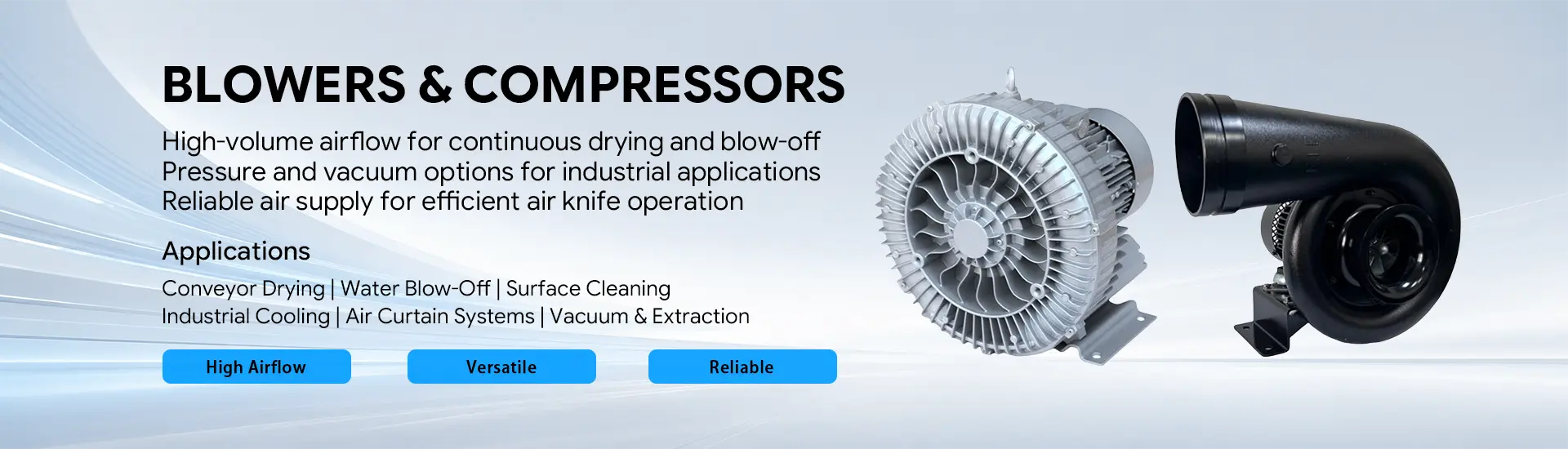
QXY supplies electrically driven industrial blowers for air knife drying, surface cleaning, cooling, air curtains, positive-pressure process air, and selected vacuum applications. The current range brings together two distinct platforms: a high-speed centrifugal blower series for high-volume, low-pressure air delivery, and the 2SG industrial blower series for pressure or vacuum duties that require a different balance of airflow and differential.
These product families are not interchangeable. The correct choice depends on the airflow required at the real operating pressure or vacuum after accounting for air knives, outlet settings, filters, silencers, manifolds, valves, pipe length, bends, and branch balance. Motor power or maximum airflow alone cannot define the final model.
For continuous air knife drying across wider products or multiple blow-off zones, the High-Speed Centrifugal Blower Series is the primary starting point. For compact process-air systems, higher-resistance circuits, or equipment that may operate in positive-pressure or vacuum mode, the 2SG Series provides a broader differential range. Share your duty point and installation data with QXY, and our engineering team will help match the blower, controls, ducting, and air knives as one complete airflow system.
Start with this series | When the process needs | Key confirmation |
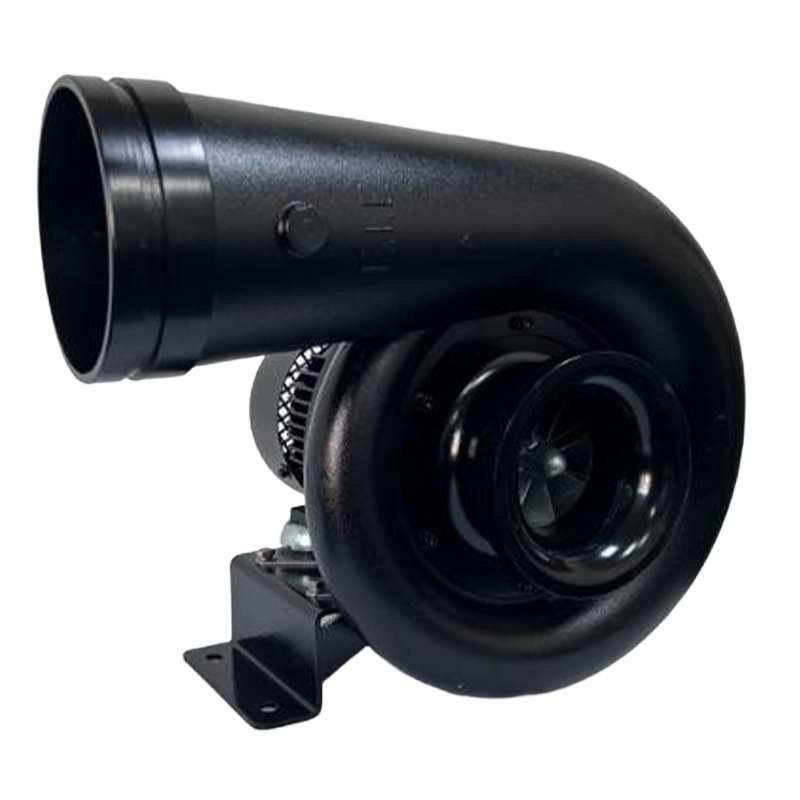
High-Speed Centrifugal Blower Series | High airflow for continuous blower-powered air knives, wider coverage, or multiple air-knife branches | Required total airflow and pressure on one speed curve, plus the approved high-frequency drive |
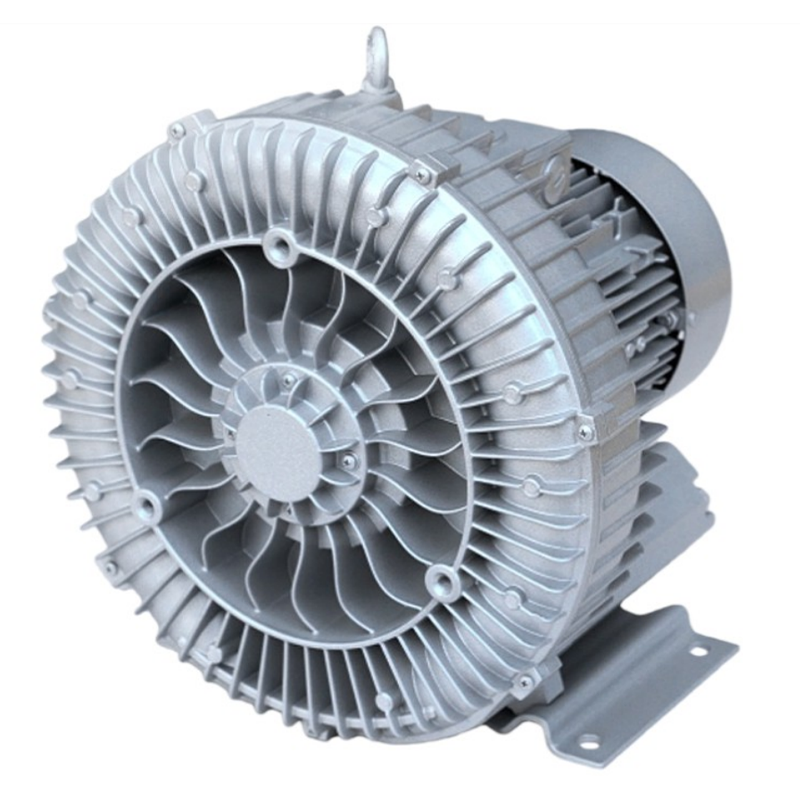
2SG Series Industrial Blowers | Positive-pressure or vacuum operation, compact process airflow, or a higher differential across a more restrictive circuit | Required airflow and differential on the correct 50 Hz or 60 Hz curve |
High-volume, low-pressure air delivery for continuous air knife drying, water blow-off, cleaning, cooling, and air-curtain systems. Four nominal power classes provide two airflow levels and two pressure levels, while the permanent-magnet synchronous motor platform supports speed-based process adjustment with the approved high-frequency drive.
• Four nominal power classes from 4 kW to 11 kW
• Rated airflow options of 1,200 or 1,800 m³/h
• Rated pressure options of 11 or 15 kPa
• Ternary-flow impeller and speed curves for application-based matching
A configurable industrial blower platform for positive-pressure air supply or vacuum service. Multiple 710, 720, 730, 740, and 790 families offer different combinations of airflow and differential for air knife systems, process-air distribution, air curtains, extraction, pickup, and hold-down duties.
• Rated output from 1.6 to 8.6 kW across the supplied range
• Maximum airflow from 318 to 600 m³/h depending on model and frequency
• Listed pressure limits from 80 to 660 mbar and vacuum limits from −100 to −460 mbar
• Model-specific 50 Hz and 60 Hz curves, electrical data, dimensions, noise, and weight
A reliable airflow system starts with one verified duty point: the airflow and pressure or vacuum that must exist at the same time. The blower curve and the resistance of the connected system determine the actual operating point. Maximum airflow, maximum pressure, and maximum vacuum are boundary values and should not be assumed to occur simultaneously.
QXY evaluates the blower together with the air knives, ducting, branches, filters, silencers, valves, separators, and process conditions. This system-level approach helps avoid weak airflow caused by excessive resistance, uneven distribution caused by unbalanced branches, and unnecessary oversizing based only on motor power.
Selection factor | High-Speed Centrifugal Blower Series | 2SG Series Industrial Blowers |
Primary airflow profile | High volume and low pressure | Moderate volume with a wider pressure or vacuum range |
Published airflow range | Rated options of 1,200 or 1,800 m³/h | Maximum 318 to 600 m³/h depending on model and frequency |
Published differential range | Rated pressure options of 11 or 15 kPa | Listed positive pressure 80 to 660 mbar and vacuum −100 to −460 mbar |
Power and control | 4 to 11 kW with approved high-frequency speed control | 1.6 to 8.6 kW with model-specific 50 Hz or 60 Hz electrical data |
Typical starting applications | Wide or continuous air-knife drying, multiple knives, cooling, and air curtains | Higher-resistance circuits, compact process air, suction, pickup, hold-down, and selected air-knife duties |
Final decision basis | One duty point on the relevant speed curve plus drive and system-loss checks | One duty point on the correct 50 Hz or 60 Hz curve plus electrical and system-loss checks |
1. Define the process result State whether the system must dry, remove water, clean, cool, create an air curtain, deliver positive-pressure air, or provide vacuum.
2. Establish the duty point Calculate the airflow and pressure or vacuum required at the process while all intended outlets operate.
3. Calculate total resistance Include air-knife slots, nozzles, pipes, hoses, bends, reducers, branches, valves, filters, silencers, separators, and fixtures.
4. Choose the correct curve Use the relevant high-speed curve or the 50 Hz or 60 Hz 2SG curve that matches the approved electrical configuration.
5. Check the complete installation Confirm voltage, current, controller, inlet condition, temperature, altitude, noise target, footprint, port direction, ventilation, and service access.
6. Commission at the real operating point Verify direction, airflow or differential, motor current, temperature, vibration, noise, leakage, filtration, and process result under production conditions.
• The blower generates the required air volume and differential at the selected speed or supply frequency.
• Ducting and manifolds carry the airflow to one or more air knives while adding pressure loss that must be included in the calculation.
• The air-knife plenum distributes the air and accelerates it through the slot or outlet geometry.
• Working distance and installation angle convert the air sheet into useful surface force for moving water, particles, or heat.
• Drainage, splash control, filtration, and guarding keep removed liquid or debris from returning to the product or entering the blower.
Application | Selection focus |
Conveyor drying and water blow-off | Continuous airflow for removing droplets after washing, rinsing, coating, machining, or ultrasonic cleaning. Product width, line speed, water load, air-knife length, and working distance determine the required duty point. |
Surface cleaning and debris removal | Non-contact removal of dust, chips, fibers, powder, or loose particles. Confirm particle adhesion, recesses, collection method, and material compatibility. |
Cooling and air curtains | Process airflow for convective cooling or a controlled air sheet across an opening. Heat load, inlet-air temperature, cross-drafts, and containment targets affect selection. |
Distributed process air | One blower can feed several branches when simultaneous demand, branch resistance, manifold design, and balancing are calculated correctly. |
Vacuum and extraction duties | Selected 2SG models can support suction, pickup, hold-down, or transfer functions when the medium, filtration, separation, and protection are suitable. |
• Keep the air path as direct as practical and avoid undersized pipe, abrupt transitions, unnecessary bends, and leaking joints.
• Use a balanced manifold or suitable balancing devices when one blower supplies multiple branches.
• Support pipework independently so external loads are not transferred to the blower casing or air-knife connections.
• Protect the inlet from dust, chips, liquid droplets, and process residue. Wet systems should include suitable separation and drainage.
• Include clean and service-limit pressure drop for filters and silencers when sizing the blower.
• Provide pressure relief or vacuum protection, motor overload protection, grounding, emergency stop, and site-appropriate interlocks.
• Maintain ventilation and service access, including when the blower is installed inside an acoustic enclosure.
• Do not use general ratings to infer suitability for flammable, explosive, corrosive, condensable, or heavily particle-laden media. Request a validated configuration for special environments.
Information Required for Model Confirmation
Information group | Details to provide |
Process | Required result, product material and shape, operating mode, line speed, daily operating hours, and process variation |
Duty point | Required airflow and pressure or vacuum at that airflow, plus acceptable adjustment range |
Air knives | Quantity, length, slot or outlet geometry, inlet size, orientation, working distance, and simultaneous operation |
Air path | Pipe or hose diameter and length, bends, reducers, branches, valves, filters, silencers, separators, and manifold layout |
Electrical | Site voltage, phase, frequency, available capacity, control method, and automation signals |
Environment | Inlet-air and ambient temperature, altitude, dust, moisture, chemicals, cleaning method, and material restrictions |
Installation | Available footprint, port direction, mounting drawing or photos, service clearance, ventilation, and noise target |
What is the difference between the two current blower series
The High-Speed Centrifugal Blower Series is the primary starting point for high-volume, low-pressure air delivery to continuous air-knife systems. The 2SG Series offers a broader positive-pressure and vacuum range at lower maximum airflow and is suitable for different resistance levels and process-air duties.
Can I select a blower by motor power or maximum airflow alone
No. The correct model must provide the required airflow at the required pressure or vacuum on the applicable performance curve. Filters, silencers, pipework, branches, valves, and air-knife outlets all affect the actual operating point.
Can one blower supply multiple air knives
Yes, when the combined simultaneous airflow and the resistance of every branch are calculated. A balanced manifold or suitable balancing devices may be required to prevent one branch from receiving most of the available flow.
Does the high-speed blower require a dedicated controller
The published high-speed models list operating frequencies well above normal facility frequency. Treat the blower, permanent-magnet motor, high-frequency drive, cable, protection settings, and control method as one approved package. Do not assume direct connection to a standard 50 Hz or 60 Hz supply.
How do I choose between a 50 Hz and 60 Hz 2SG curve
Use the curve and electrical row that match the approved site supply and motor connection. Airflow, output, pressure, vacuum, current, and noise may differ between 50 Hz and 60 Hz operation.
Can these blowers replace plant compressed air
For suitable continuous, wide-area air-knife applications, a correctly matched blower system can reduce dependence on plant compressed air. The final decision should consider the required surface result, duty cycle, available space, piping, energy use, air quality, and process control.
What should I send for a quotation
Provide the process objective, required airflow and differential if known, product and line data, air-knife configuration, full air-path layout, site electrical supply, environmental conditions, installation space, operating schedule, noise target, and photos or drawings.
Send QXY your airflow requirement, pressure or vacuum target, air-knife layout, pipe and filter information, electrical supply, installation drawing, and required process result. Our engineering team will compare the operating point with the relevant performance curve and recommend a suitable blower, controller, ducting, and air-knife configuration.
Contact info@airknifecn.com | Submit an inquiry
Need a custom air knife solution? Send us your application details, material requirement ,or air source type . Our engineering team will help you select the right model.

Shenzhen Qixingyuan Machinery Equipment Co., Ltd.
info@airknifecn.com
Building 8, Wanfeng Third Industrial Zone, Xinqiao Street, Bao'an District, Shenzhen, Guangdong, China


