
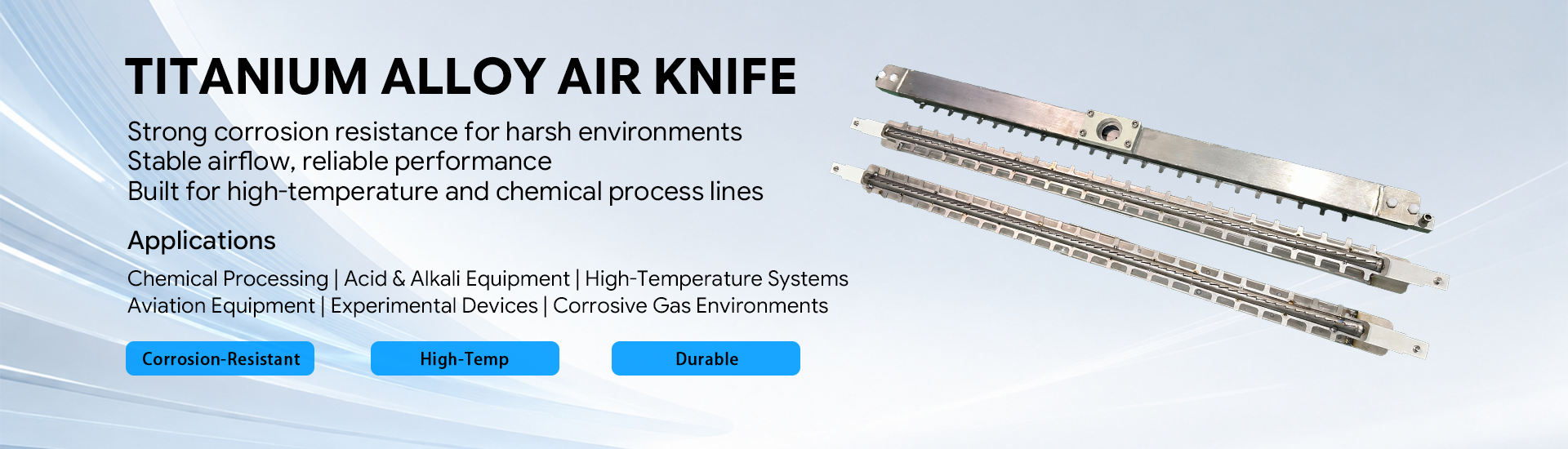
QXY titanium alloy air knives are positioned for highly corrosive, high-temperature and specialized industrial environments where conventional materials may not be suitable. The category page highlights titanium alloy for excellent resistance to chemicals, oxidation and harsh process conditions, while maintaining stable airflow performance in demanding applications.
Compared with stainless steel, titanium alloy is usually a higher-cost material, but it offers a strong combination of corrosion resistance, strength and relatively lightweight performance. This makes it more suitable for special processes where material failure, corrosion or contamination risks would be more expensive than the initial equipment cost. It is not the first choice for ordinary drying lines, but it is valuable when operating conditions exceed what aluminum alloy or stainless steel can comfortably handle.
Its material advantage is especially clear in corrosive gases, chemical treatment environments, oxidation-sensitive conditions and processes requiring durable but lightweight components. The product category also mentions use in extremely high-temperature or highly corrosive gas environments.
Typical application industries include advanced manufacturing, laboratory equipment, chemical treatment lines, aerospace-related applications, aviation, military-related equipment, experimental equipment and other precision processes requiring strong, lightweight and corrosion-resistant air knife solutions.
Titanium alloy is selected when the production environment requires stronger corrosion resistance, lighter weight than stainless steel and higher structural performance than PVC. It is especially useful when the air knife may contact chemical mist, wet process areas, chloride-containing environments or corrosive gases.
· Titanium alloy provides excellent corrosion resistance in many harsh wet and chemical environments.
· It offers a high strength-to-weight ratio, helping reduce equipment load compared with heavy stainless steel structures.
· It is suitable for long-service applications where corrosion risk, downtime and replacement cost must be reduced.
· Because titanium alloy has a higher material and processing cost, it is usually recommended for applications where process conditions justify the added durability.
· For strong chemicals, special liquids, corrosive gases or heated processes, the liquid type, concentration, temperature and exposure time should be confirmed before final selection.
The following table compares common air knife materials from the perspective of hardness, corrosion resistance, cost performance, density, heat resistance and typical use. Titanium alloy is positioned as the premium option for demanding corrosion-resistant applications.
Material | Hardness / Strength | Corrosion Resistance | Cost Performance | Density / Weight | Heat Resistance and Best Use |
Titanium Alloy | High strength-to-weight ratio. Stronger and more durable than PVC and many lightweight materials. | Excellent. Suitable for many corrosive, wet, chemical, chloride or coastal environments. | Low to medium. Higher cost, but valuable when corrosion resistance and long service life are critical. | Medium. Approx. 4.50 g/cm3, lighter than stainless steel but heavier than aluminum. | High. Suitable for harsh corrosive or high-value applications; confirm seals and process temperature for heated operation. |
Stainless Steel 316 | High strength and strong long-term durability. | Very good to excellent. Better than 304 in chloride, chemical, salt spray or coastal environments. | Medium to low. Higher cost than 304, but reliable for demanding wet lines. | High. Approx. 8.00 g/cm3, heavy but robust. | Good. Recommended for corrosive, high-humidity or hygienic production environments. |
Stainless Steel 304 | High strength and good wear resistance for durable air knife bodies. | Good. Suitable for water, food, packaging, cleaning and many wet production lines. | Medium. Higher cost than aluminum, but strong durability and cleanability. | High. Approx. 7.93 g/cm3, requiring stronger mounting support than aluminum. | Good. Suitable for wet, hygienic and demanding industrial lines; confirm process details for continuous high-temperature use. |
6063-T6 Aluminum Alloy | Medium. Good structural strength for general industrial air knife bodies. | Good for general environments; not the first choice for strong chemical or high-hygiene applications. | Excellent. Lightweight and cost-effective for standard drying and blow-off. | Low. Approx. 2.70 g/cm3, easy to install and retrofit. | Moderate. Suitable for standard industrial use; confirm details for continuous high-temperature conditions. |
PVC | Lower. Not designed for heavy impact or high-load structures. | Excellent for many normal-temperature acid and alkali washing environments. | High. Cost-effective in suitable chemical wet lines. | Low. Approx. 1.38-1.45 g/cm3, lightweight and easy to handle. | Low. Not recommended for hot air or high-temperature areas; best for normal-temperature chemical rinsing lines. |
Choose a titanium alloy air knife when the production line has stronger corrosion risks, higher equipment value or stricter long-term reliability requirements. It is a suitable choice when stainless steel may still face corrosion concerns, or when PVC does not provide enough strength, heat resistance or structural stability.
Excellent corrosion resistance: Titanium alloy is suitable for many wet, chemical and harsh environments where stronger material protection is required.
High strength-to-weight ratio: The material provides strong structural performance while remaining lighter than stainless steel.
Stable airflow distribution: A well-designed air chamber and outlet slot create a continuous air curtain for consistent drying and blow-off.
Long service life: Titanium alloy helps reduce corrosion-related downtime and replacement frequency in demanding production environments.
Suitable for high-value applications: It is a practical option when process stability, product quality and equipment reliability are more important than low initial cost.
Custom configuration: Length, inlet direction, outlet gap, mounting style and connection size can be configured according to the customer's equipment layout.
Chemical Processing Lines: Remove liquid, mist or residues from product surfaces in chemical washing, rinsing or transfer sections where corrosion resistance is important.
Electroplating and Surface Treatment: Provide stable blow-off after rinsing, plating, pickling or surface treatment processes with demanding liquid exposure.
Battery and New Energy Manufacturing: Support drying and cleaning processes where equipment reliability and material compatibility are important.
Marine and Coastal Equipment: Work in salt spray, coastal humidity or chloride-related environments where stronger corrosion resistance is required.
Precision Components and High-Value Parts: Remove moisture and particles from high-value components while supporting stable production quality.
Special Conveyor Drying Systems: Provide customized air coverage for sheets, panels, parts or continuous products in harsh industrial environments.
· Main material: titanium alloy for corrosion-resistant and demanding industrial applications.
· Air knife length can be customized according to product width and airflow coverage requirements.
· Inlet direction can be configured as end inlet, side inlet, bottom inlet or multi-inlet depending on the model and line layout.
· Outlet gap can be selected or adjusted according to droplet size, air volume and drying target.
· Mounting holes, brackets, connection size and installation angle can be designed for new equipment or retrofit projects.
· Sealing design and surface requirements can be discussed according to liquid exposure, temperature, cleaning method and process environment.
1. Confirm the product width and required air coverage.
2. Identify the target: drying, water blow-off, chemical residue removal, oil mist removal, dust removal, cooling or surface cleaning.
3. Confirm the liquid, chemical, chloride, gas, humidity and cleaning conditions around the air knife.
4. Check whether titanium alloy is required because of corrosion risk, product value, line downtime cost or special process requirements.
5. Confirm operating temperature, liquid concentration, exposure time and installation distance.
6. Check conveyor speed and the distance between the air knife outlet and product surface.
7. Confirm the available air source, air pressure, blower capacity and pipe layout.
8. Choose inlet direction, installation angle and mounting method according to the machine structure.
9. Share drawings, photos or line layout information so the most suitable model can be recommended.
What is the main material of QXY titanium alloy air knives?
The main material of this category is titanium alloy. It is selected for applications that require strong corrosion resistance, durable structure and long service life in demanding environments.
When should I choose titanium alloy instead of stainless steel?
Choose titanium alloy when the process has stronger corrosion risks, aggressive wet conditions, chloride exposure, corrosive gases or high-value production requirements where longer service life is important.
Is titanium alloy suitable for acid or alkali environments?
Titanium alloy performs well in many corrosive environments, but the actual suitability depends on the chemical type, concentration, temperature and exposure time. Process details should be confirmed before final selection.
Is a titanium alloy air knife more expensive?
Yes. Titanium alloy usually has a higher material and processing cost than aluminum, stainless steel or PVC. It is recommended when corrosion resistance, reliability and long-term performance are more important than low initial cost.
Can the titanium alloy air knife be customized?
Yes. Length, inlet direction, outlet gap, mounting style, connection size and installation angle can be customized according to the production line.
What information is needed for a quotation?
Please provide product width, conveyor speed, application purpose, liquid or chemical exposure, temperature, available air source, working distance, installation space and any machine drawings or photos.
Need a custom air knife solution? Send us your application details, material requirement ,or air source type . Our engineering team will help you select the right model.

Shenzhen Qixingyuan Machinery Equipment Co., Ltd.
info@airknifecn.com
Building 8, Wanfeng Third Industrial Zone, Xinqiao Street, Bao'an District, Shenzhen, Guangdong, China


