

A rigid printed circuit board normally stays flat enough for a fixed Air Knife gap. A flexible printed circuit can lift, flutter, curl, wrinkle, or touch a guide when the same air jet reaches it. That mechanical response changes the drying problem. The air system must remove rinse water while the circuit remains supported, correctly tracked, and free from new particles or handling marks.
The right air knife for flexible circuit cleaning lines is therefore not a standard PCB dryer with more pressure. It is a coordinated part of the transport system. Web tension, carrier design, roller spacing, vacuum support, airflow direction, slot uniformity, clean-air control, and the location of every drain path all affect the result.
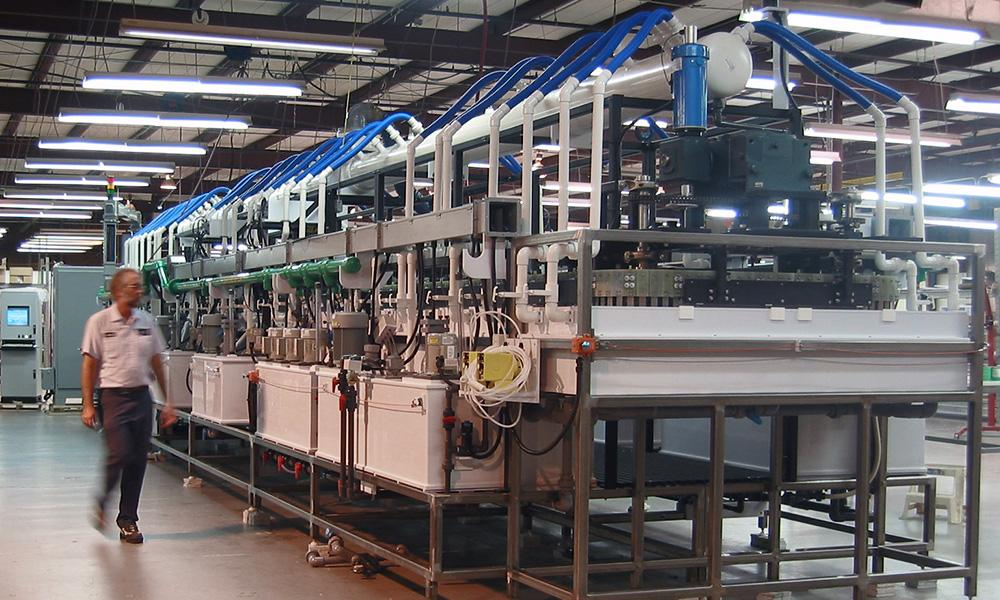
Three products may share the FPC name but need different hardware. A panelized circuit on a rigid carrier behaves partly like a PCB. A loose cut sheet can move between contact points. A roll-to-roll web has controlled tension but may cross a long unsupported span. Copper distribution, coverlay, stiffeners, openings, and wet chemistry further change stiffness and water retention.
Record the product state at the dryer. Include width, thickness, unsupported span, line speed, web tension or carrier type, allowed contact areas, leading-edge condition, hole pattern, and whether both faces must be dry. A recipe for a copper-rich panel may destabilize a thin coverlay-only area.
Inlet pressure does not directly describe the load on the circuit. Outlet geometry, air volume, distance, angle, exposed area, and support spacing determine movement. A narrow jet can start a standing wave. A poorly aimed lower knife can lift a leading edge. Opposed knives can still cause flutter if their force lines miss the supported section.
Start with enough airflow to establish a continuous water-exit path, then increase it in small steps. Watch the circuit edge and span with good lighting or high-speed video. The limit is not only visible damage. Repeated flexing can change registration, pull the web sideways, rub a guide, or produce intermittent contact that later appears as scratches or particles.
A stable carrier provides the widest process window. It can restrain edges through upper and lower blow-off, but it must drain. Pockets, tape, clamps, and support rails can trap water and release it after the surface looks dry. Aim the first stage toward a collection point, then clear remaining openings and edges.
Loose flex should not cross a strong air sheet over a wide open gap. A fine mesh belt, perforated vacuum belt, low-mark fixture, or close roller pitch can shorten the unsupported span. Confirm that suction does not pull contamination through the product or mark a critical surface. Leading and trailing edges often need a gentler angle than the center area.
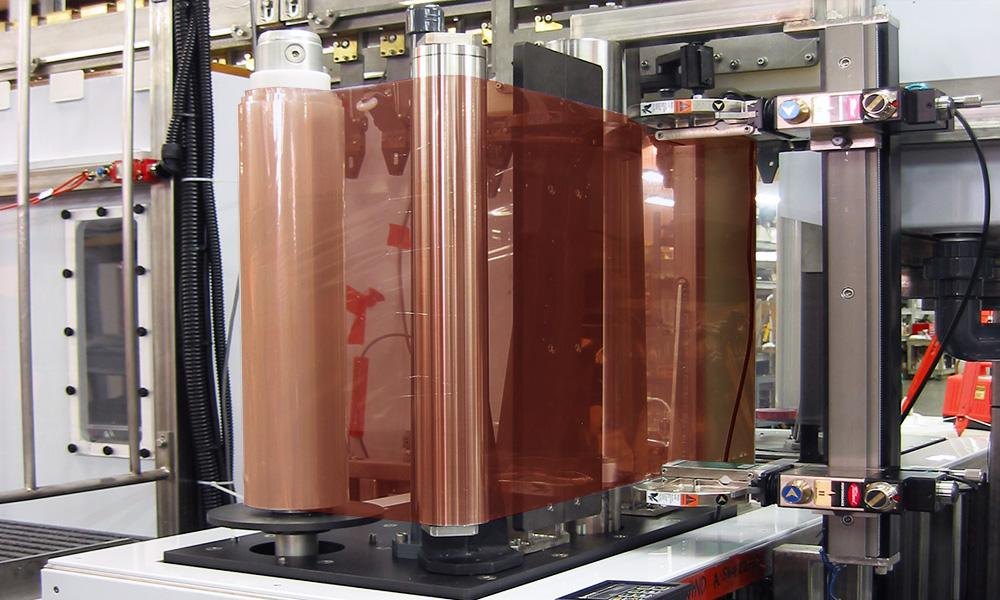
A web line requires coordinated tension and airflow. Place the knife near a backed span or controlled roller geometry, with clearance for web runout. A shallow jet with web travel usually creates less lift than a near-normal jet. Dryer exhaust should not disturb adjacent tension zones.
A rigid board can often tolerate a concentrated first strike. Flexible material usually benefits from stages. Gravity drainage or a mild pre-blow removes the heavy film. A broad, controlled air sheet then sweeps the main surface. A final targeted stage clears holes, coverlay windows, stiffener steps, tooling features, or carrier boundaries.
This sequence lowers peak force and gives displaced water an exit. Splash panels, sloped trays, and isolated wet zones must keep rinse from returning to the web or lower knife. Recirculated mist can make a uniform knife look unstable.
Flexible circuits hold water at copper-to-polyimide steps, coverlay openings, drilled or punched holes, stiffener edges, adhesive boundaries, and panel tabs. Capillary spaces around fixtures may release water several seconds later. A single slot aimed across the full width can clear the open field but miss these local reservoirs.
Mark the remaining wet locations on a product drawing after the first pass. Repeated transverse bands suggest support or knife problems. Wetness that follows a feature requires a new angle, a staged knife, or a focused hole pattern. QXY small-hole PCB air knives use dual rows of 1 mm holes, one straight and one angled, for applications where directed jets must reach through-holes or fine features. Product movement still has to be checked before this stronger local approach is accepted.
An air knife removes free liquid from a surface. It does not prove that moisture absorbed into polyimide, adhesive, or another dielectric has been removed. IPC maintains a specific moisture-absorption test method for flexible printed wiring, and material data sheets may list moisture behavior for a particular construction. Those controls belong to material storage, conditioning, baking, lamination, assembly, or other approved process steps.
Do not use a hot jet as a substitute for a validated bake. Temperature can change web shape, adhesive behavior, oxidation, or registration. If heated air is needed for the final film, set limits from the laminate, coverlay, adhesive, finish, and next process. Measure circuit temperature, not only the heater setting.
Drying air can add particles from an intake, filter, corroded duct, shedding hose, dirty plenum, or damaged knife lip. Thin polymer surfaces may also hold electrostatic charge that attracts particles after water is removed. More velocity can make both problems worse.
Locate blower intake away from chemical mist, floor dust, drilling debris, and washer exhaust. Set filtration from the cleanliness requirement and monitor loading. Where static is confirmed, evaluate ionization and grounding. Ionizers also need cleaning and verification.
The air knife body, shim, fasteners, brackets, duct, seals, and drain hardware must tolerate the rinse and nearby process chemistry. Aluminum alloy can suit many final-rinse or separated dry zones. Stainless steel or PVC may be considered closer to corrosive chemistry, while more demanding exposure needs a documented compatibility review. Material selection should cover vapor and splash, not only direct immersion.
Keep chemical mist out of the blower and prevent condensate from running back through the duct. Access for slot inspection matters because a small deposit or damaged lip can create a narrow wet lane across every circuit. The mounting system should return to its qualified position after cleaning.
QXY Machinery uses 0.5-1.5 mm as a reference slot range for PCB surface drying, with 0.5-1 mm used on many boards. General blower-driven systems commonly operate at 2-6 psi (0.14-0.42 bar), 20-50 mm working distance, and a 15-45 degree angle. These are product references, not qualified FPC settings.
For a flexible web, start at the lower mechanical load that still moves water steadily. Use a shallow angle with conveyor or web travel, reduce unsupported span, and check both edges before increasing pressure. Upper and lower knives should be balanced around a supported region. For knives longer than 600 mm, QXY commonly evaluates dual inlets to improve distribution across the width.
Begin with dry transport. Run the thinnest, narrowest, widest, and least stiff approved products without airflow, then add each air stage at low output. Record tracking, edge motion, span deflection, wrinkles, carrier movement, and contact with guides. Repeat with the normal rinse load because water changes mass, adhesion to rollers, and aerodynamic response.
Next qualify drying. Inspect both faces, holes, stiffener boundaries, carrier interfaces, and a downstream hold point where delayed drops can appear. Use the plant-approved cleanliness or ionic test when the next step requires it. IPC technical work on in-line aqueous cleaning notes that incomplete drying can affect test, coating, underfill, and reliability; the required endpoint must therefore come from the actual downstream process.
Finally, challenge the window. Test normal and maximum speed, filter loading limits, line stops, splices, different web tensions, start-up, and the largest incoming water load. Lock the approved recipes and define checks after knife cleaning, belt replacement, roller adjustment, duct work, or blower service.
Fast flutter across an open span points to support, angle, or opposing-force balance. A wet line fixed across the width suggests a blocked slot, a support shadow, or a weak section of the plenum. Random particles call for intake, duct, static, and enclosure checks. Water that appears only after a roller or carrier release is hidden liquid, not simply low pressure.
A successful air knife for flexible circuit cleaning lines produces a stable web first and a dry surface second. If the circuit position changes unpredictably, the apparent drying window will move with product thickness, tension, width, and incoming water load.
QXY Machinery (Shenzhen Qixingyuan Machinery Equipment Co., Ltd.) is based in Shenzhen, China, and integrates R&D, design, production, and sales. The company has more than 10 years of focused experience in air knife equipment for industrial drying, water blow-off, and surface cleaning.
For flexible circuit and electronics lines, QXY Machinery can supply aluminum, stainless steel, PVC, small-hole PCB, and air-to-air knife configurations, together with blowers, ducts, adjustable supports, splash control, collection trays, conveyors, and electrical controls. Custom review can cover product format, web or carrier support, working width, line speed, rinse chemistry, cleanliness target, and available machine space.
Q: Can a standard PCB air knife dry flexible circuits?
A: Sometimes, especially when the FPC is fixed to a stable carrier. Loose sheets and roll-to-roll webs normally need closer support, gentler angles, controlled tension, and lower peak mechanical loading.
Q: What is the biggest risk when drying a flexible PCB?
A: Uncontrolled motion is the main difference from rigid boards. Flutter, lift, curl, tracking error, and contact with guides can cause unstable drying, scratches, particles, or registration problems.
Q: Should upper and lower air knives use the same setting?
A: Not automatically. Their forces should be balanced around the supported product, while their angles and flow address the different water paths on each face.
Q: Does an air knife remove moisture absorbed by polyimide?
A: No. It removes free surface liquid. Absorbed moisture requires material-specific storage, conditioning, or baking controls approved for the flex construction and next process.
Q: What slot gap should be used for FPC drying?
A: QXY lists 0.5-1.5 mm as a PCB surface-drying reference, with 0.5-1 mm used for many boards. Flexible circuits need trials that also check web movement, support, distance, angle, and blower flow.
Q: What data is needed to select an air knife for flexible circuit cleaning lines?
A: Provide circuit format, width and thickness range, web tension or carrier details, unsupported spans, line speed, feature map, rinse chemistry, incoming water load, cleanliness target, utilities, and installation space.
Need a custom air knife solution? Send us your application details, material requirement ,or air source type . Our engineering team will help you select the right model.

Shenzhen Qixingyuan Machinery Equipment Co., Ltd.
info@airknifecn.com
Building 8, Wanfeng Third Industrial Zone, Xinqiao Street, Bao'an District, Shenzhen, Guangdong, China


