

Solar panel glass may pass through washing after cutting, edge grinding, drilling, tempering, or handling and before antireflective coating, screen printing, lamination, inspection, or packaging. Each downstream process demands a different handoff. A surface that looks dry to an operator may still carry an ionic film, edge water, particles, or roller marks that affect the next step.
An air knife for solar panel glass removes free rinse water without wiping the surface. Good design is not a matter of selecting the highest air velocity. It comes from matching rinse chemistry, glass dimensions, transport mechanics, airflow uniformity, air cleanliness, water collection, and the acceptance test at the next process.
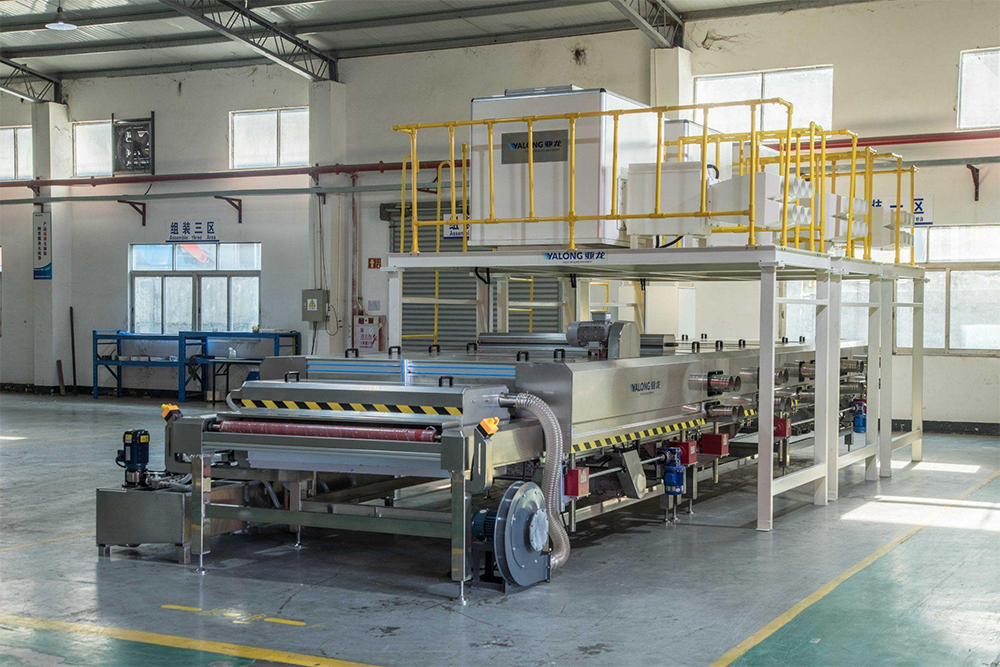
The surface may need to be free of water, particles, edge-grinding residue, dissolved-material marks, oil, and handling contamination. A uniform air sheet can remove free water, but it cannot guarantee coating adhesion or remove every bonded contaminant. U.S. Department of Energy project work on solar-glass coating pretreatment found that washing can remove light contamination, while heavier marks from handling equipment may need another treatment.
The glass must enter handling and layup without water that can transfer to encapsulant, cells, interlayers, suction tools, or the second glass sheet. Back-side and edge water matter as much as the visible face. The accepted condition should be linked to the lamination recipe and quality plan.
Droplets can change glare and contrast during camera inspection. Water can also reappear from an edge or roller contact point and mark separators or packaging. Allow a short downstream observation distance instead of judging the surface only at the last knife.
Airflow displaces liquid. It does not reliably remove silicone transfer from suction cups, oily fingerprints, strongly attached particles, brush damage, or residue that has already dried. The washer must remove contamination before the final rinse, and the rinse must not add a new residue load.
Write two specifications. The first is free-water acceptance: no film, edge bead, underside drop, or delayed re-wetting beyond the plant limit. The second is surface cleanliness: particle, ionic, organic, haze, watermark, or adhesion criteria tied to the downstream process. A glass panel can pass one and fail the other.
When a rinse droplet evaporates, dissolved material can remain on the surface. More drying heat or air speed does not remove that dissolved load; it may only create the mark faster. Use the water quality, conductivity, pH, filtration, and change-control limits defined for the coating or module process.
The last rinse should be stable across production, not only after a fresh tank or new filters. Sample at the point that supplies the glass. If marks follow the rinse pattern, investigate water and upstream cleaning before increasing blower speed.
Solar glass formats may be thin, wide, and flexible. The design input sheet should include minimum and maximum length, width, thickness, mass, bow, edge condition, hole pattern, orientation, and allowed contact zones. Small pieces can shift under an aggressive jet; large sheets can vibrate between rollers.
Set knife clearance against the highest expected glass point, not the nominal thickness alone. Include roller runout, glass bow, conveyor tolerance, and adjustment error. A collision between glass and knife is unacceptable, but excessive stand-off can weaken the air sheet and increase demand.
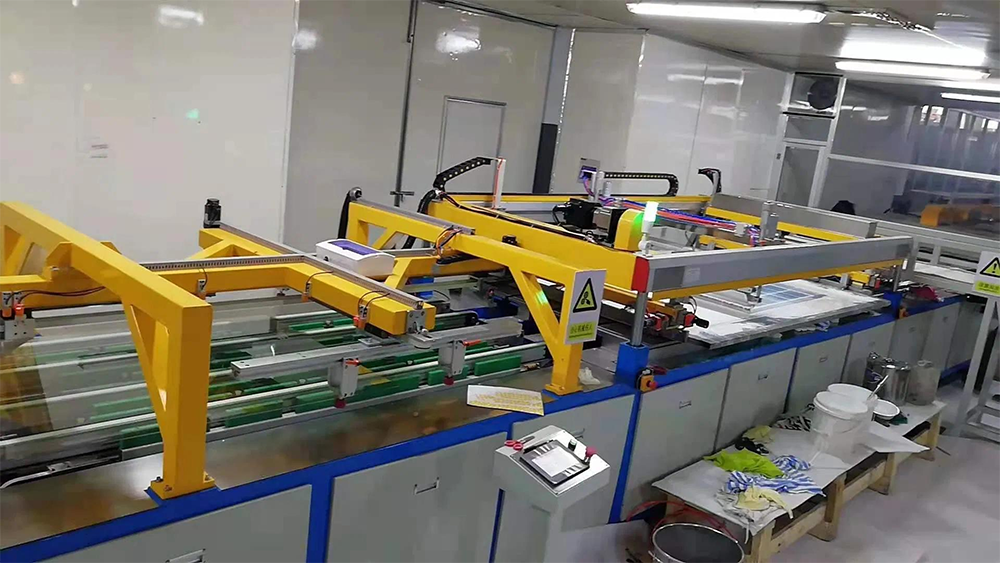
Upper and lower Air Knives can dry both faces in one pass. Balanced opposition also reduces net lift when the forces meet through an open roller gap. Poor balance can press glass into the conveyor or lift it toward guards.
Do not assume identical settings above and below. The top face may carry a broad film, while the underside holds lines of water beside rollers. Tune angle and flow around the real water path. Confirm glass tracking, vibration, edge motion, and roller loading at every recipe.
A horizontal washer supports glass on rollers, which hide narrow bands of the underside. Water can stay at the contact line or move downstream on the roller surface. Lower knives work best through open gaps or transfer positions where the underside is exposed.
Sequence the knives so removed top water does not wrap around the edge after the underside is already dry. Staggered upper and lower knives, a defined drain direction, and a final edge-focused stage often work better than one intense pair.
A panel may be dry at the center and wet near one edge when the knife, inlet, or manifold is unbalanced. Map the result in lanes across the useful glass path. Check the full range of glass widths because a narrow sheet may sit in a different part of the airflow than the largest format.
Long knives need adequate internal distribution and duct supply. QXY generally evaluates dual inlets for air knives longer than 600 mm. Keep branch lengths and restrictions balanced, and measure pressure at the knife under operating flow rather than relying on the blower nameplate.
The blower intake, filters, duct, plenum, and knife slot can introduce particles if they are dirty or corroded. Place the intake away from floor dust, edge-grinding mist, washer exhaust, and chemical vapor. Set filter efficiency and monitoring from the surface-cleanliness requirement, not from a generic industrial schedule.
Dry airflow and polymer rollers can also change static behavior. If particles return after blow-off, measure the condition before adding more pressure. Validated ionization and local extraction may help, but they add their own cleanliness and maintenance requirements.
Warm air can speed evaporation of the final film, but solar glass drying is not a tempering or quench step. Glass temperature, coating condition, incoming rinse temperature, and allowable thermal gradient need engineering review. Uneven heating can also change inspection conditions or downstream coating behavior.
Use displacement for bulk water first. Add heat only when the remaining evaporation step limits the line and a product trial shows that the temperature window is acceptable. Record glass temperature at the exit, not only heater or air temperature.
Material choice depends on rinse water, cleaning chemicals, temperature, and contamination control. Stainless steel is common inside wet glass washers and enclosed drying chambers. Aluminum may suit less aggressive locations when corrosion and particle risks are controlled.
Review the whole assembly: knife body, shim, fasteners, supports, duct, seals, blower, drain tray, access doors, and electrical enclosures. Sloped collection surfaces and splash panels should move water away from the glass path and prevent mist from returning downstream.
QXY Machinery supplies standalone air knives and integrated drying systems with blowers, conveyors, adjustable supports, splash protection, collection trays, and controls. The table gives general product references, not guaranteed solar-glass settings.
Design variable | QXY general reference | Solar-glass design question |
Knife-to-glass distance | 20-50 mm common starting range | Does the full thickness and bow range stay clear without weak zones or local over-impact? |
Impingement angle | 15-45 degrees | Does the air sheet give water a continuous exit without splash-back or edge re-wetting? |
Pressure at knife inlet | 2-6 psi (0.14-0.42 bar) | What pressure is present under operating flow after filters, duct loss, and manifold splits? |
Outlet slot | 0.5-2 mm general range | What gap meets water-removal and uniformity needs without excess mist, noise, or energy? |
Length and inlets | 150-1,000 mm standard; custom to 6 m | Does effective coverage match the glass path, and should knives above 600 mm use dual inlets? |
A single blower speed may not suit every glass width, thickness, coating state, and conveyor speed. Store validated recipes for the product families that change airflow demand or mechanical response. Useful recipe fields include blower speed, knife height, upper/lower balance, conveyor speed, rinse mode, glass temperature, and downstream destination.
Interlock the drying station with glass detection so the blower and conveyor sequence cannot trap a sheet under an unsafe condition. Define the response to a stopped conveyor, filter alarm, low pressure, open access door, or lost downstream readiness.
Run the thinnest, widest, narrowest, and most bowed approved formats, plus coated or patterned variants where applicable. Use normal and maximum line speeds and the full range of rinse conditions. Check the glass immediately after drying and again at the coating, printing, inspection, lamination, or packaging point.
Measure free water, water spots, particles, edge and underside re-wetting, vibration, tracking, breakage, camera stability, and downstream yield indicators. Use approved surface-analysis or adhesion tests where the process requires them. A visual check alone is not enough for coating-ready release.
Change one variable at a time. Record the final pressure at each knife, slot, angle, distance, duct configuration, filter condition, rinse data, conveyor speed, and acceptance result. Recheck after maintenance because knife position and filter loading can change the process window.
A wet stripe across every panel points to slot damage, blockage, or a roller shadow. One wet edge suggests coverage or water-exit direction. Random spots may follow rinse contamination, unstable flow, or particles on the surface. A dry face with downstream edge drops indicates hidden water and poor sequence.
More pressure is not the universal fix. The right air knife for solar panel glass keeps water moving in a known direction while the glass remains stable and the surface stays clean enough for the next process.
QXY Machinery (Shenzhen Qixingyuan Machinery Equipment Co., Ltd.) is based in Shenzhen, China, and integrates R&D, design, production, and sales. The company has more than 10 years of focused experience in air knife systems for industrial drying, dust removal, and water blow-off.
When specifying an air knife for solar panel glass, QXY Machinery can provide aluminum or stainless steel bodies, custom lengths, slot widths, inlet layouts, blower systems, adjustable supports, splash protection, water collection, conveyors, and controls. The engineering team can review glass formats, roller layout, line speed, rinse condition, clean-air requirement, available space, and downstream surface acceptance before proposing a configuration.
Q: Where is an air knife used in solar panel glass production?
A: Common positions include after edge-grinding wash, before AR coating or screen printing, after a final clean before lamination, and before inspection or packaging. The required surface condition changes with the next process.
Q: Can an air knife make solar glass ready for coating?
A: It can remove free rinse water, but coating readiness also depends on particles, ionic residue, organic contamination, haze, and surface activation. Use the downstream coating acceptance tests.
Q: Should solar glass be dried from both sides?
A: Often yes. Rollers hide underside water and edges can re-wet after the top looks dry. Opposed or staggered upper and lower knives should be balanced for glass stability.
Q: What causes water spots after air-knife drying?
A: Dissolved material in the rinse, dirty air, delayed evaporation, unstable water quality, or incomplete film removal can leave marks. Check rinse chemistry and filtration before only increasing pressure.
Q: How close should the air knife be to solar glass?
A: QXY uses 20-50 mm as a common industrial starting range. Final clearance must include glass bow, thickness, roller runout, conveyor tolerance, airflow coverage, and collision margin.
Q: Is heated air required for photovoltaic glass?
A: Not always. Air displacement should remove bulk water first. Add heat only when final-film evaporation limits the line and glass temperature, coating condition, and downstream requirements have been validated.
Q: What information is needed to size an air knife for solar panel glass?
A: Provide glass dimensions, thickness, bow, mass, edge and hole details, line speed, roller layout, rinse load, surface criterion, air-cleanliness target, utilities, footprint, and downstream process.
Need a custom air knife solution? Send us your application details, material requirement ,or air source type . Our engineering team will help you select the right model.

Shenzhen Qixingyuan Machinery Equipment Co., Ltd.
info@airknifecn.com
Building 8, Wanfeng Third Industrial Zone, Xinqiao Street, Bao'an District, Shenzhen, Guangdong, China


