

A customer in Mongolia purchased a conveyor-based air knife drying solution from Shenzhen Qixingyuan Machinery Equipment Co., Ltd. (QXY). The project record includes a photograph of the customer’s existing line, equipment photographs, reference drawings, blower sheets and videos. Together, these materials show the central design problem: the dryer had to fit the production line, direct air onto the wet surfaces, and keep removed water under control. They also establish the limits of this account. The available record describes the planning and equipment options, but it does not include a verified site drying result or a final as-built specification.
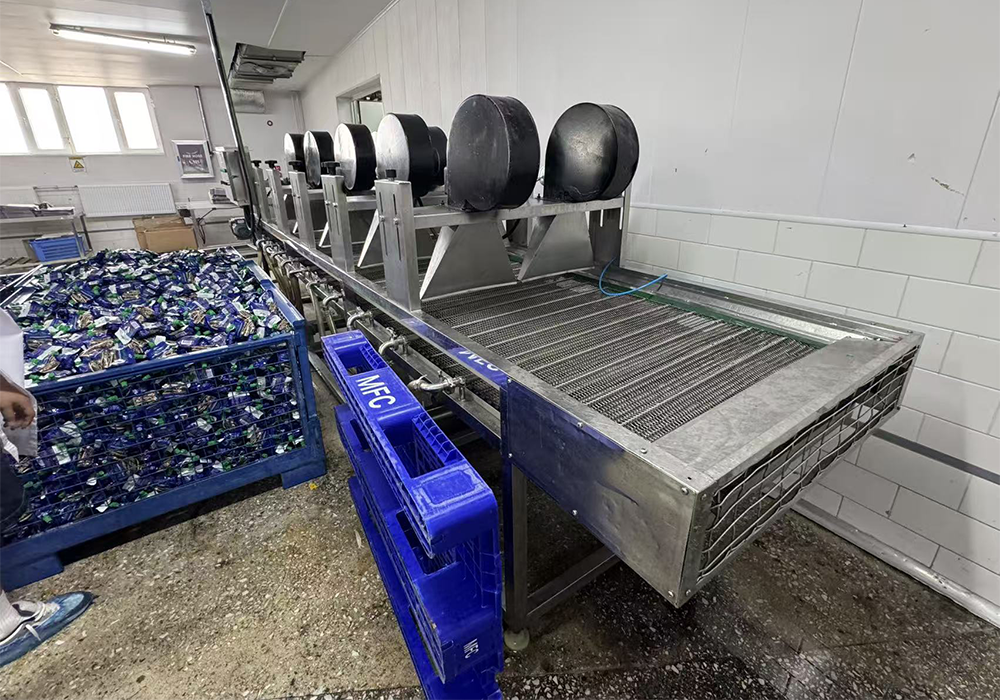
The customer shared a photograph of an existing mesh-belt conveyor in a production room. It showed the belt and nearby equipment, giving QXY a view of the line arrangement and the space around it. A photograph cannot establish every dimension, however. The product size, conveying direction, transfer height, available footprint and service access still need to be recorded before a new station can be matched to the line.
This is why the proposed solution was considered as a station rather than a stand-alone air knife. The conveyor has to carry the product through the useful airflow zone at a controlled speed. The air supply must reach the nozzles without obstructing access. Removed water needs a collection and discharge route, while the controls and electrical equipment need a suitable location away from the wet area. Each interface affects whether the dryer can work within the customer’s existing process.
The infeed and discharge deserve particular attention. A mismatch in height or belt direction can create a transfer problem even when the blow-off section works as intended. For a similar project, a dimensioned line sketch should accompany site photographs so that the supplier can review the machine envelope and the connection to equipment on either side.
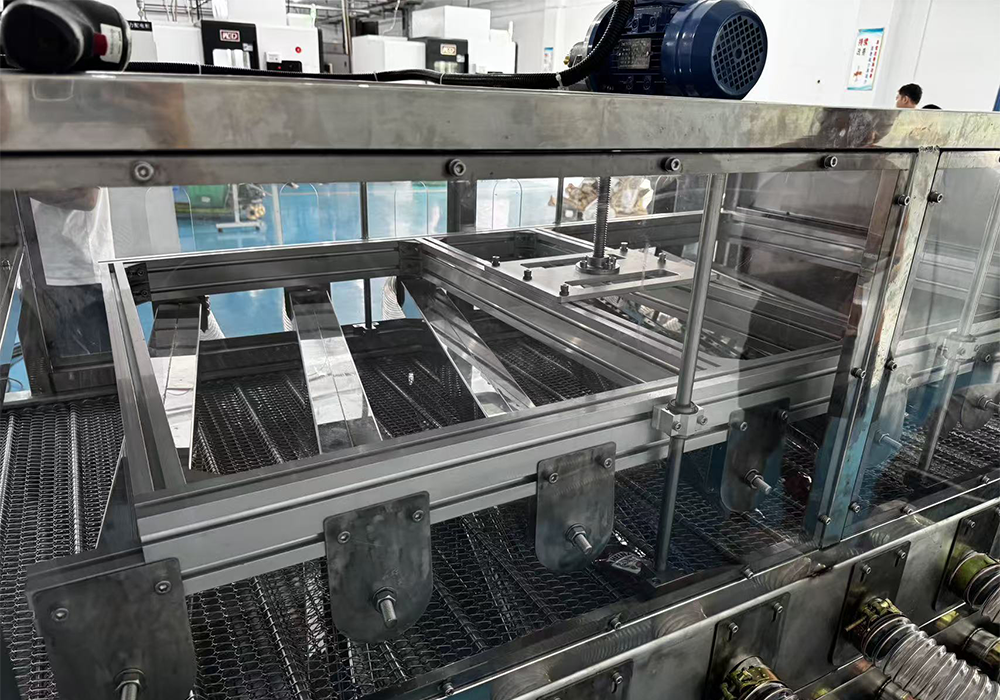
The air knives in this project were intended to remove surface water with concentrated blower airflow. That is a mechanical blow-off process. It does not, by itself, establish that every trace of moisture evaporates during one conveyor pass. The useful acceptance question is whether the product meets the dryness requirement of its next operation.
A product may look clear on top while an edge, recess, seam or underside still holds water. The project drawings explored upper and lower blow-off, several nozzle positions and adjustable upper assemblies to address different wet surfaces. Those arrangements are design options, not proof that every one appeared on the machine delivered to Mongolia. Their value lies in showing why nozzle count alone is an incomplete specification: the air must strike the surfaces that actually retain water.
Product samples or a short line video can reveal how parts sit on the belt, whether they overlap, and where droplets collect after washing. With that evidence, the air knives can be positioned for useful coverage. Conveyor speed and the length of the active blow-off zone then determine how long each product remains exposed to the airflow. The final setting should be checked with representative products and the customer’s agreed drying criterion.
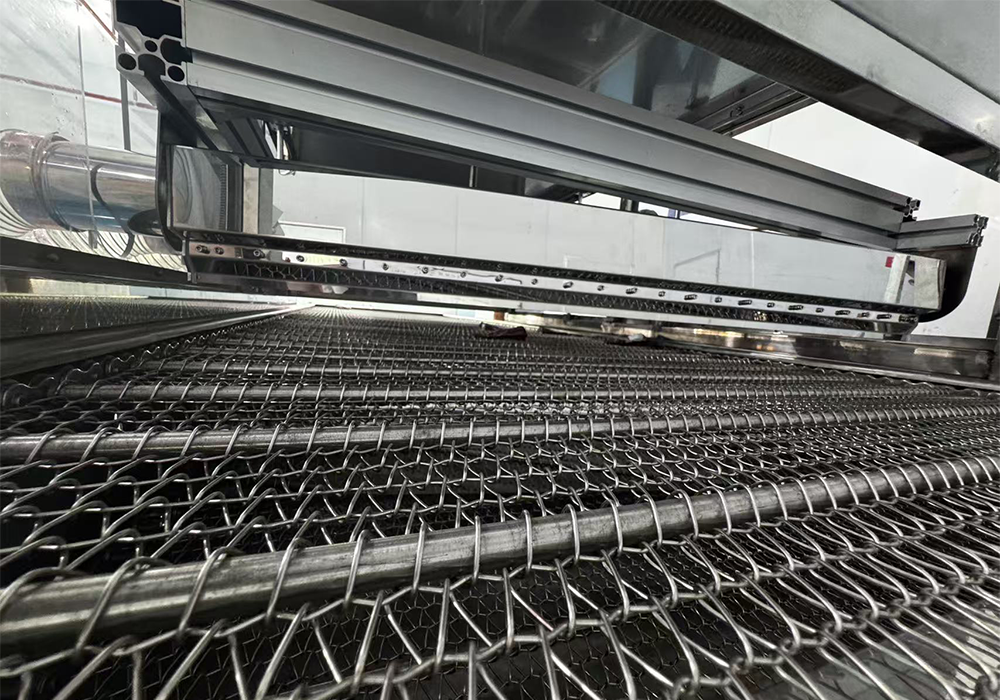
An open mesh belt serves two purposes in the proposed station. It carries products through the drying zone, and it gives displaced water a route below the conveying surface. When the product is stable and adequately supported, the openings can also allow lower air knives to reach the underside during the same pass.
That benefit depends on the item being conveyed. Mesh opening, support spacing, belt material, product weight and the risk of tipping or catching all affect belt selection. The reference drawings show stainless steel mesh conveyor concepts, while the project photographs show fabricated conveyor and air knife hardware. Neither source should be used alone to assert the final belt specification for the Mongolia order. The approved machine drawing is the proper reference for the supplied construction.
Airflow and drainage should be reviewed together. Water blown from the product should pass away from the belt or into the collection area instead of returning to another surface. A trial with the customer’s actual product can reveal whether the chosen support pattern exposes the wet underside without making transport unstable.
The project file includes parameter sheets for 7.5 kW and 11 kW high-speed centrifugal blower options. Both sheets list rated inlet airflow of 1,800 m³/h, while their pressure and speed ratings differ. These figures describe reference components. They do not report airflow measured at the air knife outlets of the Mongolia machine.
Air passes through piping, bends, manifolds and nozzles before it reaches the product. The number and length of air knives, their working distance, and resistance through that path determine the operating point. Motor power alone therefore cannot tell a buyer whether the full conveyor width will receive useful coverage or whether the intended line speed can be maintained.
The reference layouts in the project materials explore effective working widths of about 600, 1,000 and 1,200 mm, with different machine lengths and air outlet arrangements. These are examples of how the air supply and drying zone can change with the proposed geometry; they are not confirmed dimensions of the Mongolia purchase. Before release, the selected configuration should identify blower quantity, nozzle arrangement, air path and the method for checking the drying result.
Blowing water off a product is not enough if the droplets scatter onto neighboring equipment, the floor or the product again. The reference designs show a covered blow-off zone, side protection and a lower collection area. Some layouts use transparent panels so operators can observe the process while containing spray.
The enclosure must also be workable after the machine is built. Access for cleaning, inspection and adjustment affects how easily staff can find a wet area or correct a nozzle position. The drawings include doors and removable or liftable sections for that reason. For a continuous line, the collection and drainage route should be reviewed for the expected water load and kept separate from the blower and electrical area.
The available project record contains several kinds of material: the customer’s existing-line photograph, equipment and assembly photographs, engineering reference layouts, blower sheets and videos. They answer different questions. The line image describes the customer’s setting; fabrication images show hardware; drawings describe proposed configurations; parameter sheets state component ratings. None substitutes for a final approved drawing or an on-site acceptance report.
The drawings themselves state that the final design prevails. This matters when a reference image shows a particular width, blower count, control feature or nozzle position. A buyer should ask which of those features is included in the quoted machine and retain the approved revision with the order. If the site arrangement changes, the interfaces and drying target need another review.
The source record identifies a sale to a customer in Mongolia, but it does not provide a verified before-and-after moisture result, installed line speed or signed site throughput test. Those outcomes should be published only if measured records become available. For now, the case shows the engineering choices behind the order and the evidence needed to judge a similar proposal.
A useful inquiry begins with the product and the line: product dimensions, weight and material; how items are oriented and spaced on the belt; where residual water remains; required throughput; and the result needed by the next process. Add the available footprint, transfer height, conveying direction, power supply, drainage connection and photographs of the surrounding equipment.
Ask the supplier to return a proposed drawing that identifies the conveyor, air knife positions, blower configuration, enclosure, water route and controls. Agree how a representative product will be checked before treating a design target as a performance result. QXY’s mesh-belt air knife drying system page describes the configurable station; the order drawing and agreed test criterion should define the machine for a particular production line.
Product Effect Demonstration
Shenzhen Qixingyuan Machinery Equipment Co., Ltd. (QXY) makes industrial air knives and supporting air systems, including centrifugal blowers and custom conveyor drying stations. For a mesh-belt air knife drying system, QXY reviews the product, the surfaces that remain wet, and the space available on the line before proposing the conveyor and airflow layout. The final drawing should identify the equipment being supplied, while an agreed test should establish whether it meets the customer’s drying requirement.
Does the system need heated air?
The reference designs use blower-powered air knives to move surface water away; they do not specify a heater. If the next process requires a particular product temperature or moisture level, include that requirement in the inquiry so it can be evaluated separately.
Can the dryer connect to an existing production line?
It can be designed for a line connection once the interfaces are known. Send the supplier the infeed and discharge heights, conveying direction, available space, power supply, drainage location, and photographs of nearby equipment. Confirm the proposed connections on the final drawing.
Can it treat both sides of a product in one pass?
Upper and lower air knives are possible when the mesh belt supports the product securely and leaves the underside accessible. The product’s shape, weight, orientation, and wet areas determine whether that arrangement is suitable. A trial with representative products is the best way to check coverage and stability.
How should drying performance be accepted?
Define what “dry enough” means for the operation after the dryer, then agree on a test using representative wet products at the intended line speed. Record the result against that criterion. Blower power and air knife count alone cannot establish the outcome.
Need a custom air knife solution? Send us your application details, material requirement ,or air source type . Our engineering team will help you select the right model.

Shenzhen Qixingyuan Machinery Equipment Co., Ltd.
info@airknifecn.com
Building 8, Wanfeng Third Industrial Zone, Xinqiao Street, Bao'an District, Shenzhen, Guangdong, China


