

Ceramic tiles can leave washing, polishing, calibration, edge grinding, or surface cleaning with water on the face, edges, and back. The top may look dry while a groove, chamfer, rib, or conveyor contact point still holds enough liquid to re-wet the tile later. That becomes a problem when the next station is optical sorting or packaging.
A ceramic tile Air Knife uses a continuous sheet of air to move free water toward a defined edge or drain. It works without wiping the glaze or polished face. The useful layout depends on which downstream gate must be protected: stable inspection images or dry packaging materials.
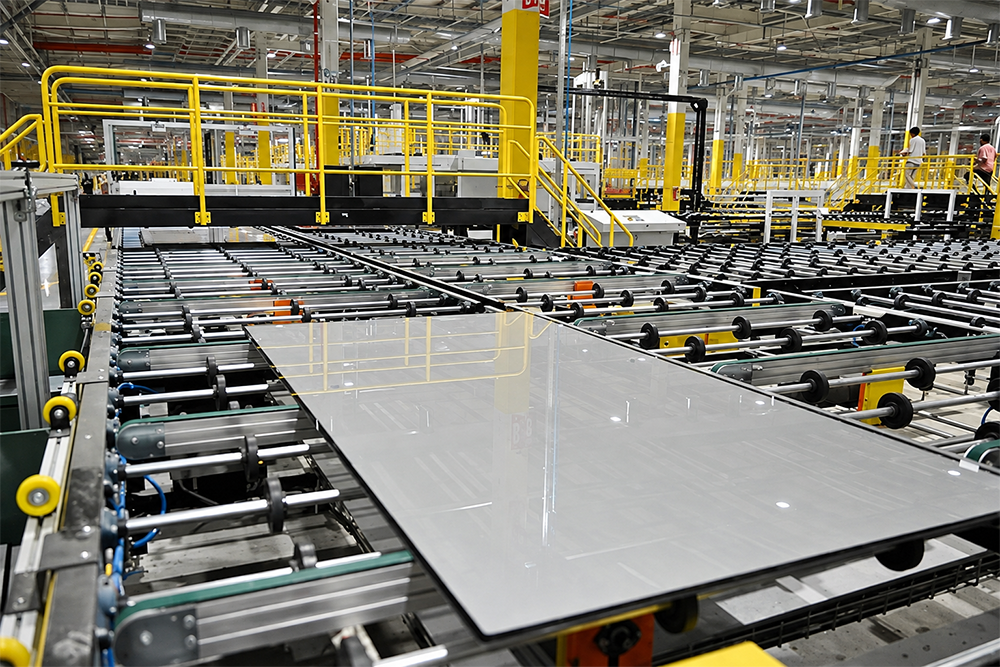
“The tile must be dry” is too vague for commissioning. Sorting cares about the inspection face, repeatable illumination, and tile motion. Packaging cares about the face, edges, back ribs, and delayed drainage into cartons or between stacked pieces.
Decision point | Before optical sorting | Before packaging |
Main risk | Water changes reflection, contrast, apparent colour, or tile stability | Water wets cartons, interleaving, film, straps, pallets, or adjacent tiles |
Critical zones | Inspection face, leading/trailing edge, camera view, conveyor contact | Face, all four edges, back ribs, corners, contact points |
Dryness evidence | Stable image and defect classification against approved dry references | No unacceptable transfer to packaging; no delayed drip after stacking |
Typical layout emphasis | Uniform upper airflow plus settling distance before the camera | Upper, lower, and edge-directed airflow with controlled drainage |
Automated tile inspection systems classify surface defects, tone, texture, and other visible characteristics. Droplets and thin films can create highlights, dark patches, false edges, or local colour shifts under the inspection lights. A wet tile may therefore look different from the dry reference used to train or set the sorter.
The drying station also affects motion. A strong vertical jet can make small or lightweight pieces chatter against guides. Mist can reach camera windows and lighting. Place the final air knife far enough upstream for vibration and airborne droplets to settle before image capture.
Tile-industry packaging commonly uses corrugated cardboard, plastic film, straps, and pallets. Water on a tile edge or back can transfer into the box, soften separators, mark adjacent pieces, reduce friction in a stack, or drip at the palletizer. The problem may appear several minutes after the face has passed inspection.
A packaging dryness test should include a dwell or short stack simulation. Check the bottom tile, carton contact area, corners, and interleaving after the normal delay between drying and packing. If water reappears, the system has an access or drainage problem, not simply a lack of top-surface air speed.
Stop the line after the current drying step and mark exactly where water remains. Separate repeatable wet zones from random droplets. A repeatable line behind a raised texture suggests an airflow shadow. A wet strip under the tile usually points to conveyor contact. Water that appears downstream may be draining from a back rib, chamfer, groove, or corner.
Inspect the leading edge, trailing edge, all four sides, polished or glazed face, textured areas, back pattern, conveyor rails, transfer rollers, and any support pad. Record tile size, thickness, orientation, gap, speed, and the time between wash exit and inspection.
For a flat face, mount the air knife across the conveyor and angle the sheet so it pushes water toward an open edge. Straight-down airflow can split the film without giving it a clear exit. A shallow sweep makes the liquid travel in one direction and reduces splash-back.
Wide tiles need even coverage. Check the center and both ends of the knife under operating flow. A long air knife supplied from one side can lose useful impact at the far end if the inlet, duct, or internal balance is wrong. QXY generally evaluates dual inlets for knives longer than 600 mm.
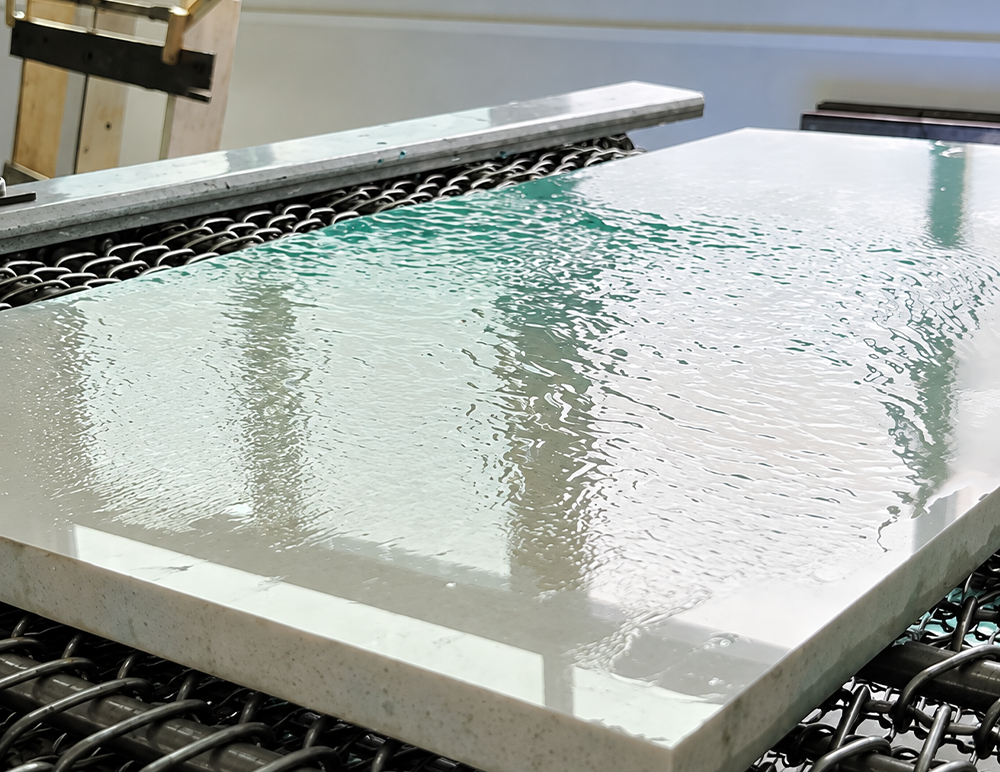 Treat Edges as Separate Drying Zones
Water wraps around a leading or trailing edge and may remain on the vertical face after the top is dry. Rectified tiles add narrow chamfers that can hold a fine line of water. Textured edges and corner profiles create local shadows.
A second angled knife or short side-directed unit can clear these zones. The air should push liquid away from the tile and packaging path, not along the edge into the next corner. Keep guides out of the water exit route.
Tile backs contain ribs, grids, logos, and recessed patterns. Conveyor belts, rollers, or pads hide part of that surface. Upper airflow cannot remove water trapped below the contact line. A lower knife can work through an open belt, roller gap, or transfer point where the back becomes exposed.
Sequence matters. If the lower knife fires first and upper water drains around the edge later, the back becomes wet again. A practical arrangement often uses gravity drain, primary top blow-off, lower or transfer-point blow-off, then a final edge check. The exact order should follow the observed water path.
Uniform water film and clean air are important because small wet patches are highly visible under bright inspection lighting. Protect the face from dirty ductwork, loose scale, or particles carried by the airflow.
Raised texture can block a flat air sheet. Change the angle, use staggered knives, or add a local air source for persistent grooves. More pressure alone may raise mist while the shadowed recess remains wet.
Large formats need uniform coverage and stable support. Confirm that airflow does not excite panel vibration or alter tracking. Several balanced knives over a longer zone may be easier to tune than one aggressive jet.
QXY Machinery offers integrated drying systems with blowers, upper and lower air knives, adjustable supports, conveyors, splash panels, collection trays, and controls. For component-level trials, these general ranges provide a starting reference:
• Air knife stand-off: commonly 20-50 mm.
• Impingement angle: commonly 15-45 degrees, aimed toward a controlled water exit.
• Blower pressure at the knife inlet: typically 2-6 psi (0.14-0.42 bar).
• Outlet slot: commonly 0.5-2 mm, selected for coverage and impact.
• Standard lengths: 150, 300, 450, 600, 800, and 1,000 mm; custom lengths up to 6 m.
• Dual inlets: evaluate on knives above 600 mm and verify end-to-end removal.
These are not guaranteed settings for every tile line. Tile width, texture, speed, water load, conveyor opening, available footprint, noise limit, and required dryness determine the final arrangement. Measure pressure at the knife under flow because long ducts, bends, filters, and split manifolds create loss.
Wide continuous tile surfaces usually favor a low-pressure, high-volume blower system. It supplies the full-width air curtains needed for repeated production without placing the entire demand on plant compressed air. Several knives can share a designed manifold when balance is verified.
A small compressed-air nozzle may still help at a narrow chamfer, corner, sensor, or isolated recess. Treat it as a local correction, not a substitute for full-width coverage. Mixing air sources also means separate controls for pressure, noise, maintenance, and energy.
Removed water needs a destination. Use sloped trays, splash panels, and drain paths that carry liquid away from motors, sensors, camera enclosures, and the packaging zone. If air velocity atomizes the rinse, reduce impact, allow more gravity drainage, or lengthen the drying zone.
The blower intake should not draw mist or polishing residue back into the air path. Locate the intake in a clean, dry position and maintain filtration. Inspect the knife slot for mineral deposit, glaze slurry, or chips that can create uneven jets.
ISO 10545-3 specifies a laboratory method for determining ceramic-tile water absorption, apparent porosity, apparent relative density, and bulk density. That material classification is not the same as free water left on a tile after a production wash.
An air knife removes surface and trapped process water. It does not change the fired body’s standardized absorption result. The line acceptance test should focus on the downstream process: optical stability, surface water, edge transfer, back-side drip, and packaging condition.
For sorting, compare dry reference tiles with production tiles across the full size and finish range. Record false rejects, missed defects, colour or shade instability, image contamination, tile vibration, and camera-window mist. Use the normal lighting and line speed.
For packaging, use a clean absorbent sheet or controlled wipe on the face, edges, and back, then run a short stack or carton trial. Check after the normal transfer delay. Record carton marks, separator condition, pallet drip, tile slip, and any water that reappears after handling.
Change one variable at a time: gravity-drain time, tile gap, conveyor speed, knife distance, angle, slot, blower speed, or number of stages. Save approved recipes for different widths, thicknesses, finishes, and back patterns.
A face can remain wet because the jet is too vertical, the tile gap is inconsistent, or the knife is wider than the useful product path. Edges stay wet when guides block the exit. Backs stay wet when the conveyor covers the ribs. Tiles re-wet when upstream water drains after the final knife.
Increasing pressure is not the first answer. Map the wet zone, open a water exit, correct the sequence, and balance airflow across the width. The best ceramic tile air knife system produces a repeatable handoff to both the sorting and packaging equipment.
QXY Machinery (Shenzhen Qixingyuan Machinery Equipment Co., Ltd.) is based in Shenzhen, China, and integrates R&D, design, production, and sales. The company has more than 10 years of focused experience in air knife systems for industrial drying, dust removal, and water blow-off.
For ceramic tile projects, QXY Machinery can provide standalone blower air knives or integrated conveyor drying systems with upper, lower, side, and multi-angle layouts. Custom options include air knife length, slot width, inlet arrangement, working distance, conveyor width, drying-zone length, splash protection, water collection, and electrical control. Final selection should use the actual tile range, water map, line speed, and downstream acceptance test.
Q: Where should an air knife be installed on a ceramic tile line?
A: Install it after the wet process and enough gravity drainage, but before the protected sorting or packaging gate. Leave settling distance before a camera and contain water away from downstream equipment.
Q: Can one ceramic tile air knife dry the face, edges, and back?
A: Usually not on every tile geometry. One upper knife can clear a flat face, while edges and ribbed backs often need a second angle, lower knife, or transfer-point blow-off.
Q: Why does a tile look dry and then become wet again?
A: Water can drain later from a back rib, groove, chamfer, corner, or conveyor contact point. Map the delayed wet area and change the sequence or access instead of only increasing pressure.
Q: Can water interfere with automatic tile sorting?
A: Yes. Droplets and films can alter reflection, contrast, apparent colour, and visible edges. Validate the drying setup with the actual camera, lighting, tile finishes, and sorter reference settings.
Q: How dry must ceramic tiles be before packaging?
A: Dry enough that no unacceptable water transfers to cardboard, separators, film, adjacent tiles, or pallets during the normal delay and stacking process. Set a measurable plant criterion.
Q: Is blower air or compressed air better for ceramic tile drying?
A: Blower air is usually better for wide continuous coverage. Compressed air can supplement narrow edges or isolated recesses. Compare required flow, local impact, energy, noise, and maintenance.
Q: Does air-knife drying change ceramic tile water absorption?
A: No. Air knives remove free process water from surfaces and recesses. Standardized material water absorption is determined by a separate laboratory method such as ISO 10545-3.
Need a custom air knife solution? Send us your application details, material requirement ,or air source type . Our engineering team will help you select the right model.

Shenzhen Qixingyuan Machinery Equipment Co., Ltd.
info@airknifecn.com
Building 8, Wanfeng Third Industrial Zone, Xinqiao Street, Bao'an District, Shenzhen, Guangdong, China


