

Yes, but only when wet conveyor surfaces are on the startup critical path. If the next shift is waiting for the belt to dry before pre-operation inspection, reassembly, or product release, an Air Knife for conveyor belt drying can remove movable water faster than still air. If the hold comes from sanitation verification, missing parts, a laboratory result, or a damaged belt, faster blow-off will not change the start time.
The useful question is not “How quickly can the air knife dry the belt?” It is “Which step controls the time from final rinse to approved production?” A short time study usually answers that question before equipment is purchased.
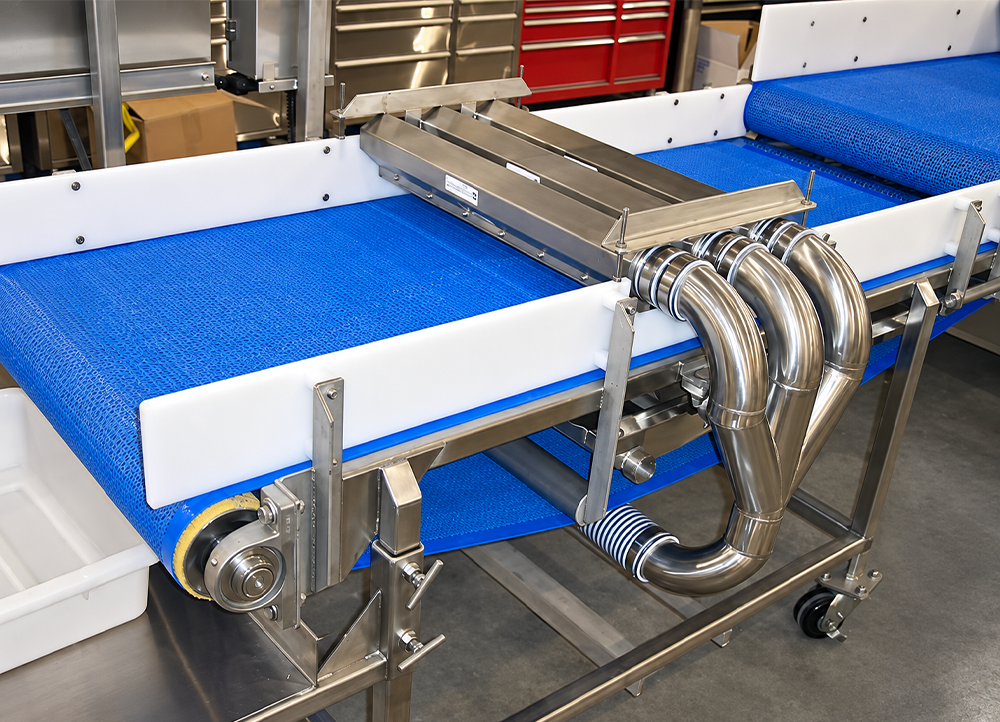
Start the measurement when the final rinse or sanitizer application ends. Stop it when quality or sanitation releases the conveyor for production. Record each gate in between. Many plants discover that “drying time” includes several unrelated waits: sanitizer dwell, gravity drainage, belt jogging, removal of pooled water, guard installation, ATP or allergen verification, paperwork, and the pre-op walk.
The table separates steps an air knife can affect from steps it should not shorten. The exact release sequence must follow the site sanitation standard operating procedure and hazard analysis.
Startup gate | What ends the step? | Could an air knife shorten it? | Evidence to record |
Sanitizer contact | Required concentration and contact time are complete | No. Airflow must not end the validated contact time early. | Chemical, concentration, start and finish time |
Gravity drain | Bulk rinse and sanitizer solution stop running from open surfaces | Sometimes. First allow liquid to reach an edge or drain. | Drain time and main water paths |
Belt dry-down | Defined belt areas meet the site dryness criterion | Yes, when movable water on the belt is the delay. | Water mass, visual limit, swab rule, elapsed time |
Pre-op release | Inspection, verification, guards, and records are accepted | Only if wetness was holding release. | Release timestamp and cause of any hold |
A belt presents much more wet area than its top surface. Water remains on the underside, around sprockets and rollers, inside modular-belt hinges, beneath cleats, and against sidewalls. A solid urethane belt may shed water quickly from the carry side but keep a film on the return side. Plastic modular belts drain through openings yet retain water at pins and joints. Wire mesh drains freely but offers many small surfaces.
The room also matters. High humidity, low air movement, and cold stainless frames slow evaporation. A wet floor or nearby foam-cleaning operation can keep adding moisture to the air. An air knife is strongest at displacing droplets and films. It is not a room dehumidifier.
A knife spanning the belt can sweep water toward an edge while the belt moves at a controlled drying speed. Angle the jet rather than pointing straight down. The belt needs a safe water destination, such as a drip tray or drain, so the liquid does not return on the underside.
The underside is often missed. A second knife near the return run can remove water before it reaches rollers or sprockets. Guarding, service access, and worker exposure are critical because the installation is close to moving components.
A compact drying station after a final rinse can combine a short gravity-drain section, top and bottom blow-off, and splash containment. This arrangement keeps removed water near the sanitation zone rather than carrying it toward packaging or high-care production.
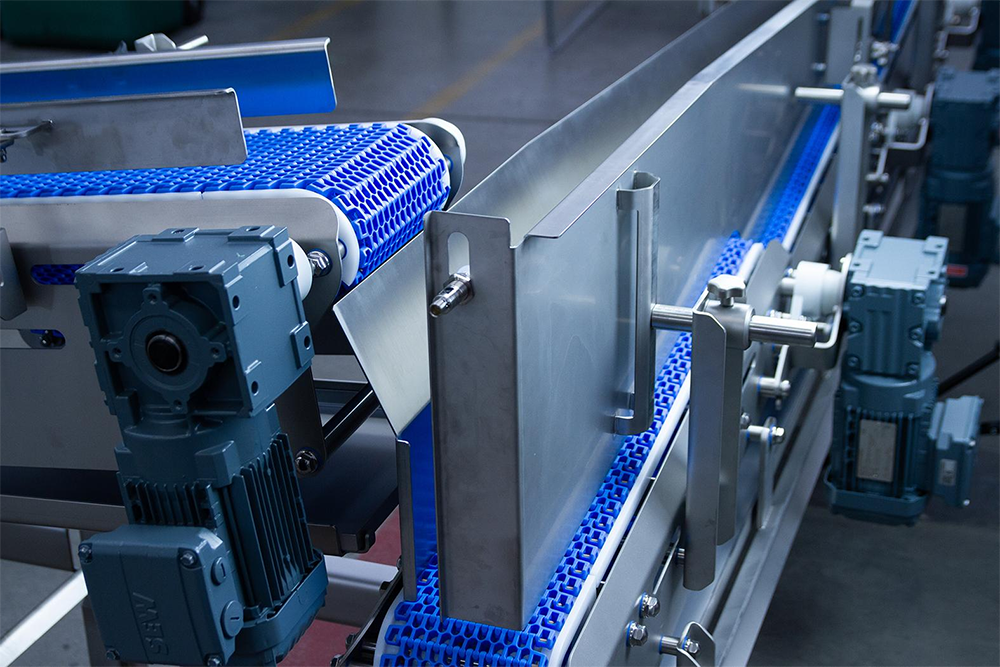
Start with a wet map. Mark the top film, edges, splice, cleats, hinge rods, sidewalls, return side, rollers, wear strips, and frame ledges. Run the belt slowly after cleaning and watch where drops reappear. Water that emerges only when a hinge flexes needs airflow at that flex point, not another knife over a flat section.
Deep pockets may need a different nozzle angle, intermittent belt indexing, or a brief mechanical drain position. Some water is trapped by equipment design. If it cannot reach the jet or a drain, more blower pressure usually adds noise and aerosol without solving the hold.
Blow-off belongs after the validated sanitizer contact period unless the sanitation program explicitly defines another sequence. Starting airflow too early can remove or dilute the chemical film before it completes its required dwell. The air knife control should therefore be interlocked or procedurally linked to the sanitation step.
Chemical residue is a separate question. The sanitation team must decide whether the applied sanitizer is no-rinse, requires a potable-water rinse, or has another approved finish. Airflow is not a method for making an out-of-spec chemical application acceptable.
A dry belt is not a success if droplets land on a sanitized filler, open product, camera, wall, or clean floor. Lower the jet angle, increase gravity drain time, add drip pans, or use side shields when mist appears. Exhaust may be needed in an enclosed drying station, but it must not pull dirty room air across a clean surface.
Check both sides of the hygiene boundary during trials. Dye in the final rinse can help show where liquid travels, provided the plant approves the test material and cleans it afterward. Good placement sends water back toward the wet sanitation area.
The belt may be a food-contact surface. That makes the air source part of the sanitation review. A blower can draw dust, condensate, chemical aerosol, or warm humid air from its intake location. Plant compressed air can carry oil, water, pipe scale, or microorganisms when treatment and distribution are poor.
Define filtration, oil and condensate control, intake location, duct cleanability, point-of-use testing, and response limits according to the hazard analysis and applicable rules. A clean stainless steel air knife supplied by dirty air can re-contaminate the surface it is meant to dry.
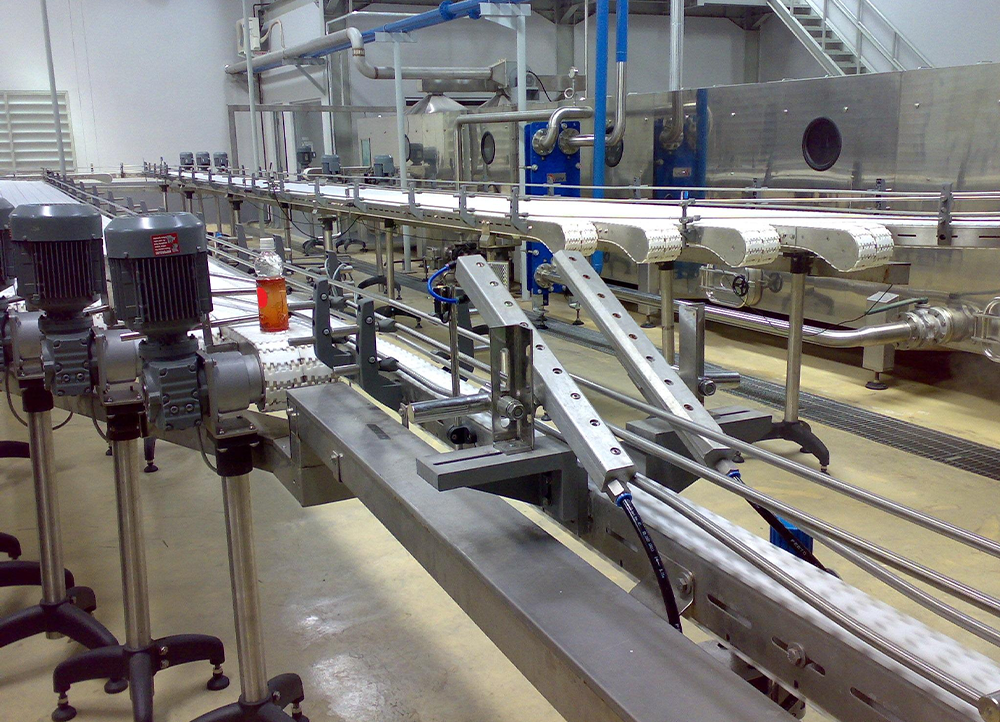
3-A hygienic-design principles emphasize cleanable materials, access for inspection, free drainage, and the removal of niches and liquid collection points. Apply that review to the air knife body, mounting arms, fasteners, shims, inlet fittings, duct, drip tray, guards, blower, and nearby cable routes.
For wet food areas, 304 stainless steel may suit moderate cleaning conditions, while 316 or 316L deserves review for chloride-rich chemicals, salt, persistent wetness, and welded construction. Material grade does not prove sanitary certification. Verify the exact model, fabrication, finish, seals, and documentation required by the project.
QXY Machinery can supply stainless steel air knives with custom lengths and inlet arrangements. These values are starting points for a blower-driven test, not guaranteed conveyor settings:
• Knife-to-belt distance: commonly 20-50 mm.
• Impingement angle: commonly 15-45 degrees to sweep water toward a drain.
• Blower pressure at the air knife inlet: typically 2-6 psi (0.14-0.42 bar).
• Outlet slot: typically 0.5-2 mm, selected for the required airflow and impact.
• Standard lengths: 150, 300, 450, 600, 800, and 1,000 mm; custom lengths up to 6 m.
• For knives longer than 600 mm, evaluate dual inlets and verify uniform removal across the belt.
Measure pressure under operating flow at the knife, not only at the blower. Long duct runs, elbows, filters, and split manifolds create loss. Use the lowest setting that meets the dry criterion without unstable belt tracking, excessive noise, or mist.
Drying often occurs while the line is partly guarded and sanitation staff are nearby. Belt motion, exposed nip points, wet floors, high noise, and automatic blower start all need a formal safety review. Follow the plant lockout/tagout program. Do not create an informal jog routine that bypasses guards or interlocks.
Useful controls include a sanitation-complete permissive, adjustable belt-dry speed, timed blower run, guard confirmation, and an emergency stop reachable from the drying station. The control sequence should fail safely after a power loss or interrupted sanitation cycle.
Collect baseline data across enough sanitation cycles to capture normal variation. Record final-rinse end, sanitizer contact completion, blower start and stop, pre-op start, release time, first good product, and the reason for every hold. Separate planned sanitation time from waiting.
After installation, repeat the same record under comparable products and cleaning programs. Track median time and the slowest normal cycles, not only the best trial. Also record re-cleaning, wet-belt findings, moisture-related startup stops, energy, noise, and sanitation labor. A five-minute faster belt with a ten-minute mist cleanup has not improved the shift change.
The strongest result is a shorter and more predictable final-rinse-to-release interval with no loss of sanitation performance. Keep the air knife settings, belt speed, inspection criterion, and approved sequence in the sanitation record so the gain survives crew changes.
Do not buy an air knife to compensate for a frame that cannot drain, a belt that needs repair, water inside hollow members, recurring overhead condensation, or an undersized floor drain. It also cannot speed a mandatory verification hold. Fix those constraints at the source.
An air knife for conveyor belt drying earns its place when the wet map is understood, sanitizer dwell is protected, removed water is contained, and dry-down is proven to control startup. Under those conditions, it can convert an open-ended waiting period into a timed, repeatable step.
QXY Machinery (Shenzhen Qixingyuan Machinery Equipment Co., Ltd.) is based in Shenzhen, China, and integrates R&D, design, production, and sales. The company has more than 10 years of focused experience in air knife systems for industrial drying, dust removal, and water blow-off.
For food-conveyor drying projects, QXY Machinery can provide 304, 316, and 316L stainless steel air knife options, custom lengths, slot widths, and inlet layouts. The engineering team can review belt width, construction, speed, sanitation chemicals, retained-water locations, drainage, guarding, air source, and the target startup time. Hygienic and compliance requirements should be agreed for the exact configuration before purchase.
Q: Does an air knife make a sanitized conveyor belt dry faster?
A: It can remove movable films and droplets much faster than still air. The actual startup gain depends on whether belt dryness is delaying release and whether water is accessible to the jet.
Q: When should the air knife start after sanitation?
A: Start only after the validated sanitizer contact time and any required rinse are complete. Link the blower sequence to the sanitation procedure so airflow cannot shorten chemical dwell.
Q: Should the air knife dry the top and underside of the belt?
A: Often yes. Water carried on the return run can rewet rollers, hinges, and the carry surface. The wet map should decide whether one knife, opposed knives, or a staged station is needed.
Q: Can an air knife remove water from modular belt hinges?
A: It may remove water when the hinge opens around a sprocket or transfer. Aim at the point where trapped water becomes exposed. Deep pockets may still require indexing, more drain time, or a design change.
Q: What air knife material is suitable for food conveyor washdown?
A: Stainless steel is commonly selected. Grade 304 may suit moderate exposure; 316 or 316L deserves review for chloride cleaners, salt, persistent wetness, or welded assemblies. Review the whole station, not only the knife body.
Q: Can compressed air be used for conveyor belt drying?
A: It can, but air quality, oil, condensate, filtration, pipe condition, noise, and operating cost require review. Wide continuous belts often favor a low-pressure, high-volume blower system.
Q: How should faster startup be measured?
A: Compare final-rinse-to-release and first-good-product times across multiple comparable cycles. Record all holds, sanitation verification, wet-belt findings, mist cleanup, and rework so the measured gain is real.
Need a custom air knife solution? Send us your application details, material requirement ,or air source type . Our engineering team will help you select the right model.

Shenzhen Qixingyuan Machinery Equipment Co., Ltd.
info@airknifecn.com
Building 8, Wanfeng Third Industrial Zone, Xinqiao Street, Bao'an District, Shenzhen, Guangdong, China


