

Leafy vegetables leave a wash system with water on flat surfaces, inside curls, around stems, and between overlapping leaves. Removing it reduces package fog, clumping, ingredient dilution, and drip. Yet spinach, lettuce, baby leaves, and herbs can be damaged by the same energy used to dry them.
The most reliable way to dry leafy vegetables after washing is a staged process. Let gravity remove easy water first. Use only enough mechanical action to open the product bed. Then apply broad, low-impact air in several short contacts instead of one concentrated blast. Finish when the packaging requirement is met, not when the leaf has begun to lose its own moisture.
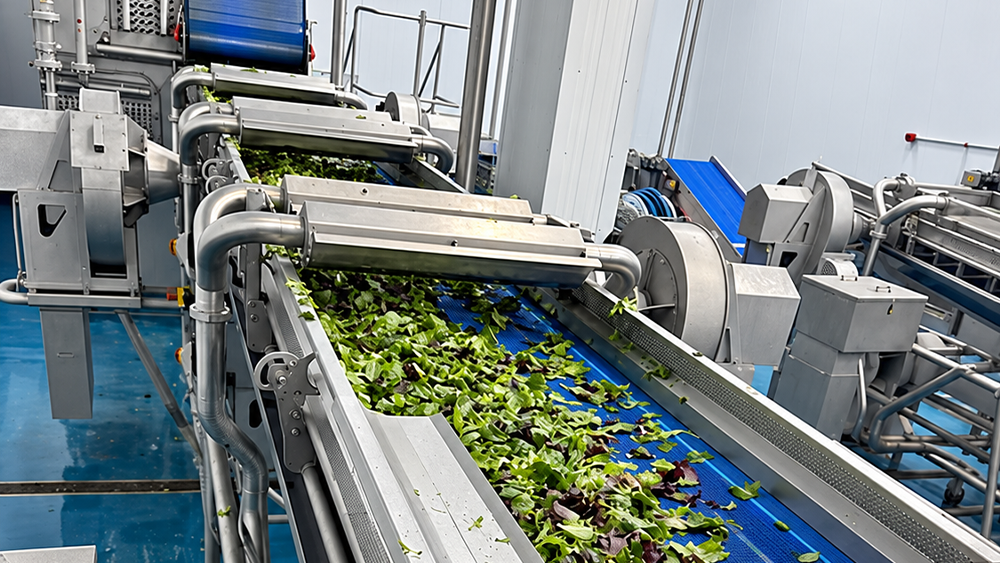
A leaf does not need to feel paper dry. For many fresh-cut products, the useful endpoint is no visible pooling, no heavy clumping, and a controlled amount of surface water entering the package. A salad kit may also need enough dryness to protect a seasoning or dressing compartment. A whole-head line can accept a different result than baby spinach packed in a film bag.
Write the acceptance rule before choosing equipment. Possible measures include mass of water removed from a standard sample, free water collected in the package, fogging after a defined cold-storage period, clump rate at the weigher, seal contamination, or visual coverage of droplets. Pair the moisture result with damage and shelf-life checks.
Bruising rarely comes from one obvious event. A leaf may already be weakened by cutting, vigorous washing, a high drop, and compression in a deep bed before it reaches the dryer. Research on spinach and other baby leaves shows that processing damage varies with species, leaf age, growth condition, and the operations used. A setting that works for mature romaine may be too harsh for summer-grown baby spinach.
Damage source | What the leaf experiences | Lower-damage control | What to inspect |
Drop and collision | Impact at transfers, chutes, and deep product beds | Reduce drop height; keep transfers full and smooth | Cracks, torn edges, crushed stems |
Compression | Heavy product bed, tight guides, hold-down devices | Use shallow layers and open passages | Fold lines, dark pressure marks, clumping |
Rotation or vibration | Repeated contact in spinners, shakers, or tumblers | Use only the intensity and time needed for bulk water | Stem breakage, edge fray, wet bruises |
Air impact | Leaf flutter, lift, slap, or pinning under a concentrated jet | Use broad, shallow, staged airflow and stable support | Flapping, leaf displacement, local dehydration |
Time and heat | Warm exposure and prolonged surface evaporation | Keep the process short and temperature controlled | Wilting, curl, dull color, weight loss |
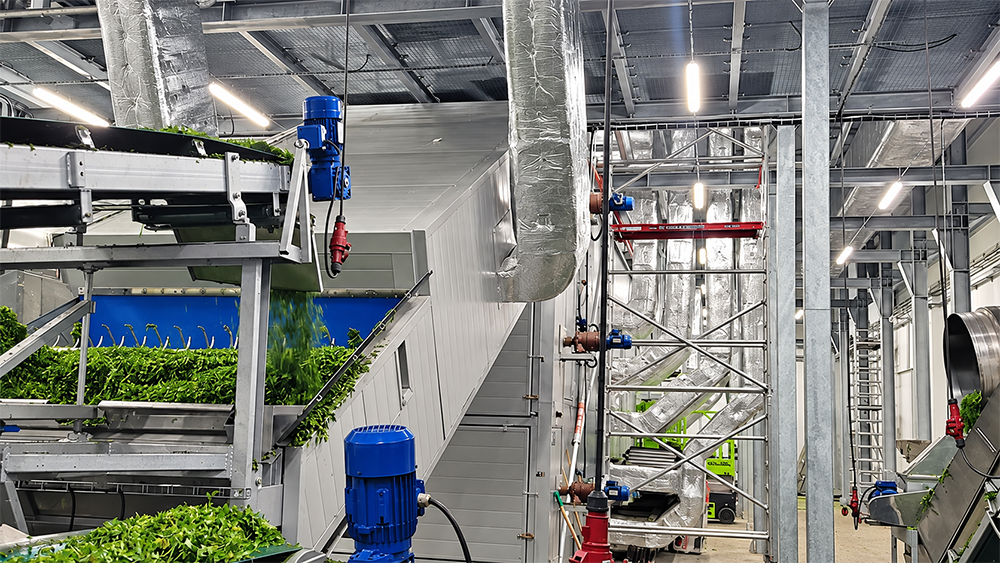
Lift the product from the wash with enough residence time for bulk water to fall away. Perforated conveyors, open flights, and short drain sections remove water without striking the leaves. Keep the bed shallow enough for lower layers to drain, but avoid a transfer that drops leaves onto a hard surface.
Drainage is cheap and gentle, yet it has a limit. Water remains where leaves overlap and in curled margins. Extending the drain section too far can add line length without opening those contact points. The next step should loosen the bed with the least possible mechanical force.
Centrifugal dryers, vibratory dewatering, tumblers, and shaking conveyors can remove large amounts of water. Their suitability depends on product and control. A short, controlled action may work for robust cut lettuce but mark delicate herbs or baby leaves when residence time, loading, or acceleration is too high.
Avoid deep loads that compress the bottom layer and unnecessary transfers between units. Rounded contact surfaces, low drops, and steady feed reduce impacts before the product reaches the air knife.
An air knife produces a sheet of air across the conveyor width. For loose leafy vegetables, the goal is not maximum impact. The jet should move droplets and separate light overlaps without pinning leaves to the belt, lifting them into guards, or making them slap repeatedly against each other.
A shallow angle spreads the force along the leaf surface. Greater stand-off and lower blower speed soften impact. Two or three gentle air contacts can outperform one close, high-velocity knife because each stage exposes a different part of the moving bed. A perforated belt can let displaced water and air pass through instead of rebounding into the product.
Leaf stability decides the layout. If product lifts, add a wider low-force zone, reduce local velocity, change the angle, or improve belt support. Avoid a tight hold-down mesh unless tests show that contact and compression do not mark the leaves.
After free water is removed, the remaining film may need evaporation. Warm air can accelerate that step, but heat also raises leaf temperature and can increase wilting or water loss from the tissue. Many fresh-cut lines are better served by short contact with clean, relatively dry air while maintaining the product’s required temperature control.
A cold, humid room limits evaporation even at high air speed. Better intake placement, dehumidification, or enclosure exhaust may help more than added pressure. Exhaust must not pull dirty air across exposed product.
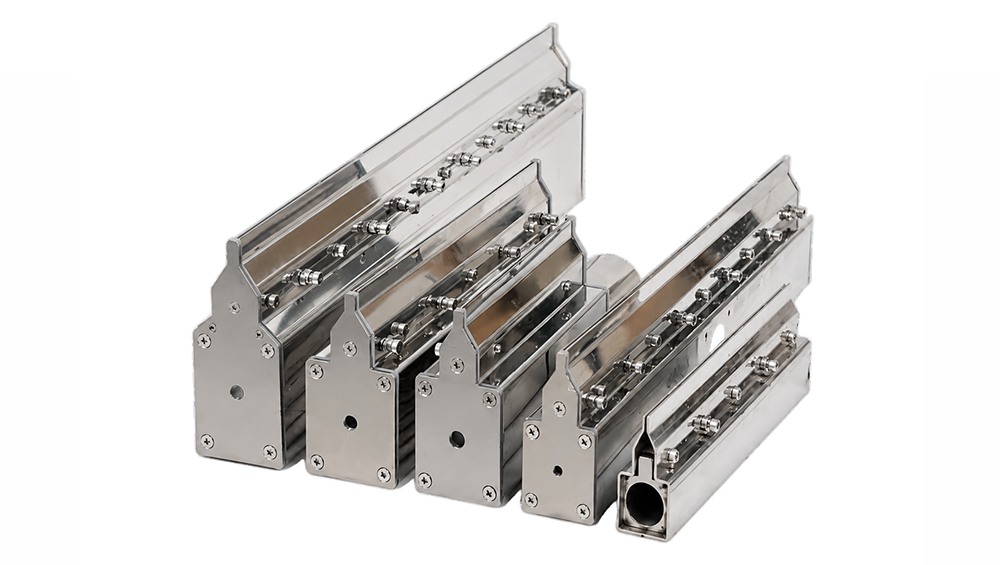
QXY Machinery’s general blower-driven air knife range uses 2-6 psi (0.14-0.42 bar) at the knife inlet, outlet slots commonly from 0.5-2 mm, a typical industrial stand-off of 20-50 mm, and angles from 15-45 degrees. These are equipment reference ranges, not a ready-made recipe for loose leaves.
Start the product trial at the lowest controllable blower speed and with enough distance to prevent flutter or lift. Use a shallow angle and increase energy in small steps. A fragile product may need more stand-off than a fixed package or metal part. Measure at the air knife under flow because duct bends, filters, and manifolds change the delivered pressure.
• Match knife length to the actual product bed, not the full frame width.
• Use balanced inlets on long knives when one-sided supply leaves uneven drying.
• Keep the slot and internal air path clean; a partially blocked slot creates local hard jets.
• Place splash capture below or beside the belt so removed water cannot return to the leaves.
• Provide adjustment marks so sanitation crews can restore the validated angle and distance.
In many fresh-cut operations, air contacts exposed ready-to-eat food and needs a hazard-based review. Check the intake, filters, duct and plenum cleanability, condensate, oil risk, maintenance, and point-of-use verification. Keep intakes away from drains, chemical mist, traffic, and sanitation exhaust. Stainless steel does not correct contaminated supply air.
FDA guidance for fresh-cut leafy greens stresses that wash-water disinfectants are used to limit cross-contamination in the wash system, not to surface-sanitize every leaf. Drying is also not a microbial kill step. It removes water; it does not make contaminated produce safe.
Keep wash-water quality, disinfectant concentration, organic load, pH, temperature, and product flow under the approved process controls. The drying line should prevent re-contamination through dirty belts, pooled water, poorly located air intakes, or splash returning from drains.
Wet leaves shed soil and organic material. The air knife body, brackets, belt supports, drip pans, guards, ducting, and enclosure must be accessible for cleaning and inspection. Avoid horizontal ledges, exposed threads over product, hollow members that can leak, and brackets that retain wash water.
Stainless steel is commonly selected for wet food zones. Grade 304 may suit moderate exposure, while 316 or 316L deserves review for chloride sanitizers, persistent wetness, or welded assemblies. Material alone does not establish hygienic certification. Verify the complete construction and project documentation.
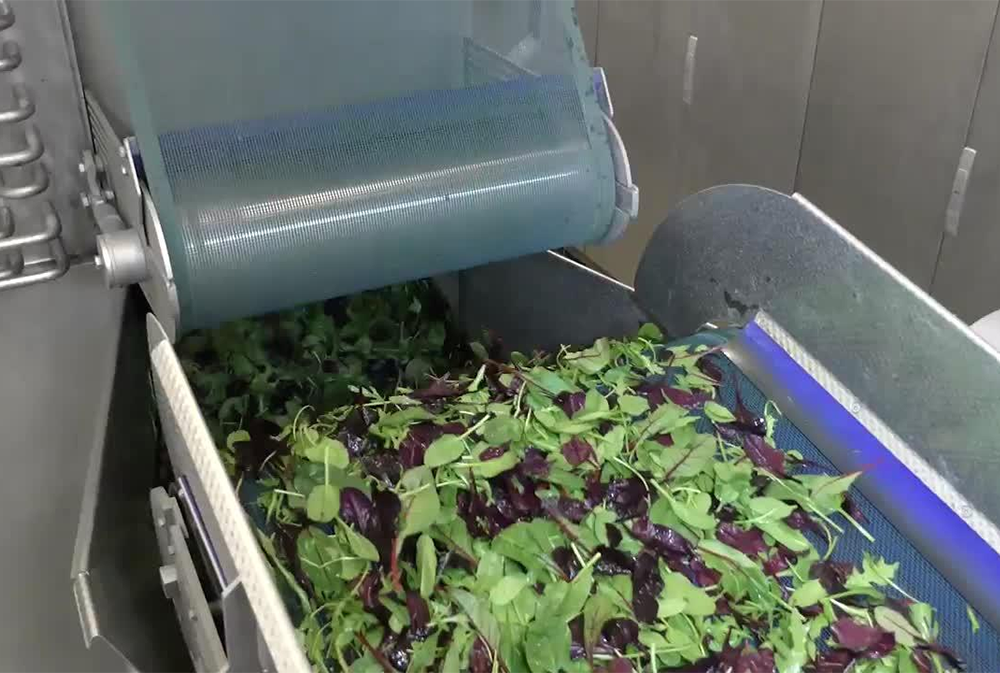
Use the real product mix, including the most fragile cultivar, maturity, cut size, seasonal condition, and incoming temperature. Run normal and maximum line rates. Keep a control sample that passes through washing and handling without the new drying step, then compare it with each air setting.
Measure moisture immediately, then inspect bruising, tears, stem breakage, color, wilting, package fog, clumping, odor, and shelf-life at normal checkpoints. Damage may appear after packing. Weighing a standard sample helps separate removed wash water from later product water loss.
Change one variable at a time: drain time, bed depth, belt speed, knife distance, angle, slot, blower speed, or number of stages. Record the approved window, not only one ideal setting. Seasonal leaf strength may require a different recipe.
Uneven feed creates a deep wet bed beside an exposed thin area. The operator raises air speed to dry the pile, then damages the single layer. Fix distribution first. A blocked slot or one-sided duct supply can produce the same mixed result.
Water may also hide beneath folded leaves because the jet never changes their orientation. Add a gentle bed-opening step or a second air direction. If leaves are dry but edges darken later, check upstream cutting, drop height, compression, water temperature, residence time, and product age before blaming only the dryer.
To dry leafy vegetables after washing without bruising, use the least energy that reaches the packaging moisture limit. Drain first, reduce impacts, spread the bed, apply broad staged air, and use evaporation only for the thin film that remains. Stop when the process requirement is met.
An air knife is useful when it is treated as a controllable, low-contact tool rather than a high-pressure shortcut. The successful setting is the one that holds moisture, damage, food safety, temperature, and throughput inside the approved window across real product variation.
QXY Machinery (Shenzhen Qixingyuan Machinery Equipment Co., Ltd.) is based in Shenzhen, China, and integrates R&D, design, production, and sales. The company has more than 10 years of focused experience in air knife systems for industrial drying, dust removal, and water blow-off.
For leafy-vegetable and fresh-cut produce projects, QXY Machinery can provide 304, 316, and 316L stainless steel air knife options, custom lengths, slot widths, and inlet layouts. The engineering team can review product fragility, bed width and depth, belt speed, water load, temperature, air source, drainage, hygiene zoning, and the required moisture endpoint. Final settings must be validated on the processor’s actual product.
Q: What is the gentlest way to dry leafy vegetables after washing?
A: Use gravity drainage first, keep the product bed shallow, minimize drops and compression, then apply broad low-impact air in short stages. Stop at the packaging moisture limit instead of trying to dehydrate the leaf.
Q: Can an air knife dry lettuce and spinach without bruising?
A: It can when airflow is spread, angled, and tested at low energy. Baby spinach and herbs usually tolerate less impact than robust lettuce. Product lift, flutter, edge damage, and delayed bruising must be checked.
Q: Is a centrifugal dryer better than an air knife?
A: They perform different jobs. A centrifugal unit can remove bulk water quickly, while an air knife provides continuous noncontact blow-off. The best choice depends on leaf strength, batch or continuous flow, loading, damage, and moisture target.
Q: How dry should leafy greens be before packaging?
A: Dry enough to prevent unacceptable free water, fog, clumping, seal contamination, or ingredient dilution. There is no universal target. Set a measurable specification for each product and package.
Q: Should heated air be used on leafy vegetables?
A: Use heat cautiously. It can speed evaporation but may warm, wilt, curl, or dehydrate the product. Short contact with clean, dry, temperature-controlled air is often easier to validate for fresh-cut leaves.
Q: What air knife pressure should be used for baby leaves?
A: There is no universal pressure. Begin at the lowest controllable blower setting with generous stand-off and a shallow angle, then increase gradually while measuring moisture and damage on the real product.
Q: Does drying leafy vegetables reduce pathogens?
A: Drying is not a kill step. It may remove some water, but safety depends on controlled raw material, wash water, hygienic equipment, clean air, temperature control, and the facility’s preventive controls.
Need a custom air knife solution? Send us your application details, material requirement ,or air source type . Our engineering team will help you select the right model.

Shenzhen Qixingyuan Machinery Equipment Co., Ltd.
info@airknifecn.com
Building 8, Wanfeng Third Industrial Zone, Xinqiao Street, Bao'an District, Shenzhen, Guangdong, China


