
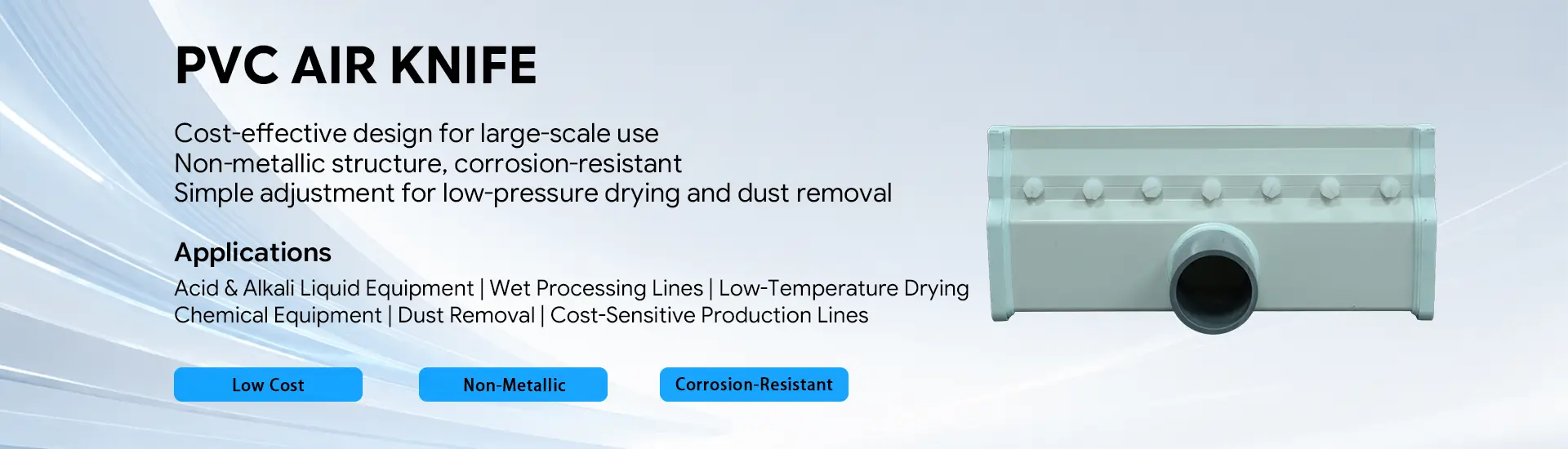
QXY PVC air knives are mainly used in cost-sensitive or metal-reactive environments. The category page identifies PVC air knives as suitable for simple dust removal, low-temperature and low-pressure applications, as well as drying equipment involving acid and alkali liquid medicine. This makes PVC different from metal air knives: its value is not high strength, but chemical compatibility and lower cost.
Compared with aluminum alloy or stainless steel, PVC is lighter and usually more economical, making it suitable for large-scale or budget-sensitive installations. It is also useful where metal reaction or metal contamination needs to be avoided. For equipment handling acid or alkali liquid medicine, PVC can provide better practical compatibility than ordinary metal structures, depending on the exact chemical conditions.
However, PVC air knives should be selected carefully. They are better for low-temperature, low-pressure and relatively simple blow-off conditions, not for high-temperature, heavy-duty or high-pressure drying lines. Where mechanical strength, heat resistance or long-term structural rigidity is required, stainless steel, titanium alloy or aluminum alloy may be more suitable.
Typical applications include acid and alkali liquid medicine equipment, chemical wet processing, simple dust removal, low-pressure drying, low-temperature blow-off and cost-sensitive industrial cleaning systems.


PVC is selected when the application requires corrosion resistance against many wet, acidic or alkaline process conditions. For chemical cleaning, rinsing, plating and PCB wet processes, PVC can provide a good balance between chemical resistance, weight and cost efficiency.
PVC is not positioned as a high-temperature or heavy-impact material. For high-temperature air supply, strong mechanical load, severe impact or special hygiene requirements, stainless steel, titanium alloy or other materials may be recommended based on the actual working environment.
· PVC offers strong resistance in many water-based acidic, alkaline and wet cleaning environments.
· The lightweight body helps reduce installation load and makes equipment adjustment easier.
· PVC provides a cost-effective solution for corrosive blow-off and water removal applications.
· Chemical compatibility should be confirmed according to the chemical type, concentration, temperature and exposure time.
The table below helps customers compare PVC with common air knife materials. Final selection should be based on the working environment, chemical contact, air temperature, required strength, cleaning method and budget.
Material | Hardness / Strength | Corrosion Resistance | Cost Efficiency | Density / Weight | Heat Resistance | Recommended Use |
PVC (Main Material) | Low to medium; suitable for low-load air knife structures | Excellent in many wet, acidic and alkaline environments; confirm compatibility for strong solvents or high concentrations | Very high | Very light | Low to moderate; best for normal-temperature air supply and ambient process areas | Chemical cleaning, PCB wet processes, electroplating, acid or alkaline rinse lines and water blow-off |
6063-T6 Aluminum Alloy | Medium strength with good machinability | Good for general industrial environments; not preferred for strong chemical exposure | High | Light | Medium; suitable for general industrial drying conditions | General conveyor drying, electronics, packaging and applications requiring lightweight installation |
304 Stainless Steel | High strength and good durability | Good corrosion resistance for many wet and hygienic environments | Medium | Heavy | High | Food processing, pharmaceutical packaging, washing lines and general wet production areas |
316 Stainless Steel | High strength and durable structure | Very good corrosion resistance, especially in chloride-containing or more demanding wet environments | Medium to low | Heavy | High | Marine-related equipment, chemical process areas and more corrosive wet lines |
Titanium Alloy | High strength-to-weight ratio | Excellent corrosion resistance in many harsh chemical environments | Low; premium material | Medium; lighter than stainless steel | High | High-value corrosive applications, chemical processing, battery manufacturing and harsh process environments |
QXY PVC air knives can be customized to match different line widths, installation spaces and chemical process layouts. The air outlet design creates a long and continuous airflow curtain for surface water removal, residue blow-off and cleaning support.
· Custom length: designed according to product width, conveyor width and required airflow coverage.
· Inlet configuration: end inlet, side inlet or customized inlet direction can be selected according to the pipe layout.
· Uniform air outlet: supports stable air distribution along the working width.
· Lightweight installation: suitable for compact frames, wet equipment and corrosion-resistant machine structures.
· Application-specific selection: air gap, working distance and air volume can be recommended according to the drying or blow-off target.
PVC air knives can be installed after chemical washing or water rinsing to remove liquid from product surfaces before the next production step. Their chemical-resistant body makes them suitable for many wet process environments.
In PCB cleaning, etching or rinsing lines, PVC air knives can help remove surface water and chemical residue from boards, holes and edges. A stable air curtain reduces residual moisture before inspection, transfer or further processing.
For electroplating and surface treatment lines, PVC air knives can be used near rinse tanks or wet conveyors to blow off liquid and reduce carryover between process stages. This helps improve process cleanliness and reduce solution waste.
For plastic parts, panels, bottles, sheets and general wet products, PVC air knives provide a lightweight and economical way to remove water from moving surfaces. Customized length and inlet direction help match different conveyor layouts.
To select the right PVC air knife, QXY recommends confirming the following information before quotation and design:
1. Product width and required airflow coverage.
2. Conveyor speed and drying or blow-off target.
3. Chemical type, concentration, temperature and contact time.
4. Available air source, pressure, airflow and pipe size.
5. Working distance between the air knife outlet and product surface.
6. Installation space, mounting direction and preferred air inlet position.
7. Ambient temperature, air temperature and any special cleaning requirements.
8. Photos, drawings or layout information of the machine location.
What are PVC air knives mainly used for?
PVC air knives are mainly used for drying, cleaning, rinsing support and blow-off in wet or corrosive process environments. Common applications include acid or alkaline cleaning lines, PCB wet processes, electroplating equipment and conveyor water removal.
Why choose PVC instead of metal materials?
PVC is a good choice when the process requires chemical resistance, lightweight installation and cost control. It can be more suitable than aluminum alloy in many corrosive wet environments and more economical than stainless steel or titanium alloy in appropriate conditions.
Can PVC air knives be used in high-temperature areas?
PVC is not recommended as the first choice for high-temperature air or high-temperature ambient conditions. If the process involves elevated temperature, stainless steel or titanium alloy may be more suitable. Please confirm the actual air temperature, ambient temperature and working distance before selection.
Can PVC air knives resist acids and alkalis?
PVC has good resistance to many acids, alkalis and water-based chemical environments. However, compatibility should be confirmed for strong solvents, high chemical concentration, elevated temperature or long-term exposure.
Can the length and inlet position be customized?
Yes. QXY can customize the air knife length, inlet direction, inlet size, mounting method and outlet design according to the production line width, pipe route and installation space.
What information is needed for a quotation?
Please provide the product width, conveyor speed, drying or cleaning target, chemical environment, available air source, working distance, temperature, installation space, preferred inlet direction and any drawing or photo of the machine location.
Need a custom air knife solution? Send us your application details, material requirement ,or air source type . Our engineering team will help you select the right model.

Shenzhen Qixingyuan Machinery Equipment Co., Ltd.
info@airknifecn.com
Building 8, Wanfeng Third Industrial Zone, Xinqiao Street, Bao'an District, Shenzhen, Guangdong, China


