

A speck that was barely visible on a bare panel can become an obvious defect once protective film covers it. Blowing harder is not always the answer. The particle may be held by static charge, carried back from the surrounding air, or introduced by the film-handling equipment after the panel was cleaned.
For plastic display panels, dust removal before lamination needs a controlled path from surface exposure to film contact. Use suitable clean air to dislodge loose particles, assess whether static neutralization is needed, and collect the displaced contamination away from the panel and adhesive.
This guide addresses plastic cover sheets and display-facing panels being prepared for protective film. It does not assume that a bare plastic sheet and an assembled electronic display have the same handling, electrical, or cleaning requirements. Identify the actual surface and coating before choosing the process.
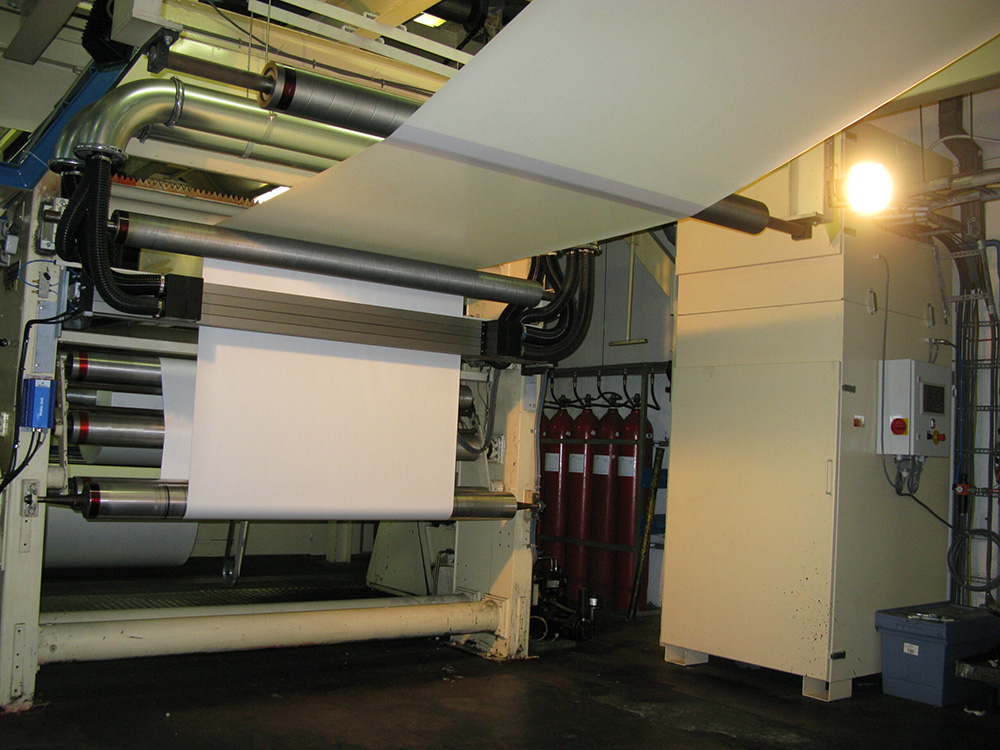
Sketch the short route between unpacking or removal of existing masking and the laminating nip. Include the support surface, operator handling, guides, film unwind, and any release-liner take-up. Mark where the face that will receive the new film becomes exposed.
If existing protective masking is removed, place the final cleaning assessment after that removal. Cleaning the outside of the old masking does not establish the condition of the face underneath. Keep discarded masking and its handling route away from the exposed surface.
Where a film construction includes a release liner, inspect the liner-separation area as a possible contamination source. For other constructions, inspect the exposed adhesive and unwind path appropriate to that film. Don't assume every protective film uses the same arrangement.
The proposed cleaning location should leave as few contamination opportunities as practical before lamination. However, placing a jet directly beside an unprotected adhesive surface may blow particles onto it. Review cleaning and collection together with the laminator supplier rather than choosing a location from available space alone.
Observe a normal stop and restart, too. A panel waiting between cleaning and lamination experiences a different exposure from one moving straight through. Specify how waiting panels are protected or reinspected before the film is applied.
Plastic surfaces can retain electrostatic charge and attract airborne dust. Removing protective film can generate charge, so a surface that looked clean immediately after peeling may attract contamination during the next handling step. Ordinary airflow may remove some loose particles while leaving others attached.
An Air Knife produces directed airflow; it is not automatically a static neutralizer. An ionizing device supplies ions to help neutralize surface charge. A complete arrangement may combine these functions, but their effectiveness must be assessed separately.
Grounding conductive machine parts remains part of proper equipment installation. It should not be treated as proof that charge on an insulating plastic surface has been removed. Discuss the actual panel, coating, and handling arrangement with the static-control supplier.
Use suitable measurement equipment and a repeatable measurement method to investigate where charge develops. Record the locations and conditions before and after masking removal, treatment, and transfer. A single reading taken at an arbitrary distance is not a useful basis for comparing different settings.
When ionization is proposed, confirm its working distance, coverage, exposure time, and performance-check method with the supplier. Supports or guards may obstruct treatment. Also determine how emitter condition and contamination will be checked during maintenance. A power light alone does not establish effective neutralization at the panel surface.
Loose dust and fibers are candidates for air blow-off. Grease, fingerprints, adhesive residue, or particles embedded in a tacky deposit require a different assessment. Increasing air delivery does not turn a dry particle-removal station into a degreasing process.
Inspect representative incoming material under consistent lighting before defining the station's duty. Record whether defects are loose particles, smears, pre-existing scratches, or coating irregularities. Where the classification is uncertain, have the material or process specialist identify it before approving a cleaning method.
Avoid rubbing a dusty optical face merely to make the inspection easier. For acrylic sheet, inappropriate dry wiping or unsuitable cleaners can damage the surface. A cleaning method accepted for one plastic grade cannot be assumed compatible with another plastic, printed layer, or hard coating.
If wet cleaning is necessary, obtain approval for the actual substrate, coating, and film adhesive. Define how residues and moisture will be removed before lamination. General-purpose anti-static sprays should not be introduced without checking whether the resulting surface condition is compatible with the film.
Contact cleaning may be worth evaluating where air alone does not meet the requirement. It needs its own checks for contact pressure, contamination transfer, marking, and maintenance. Neither contact nor non-contact treatment should be selected solely from a promise of cleaner-looking samples.
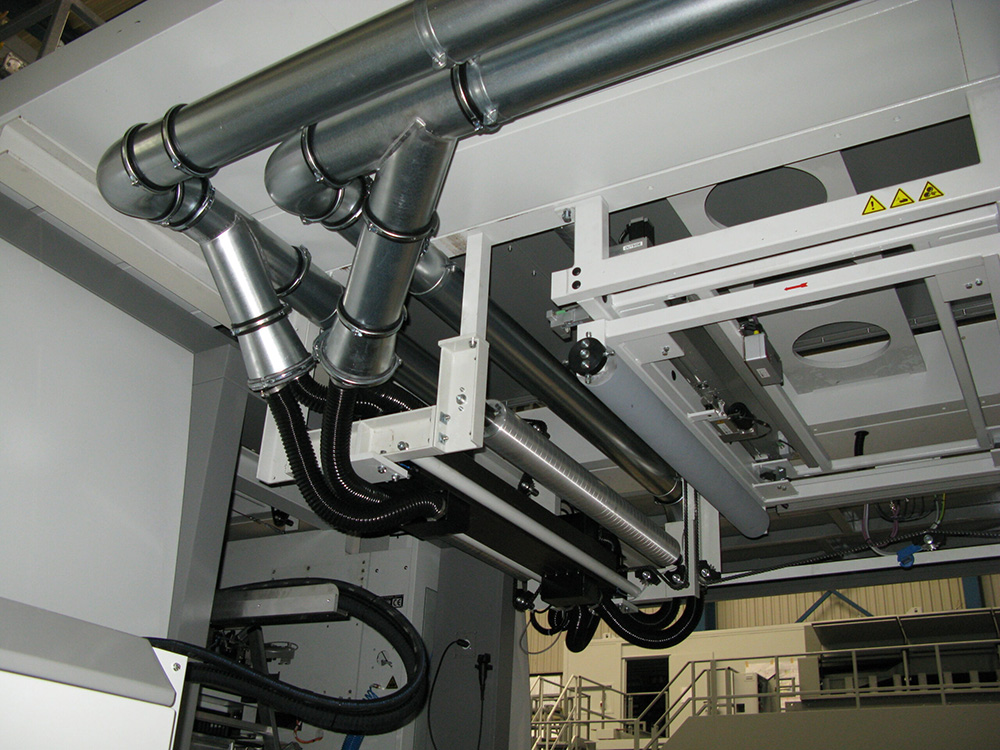
An open jet can move a particle off one panel and into the path of the next. The cleaning station needs a destination for the removed material. Assess a contained collection arrangement with suitable extraction and filtration for the contamination involved.
For a proposed air knife layout, direct the displaced material toward collection and away from the film, nip rollers, and clean incoming surfaces. Check the actual airflow pattern at normal extraction settings. A collection opening that looks close to the panel may still fail to capture material carried in another direction.
Keep supports and guides out of the cleaning path where practical, while maintaining stable transport. Check edges and corners as well as the center of the sheet. Thin panels need enough support to prevent movement or flexing that changes their distance from the outlet.
Set the working width around the panel's occupied lane and permitted sideways movement. If several outlets are used, inspect their combined coverage rather than assuming that nominal outlet lengths produce uniform treatment. Preserve access for cleaning and adjustment without exposing the product face to dirty tools or surfaces.
Air quality belongs at the point of use. For compressed air, assess particles, oil, and moisture in the delivered supply. For blower-fed equipment, review the intake environment, filtration, and downstream air path. Specify the required quality from the panel and lamination process; do not assume either supply is clean because it is available.
Start within the supplier's approved operating range and increase treatment only where observations justify it. Excessive panel movement, spreading contamination, or disruption of the film path indicates an arrangement that needs correction. There is no universal pressure or stand-off distance for every panel and fixture.
Before commissioning, agree on how particle defects will be judged on the finished panel. Define the viewing light, background, inspection area, observation distance, and any magnification. If limits are based on particle size or count, the quality team should specify the measurement method and permitted result.
Retain identified samples or images from the incoming surface, the cleaned surface, and the laminated panel. This record helps separate poor removal from contamination introduced afterward. It also prevents a change in inspection conditions from being mistaken for an improvement.
Not every visible feature beneath the film is dust. Entrapped air, wrinkles, film defects, and surface damage need separate diagnosis. Examine representative rejects using the approved inspection method before changing the cleaning settings. Do not use airflow adjustments to compensate for an unrelated film-application problem.
For dust removal before lamination, test the actual production combination: panel finish, thickness, film construction, handling method, and line speed. Include the permitted loading range and a stop-and-restart sequence. A slow demonstration with specially prepared parts cannot establish normal production performance.
Record air settings, outlet positions, extraction condition, and any ionization checks alongside the results. If film application changes at the same time, record that change rather than crediting the cleaner with the entire improvement. Compare accepted product output and rejects under sufficiently similar incoming conditions.
Use the approved record to decide when requalification is needed. A new coating, masking material, film adhesive, panel size, or support arrangement may change the task. Keep a defined response for suspect panels rather than repeatedly passing them through the station without inspection.
The operating instructions should identify which face is being prepared, where final cleaning occurs, and how panels reach the laminator without unnecessary handling. Specify the permitted settings and the action to take after a stop, an extraction fault, or a failed cleanliness check.
For plastic display panels that previously passed but now show more defects, compare the current process with that record. Check incoming contamination, masking removal, air delivery, collection performance, ionizer condition if fitted, and the film path. Investigate changes before simply increasing the airflow.
Maintain outlets, filters, collection equipment, and treatment devices according to their suppliers' instructions. Isolate equipment as required before servicing it, and avoid returning loosened maintenance debris to the product path. Recheck representative laminated panels after work that could change the cleaning result.
QXY Machinery offers industrial air knives and configurable air knife systems. For a pre-lamination inquiry, provide the panel dimensions, substrate and coating details, film type, line layout, throughput, and examples of the particle defects.
Ask QXY to review the air-delivery arrangement and integration requirements. Any ionization, dust extraction, filtration, or cleanliness performance required for the project should be separately specified and confirmed. General air knife information does not establish a validated optical-panel cleaning process.
You can assess cleaning the masking's exterior, but that does not qualify the underlying face for new film. If the original masking must be removed, inspect and prepare the exposed face afterward, with controls appropriate to any charge or contamination introduced during peeling.
Do not assume so. Environmental conditions may affect static behavior, but any humidity change must remain compatible with the materials and lamination process. Verify the actual surface-charge and cleanliness results rather than treating room humidity as proof of adequate control.
No. An assembly may add electrical sensitivity, openings, bonded layers, and manufacturer-specific restrictions. Its cleaning and electrostatic-control requirements need separate review. The acceptance criteria for an unassembled cover sheet should not be transferred automatically.
Send representative panels or approved samples, material and coating information, photographs of defects, the masking and film sequence, transport details, target speed, and the acceptance method. Identify available air and extraction services, and request confirmation of any additional static-control requirements.
Need a custom air knife solution? Send us your application details, material requirement ,or air source type . Our engineering team will help you select the right model.

Shenzhen Qixingyuan Machinery Equipment Co., Ltd.
info@airknifecn.com
Building 8, Wanfeng Third Industrial Zone, Xinqiao Street, Bao'an District, Shenzhen, Guangdong, China


