

Chemical waste often begins as a thin film on a part. The liquid leaves a cleaner, acid, etchant, plating bath, conversion stage, or rinse and travels forward on the product, rack, basket, sheet, or conveyor. Once mixed with the next liquid, the same material becomes harder to recover and more expensive to manage.
An Air Knife blow-off system removes much of that film while the liquid can still enter an approved return or segregated capture path. This is source reduction. It lowers the mass passed to rinsing and treatment rather than trying to separate the chemistry after it has been diluted and mixed.
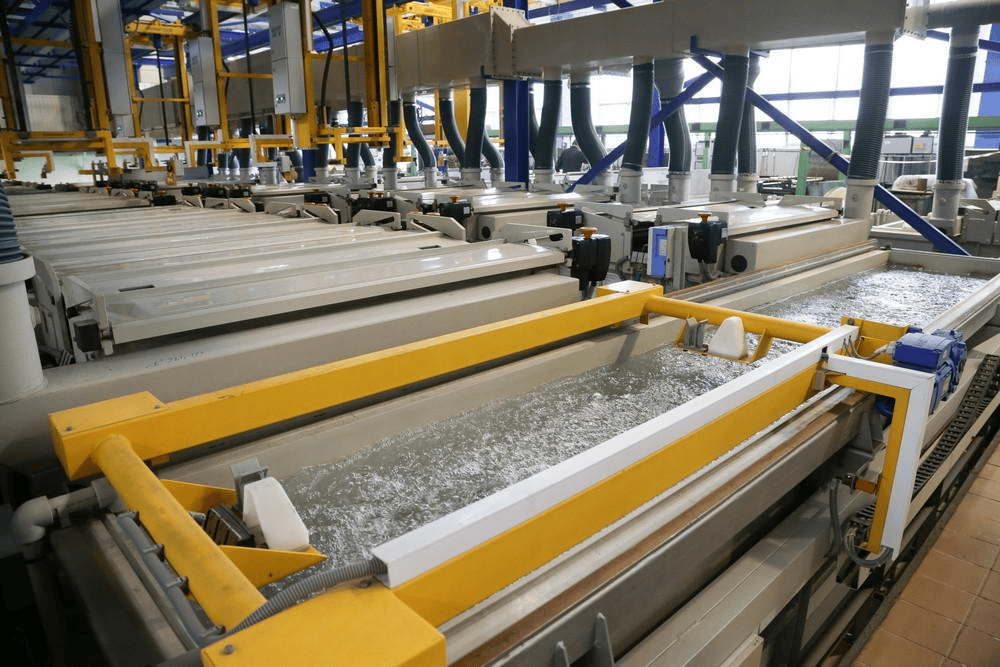
Wastewater treatment does not create the original chemical load. It receives material that escaped from production. When concentrated solution reaches a rinse, more water may be needed to hold the rinse within its limit. Treatment then needs neutralization chemicals, precipitation reagents, polymers, filtration, or other controls. Solids that were valuable or useful in the process can leave as sludge or filter waste.
A source-focused program therefore asks a different question: which liquid transfers can be prevented before dilution? An air knife is useful where free liquid remains on a moving load and where a controlled drain, catch tank, or return path can receive it.
Track chemical makeup that replaces solution carried out on parts and carriers. Normalize additions by rack, batch, square meter, or 1,000 parts. Raw purchase totals alone can hide improvement when production volume changes.
Carryover sets the incoming pollutant load for the first rinse. More load can mean higher fresh-water flow, faster conductivity rise, more frequent dumping, or extra rinse stages. Record rinse chemistry and water use against the same production unit.
Acid, alkali, coagulant, precipitant, and polymer use may rise with the chemical mass entering treatment. Lower flow does not always mean lower pollutant mass, so track both water volume and reagent consumption.
Dissolved metals and other constituents can become treatment solids. Salt buildup, corrosion debris, contaminated filters, spent absorbents, and floor-cleaning waste also belong in the ledger. These streams carry handling and disposal cost even when their volume looks small.
Chemical carryover can disturb the next bath, leave residue, cause stains, affect coating adhesion, or contaminate a clean surface. Rework consumes more chemistry and creates another pass through the waste-producing steps. Quality loss must be included in the waste calculation.
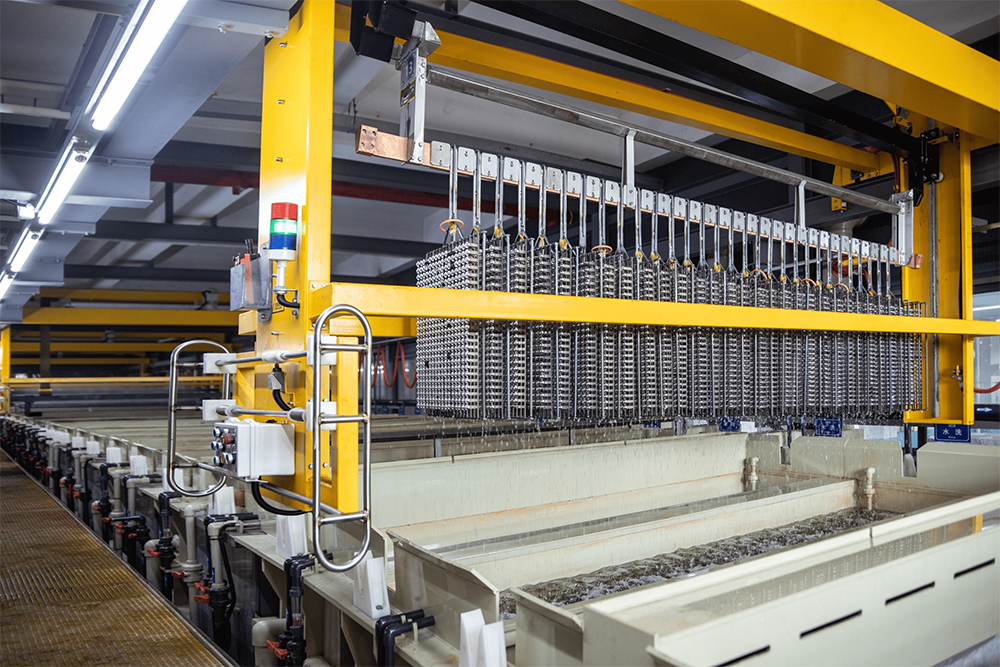
The preferred order is to prevent waste, recover compatible material, reuse it when approved, and treat only what remains. An air knife supports the first two levels. It reduces the amount leaving the process boundary, then directs the removed liquid to the intended destination.
Direct return may be suitable above the source bath or a sloped shield connected to it. A segregated vessel may be better when the liquid is diluted, contains mixed chemistry, or needs filtration and analysis. Some recovery streams cannot go back to the process at all. Chemistry ownership and volume balance come before a reuse decision.
The air sheet should push liquid toward an open edge, drainboard, catch tank, or enclosed recovery zone. Guards must stop splash without forming shelves that hold liquid and drip later. Drain surfaces need the correct slope, compatible construction, clean outlets, and enough capacity for the highest wet load.
Exhaust matters as well. A strong hood can pull the air stream and droplets away from the return point. Too little capture can allow aerosol to escape. Test the blow-off with normal ventilation running and inspect rims, bus bars, sensors, walls, duct surfaces, floors, and neighboring stages.
These values are practical starting points for blower-driven QXY systems. Final settings depend on liquid properties, product and carrier geometry, process tolerance, available dwell, exhaust, and chemical compatibility.
Control variable | QXY starting point | Waste-minimization reason |
Working distance | 20–50 mm for many blower-driven applications | Maintains impact while allowing safe clearance for product and carrier variation |
Impingement angle | 15°–45°, aimed toward the approved return or capture surface | Directs liquid into a known waste or recovery stream instead of the next stage |
Slot and pressure | 0.5–2 mm standard slot; 2–6 psi (0.14–0.42 bar) blower pressure | Provides a continuous air sheet; final setting comes from removal and mist testing |
Working width | Standard lengths 150, 300, 450, 600, 800, and 1,000 mm; custom lengths available | Covers the full wet envelope so edge positions do not remain a hidden waste source |
Inlet arrangement | Dual inlets normally used above 600 mm | Helps maintain distribution on wide conveyors, panels, and long racks |
Material | Aluminum, 304/316 stainless steel, PVC, or titanium after compatibility review | Prevents corrosion products, coating damage, or material failure from creating more waste |
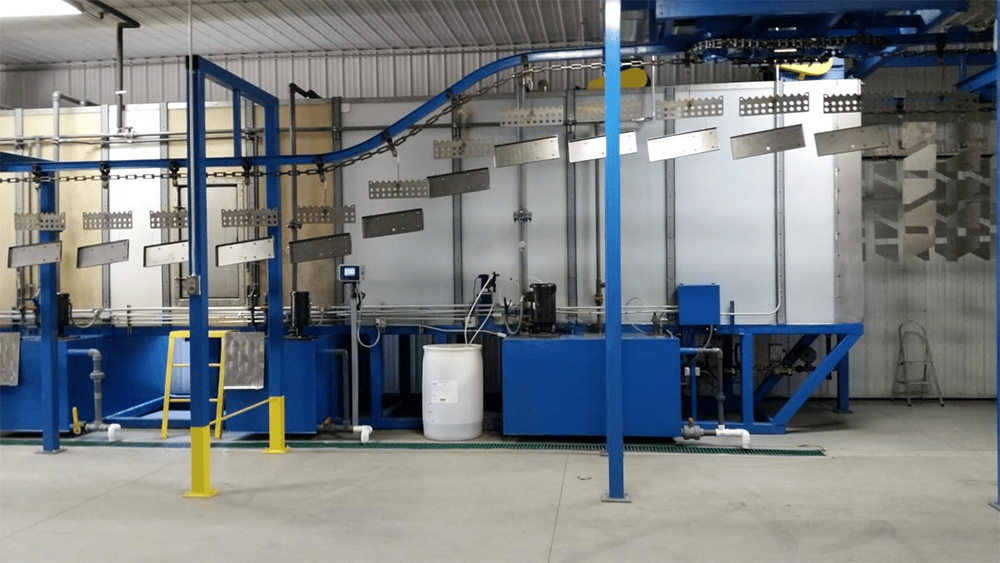
Gravity should remove heavy runoff first. Use a smooth withdrawal and a short drain period, then apply the air sheet to the remaining film and droplets. Higher pressure is not automatically better. Excess force can create mist, foam a bath, cool a heated surface, move light parts, or throw chemistry outside the capture boundary.
Broad open surfaces respond well to a continuous slot. Bores, threads, recesses, nested parts, rack insulation, and basket corners may need reorientation, rotation, indexing, or a second direction. The air knife should be tested with the densest approved carrier and the most difficult feature, not only with a flat sample.
The body, shim, fasteners, mounts, ducts, guards, and seals may see splash, vapor, washdown, and concentrated deposits. Aluminum alloy fits many general industrial positions with low chemical exposure. PVC can be a practical option near many low-temperature acidic or alkaline wet processes. Stainless steel or titanium may be needed when temperature, load, corrosion, or cleanliness requirements are higher.
Compatibility depends on the exact chemical, concentration, temperature, contaminants, cleaning method, contact time, and mechanical duty. A corroding or softening component creates debris, leaks, maintenance waste, and unplanned replacement. Material selection is part of waste prevention.
A poor installation can reduce one visible stream while increasing another. Aerosol may load the exhaust scrubber. Oil or condensate from the air supply may contaminate parts and baths. Recovered liquid from different chemistries may be mixed into a stream that is harder to reuse. Excess drying may cause oxidation, passivation, spotting, or residue.
Use suitable air filtration and drain the supply system. Define the allowable wetness before the next stage. Mark the approved liquid destination. Check whether added blower energy is proportionate to avoided chemical and treatment costs. Waste minimization is a total-system result, not a dry-surface result.
Choose a representative product family and hold line speed, withdrawal, drain time, bath condition, rinse flow, and load pattern as constant as possible. Before installation, measure retained-liquid mass or collected volume and record the five waste accounts. Repeat after the air knife has been tuned.
Use production-normalized data and enough cycles to capture normal variation. A useful avoided-cost calculation includes process chemistry, water and sewer, treatment reagents, sludge and filter disposal, labor, maintenance, energy, downtime, and rework. Do not claim savings from one short demonstration while bath levels and production mix are changing.
• Confirm that removed liquid reaches the approved recovery or waste stream.
• Check source-bath makeup and first-rinse concentration at comparable production.
• Track treatment chemical and sludge changes over a stable reporting period.
• Inspect the full width, all carrier positions, and the hardest-draining geometry.
• Verify surface quality and downstream process performance before releasing the setting.
Salt buildup can narrow the slot and change distribution. Filters load, ducts leak, brackets shift, drains block, and guards collect deposits. Include airflow, slot condition, drain-back surfaces, capture points, and air cleanliness in preventive maintenance.
Repeat the baseline check when the product, rack, basket, line speed, chemistry, temperature, exhaust, or air supply changes. The installation must remain effective at the current approved process, not only at the conditions used during commissioning.
QXY Machinery (Shenzhen Qixingyuan Machinery Equipment Co., Ltd.) is a high-tech enterprise integrating R&D, design, production, and sales. Based in Shenzhen, China, the company has more than 10 years of focused air knife experience for industrial drying, liquid removal, cleaning support, and wet-process equipment.
For chemical waste reduction, QXY Machinery supplies aluminum alloy, 304 and 316 stainless steel, PVC, titanium alloy, slot, small-hole, tornado, and dual-sided air knife systems. Length, slot width, inlet arrangement, mounting, material, and air source can be matched to the process boundary, chemical exposure, work envelope, and approved liquid destination.
A useful application request includes the source chemistry, receiving stage, part and carrier drawings, wet width, production rate, drain time, ventilation, available air source, recovery plan, material exposure, and the waste metric used for acceptance.
→ Contact QXY Machinery to review an air knife blow-off system for chemical waste reduction.
Q: How does an air knife reduce chemical waste?
A: It removes process liquid from parts and carriers before that liquid enters another bath or rinse, reducing dilution, treatment load, and chemical replacement.
Q: Can an air knife return all removed liquid to the process bath?
A: No. Direct return requires compatible chemistry, suitable cleanliness, and an acceptable bath-volume balance. Other liquid may need segregation, treatment, or disposal.
Q: Does higher air pressure always reduce more waste?
A: No. Excess pressure can atomize chemistry, increase exhaust loading, move parts, and create defects. Use the lowest stable setting that reaches the capture path.
Q: Which chemical processes benefit from air knife blow-off?
A: Common candidates include cleaning, acid activation, etching, plating, conversion coating, chemical stripping, PCB wet processing, and multi-stage rinsing.
Q: How should chemical waste reduction be measured?
A: Track retained liquid, process makeup, rinse loading, water use, treatment reagents, sludge, disposal, energy, rework, and production volume before and after installation.
Q: Which air knife material is suitable near acids or alkalis?
A: PVC, stainless steel, or titanium may be suitable depending on the exact chemistry, concentration, temperature, exposure, load, and cleanliness requirement.
Q: Can blow-off create a new waste or safety problem?
A: Yes. Poor direction or excessive force can create mist, floor contamination, mixed waste, air-system contamination, or surface damage. Capture and verification are essential.
Need a custom air knife solution? Send us your application details, material requirement ,or air source type . Our engineering team will help you select the right model.

Shenzhen Qixingyuan Machinery Equipment Co., Ltd.
info@airknifecn.com
Building 8, Wanfeng Third Industrial Zone, Xinqiao Street, Bao'an District, Shenzhen, Guangdong, China


