

A finishing line can clean, rinse, plate, pickle, passivate, phosphate, or anodize at the planned rate, then lose capacity at drying. Racks queue after final rinse. Conveyor speed drops because one recess stays wet. Parts that look dry release a drop during inspection and return for rework.
Air knives can shorten the free-water part of that delay. The real job, though, is reducing drying bottlenecks in metal finishing operations without moving the constraint somewhere else. A faster dryer is not useful if it creates mist at the next station, leaves chemistry in blind holes, marks delicate parts, or raises the reject rate.
Start the clock when the part leaves its last wet stage. Stop it when the next process accepts it. Record drain dwell, transfer, blow-off, hot-air or vacuum time, cooling, inspection, touch-up, rework, and the queue before each step.
This timing separates a slow drying device from a slow drying system. A hot-air oven may have spare capacity while racks wait for unloading. An Air Knife may clear open faces in seconds while one downward-facing blind hole controls the release time. A camera may be the real hold because moving droplets cause false defects.
Run the study by product family. Stampings, cast housings, threaded parts, extrusions, and baskets of hardware carry water differently. A plant-wide average hides the constraint that sets the schedule.
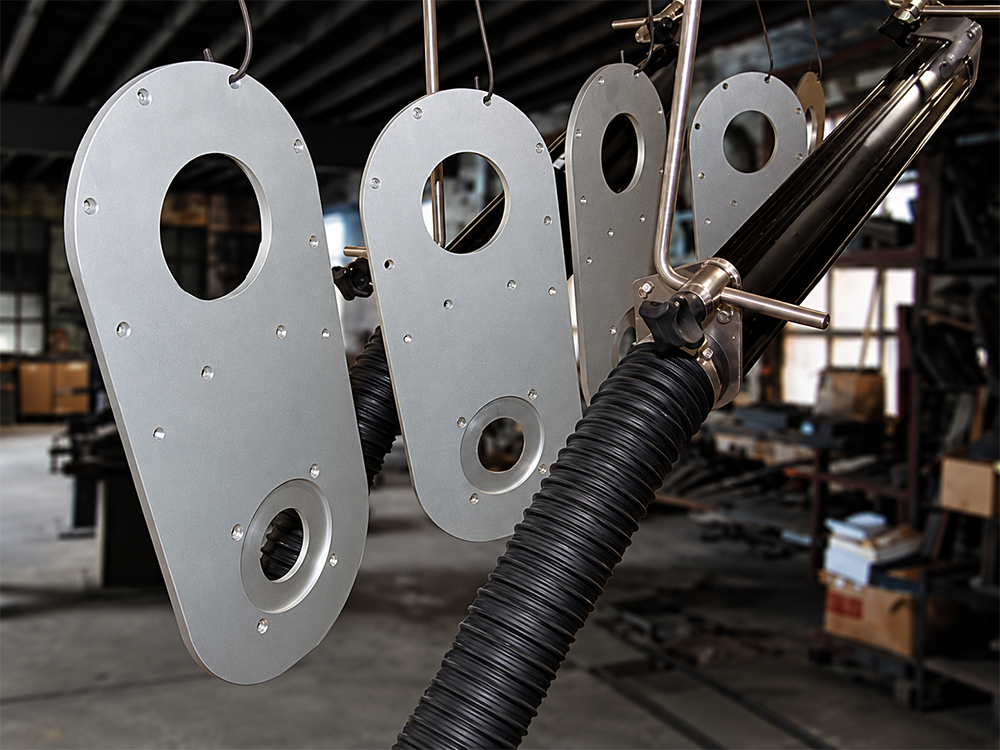
Liquid continues to leave pockets, overlaps, holes, rack contacts, and lower edges after withdrawal. The US EPA notes that part geometry and liquid viscosity affect drag-out and drainage. More dwell may help, but every extra second at a hoist position consumes line time. Reorientation or a better hanging angle can be worth more than extra air.
A mobile film on an open face is the easiest load to remove. This is where a full-width air knife earns its place. It shears water toward an edge or collection zone before heat is used. Less liquid reaches the evaporative stage.
Blind holes, ribs, threads, tubes, deep bores, and stacked parts can stay wet after the main surface clears. Air must reach the liquid and give it an exit. Ecoclean describes a similar split in complex-part cleaning: high-speed air removes most adhering medium, while vacuum drying handles moisture left in cavities and recesses.
Hot air is useful for the thin film that remains and for surfaces that need a defined temperature. It is an expensive first step for large droplets. If the oven is the constraint, use drainage and air-knife blow-off to reduce its incoming water load before raising temperature or extending length.
Water spots, flash rust, staining, trapped rinse chemistry, coating defects, unstable vision results, and wet packaging can send nominally dry parts backward. A cycle-time improvement only counts when these losses remain controlled.
Water cannot be blown out through solid metal. Turn cup-shaped features downward when the process permits. Avoid nesting flat parts. Give tubes and bores a drain path. On racks, leave enough spacing for the air sheet to reach the work instead of striking the first row and shielding the rest.
For baskets or bulk parts, contact changes with every load. Rotation, indexing, tumbling, or a second angle may be needed. A fixed knife can dry the exposed layer while water remains between components. That is a handling limit, not a pressure shortage.
Record the approved loading pattern. If operators add more parts to a rack to improve upstream output, they may quietly create the drying bottleneck again.
Place blow-off where removed liquid can return to the correct tank or approved collection point. The air stream must work with exhaust capture, not push chemical mist into the aisle or neighboring bath. Moving racks may need angled knives from more than one side, plus a short indexed dwell for the hardest geometry.
Upper, lower, and side knives can clear faces, edges, and belt contact zones. A lower knife must drain away from the product instead of throwing water back through the mesh. QXY drying systems combine knives, adjustable supports, splash protection, collection trays, conveyors, and controls for this reason.
A rotating drum or controlled cascade exposes more surfaces than a static pile. The air system must also contain loose parts and avoid impact damage. Very small threaded or cupped components may still need heated media, centrifugal drying, or another bulk-specific method.
Continuous material makes line balance easier to measure but raises the importance of uniform airflow. A weak zone across the width leaves a repeating wet band. Round wire and tube may need annular coverage; flat strip can use opposed or staged slot knives.
A blower-driven air knife usually fits continuous, wide-area water removal. It supplies high-volume, low-pressure air and avoids running a large full-width station entirely on plant compressed air. Compressed air still makes sense for short, intermittent, or tightly targeted jets when the utility, air quality, and operating cost are acceptable.
Treat blower, duct, filter, inlet count, and slot as one system. A larger motor cannot fix poor ducting, an unbalanced manifold, a clogged filter, or excessive working distance. Measure inlet pressure while air is flowing.
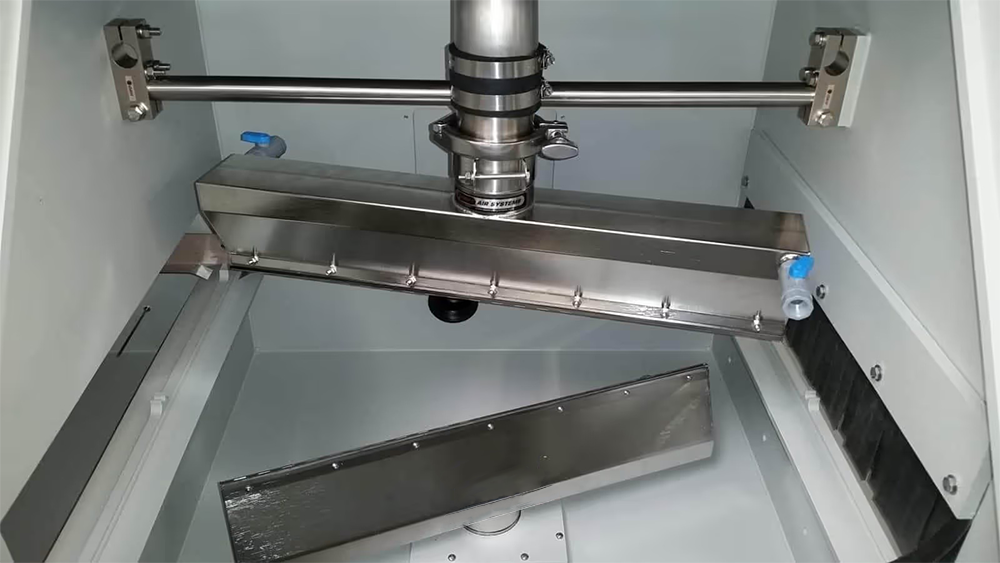
QXY Air Knife - Metal Finishing Trial References | |
Blower inlet pressure | 2-6 psi (0.14-0.42 bar) as a general blower-driven reference |
Slot gap | 0.5-2 mm standard range for many industrial drying duties; set for the project |
Starting position | 20-50 mm working distance and 15-45 degree angle in many blow-off trials |
Length and inlet layout | Standard lengths 150-1,000 mm; custom to 6,000 mm; dual inlets commonly used above 600 mm |
Uniformity reference | +/-5% target across QXY standard aluminum air knives |
A useful sequence begins with gravity and orientation, then removes the exposed water film with a broad air sheet. A second angle or focused jet targets known recesses. Heat or vacuum finishes the moisture that airflow cannot reach. The last step verifies the surface condition needed by coating, assembly, inspection, or packaging.
This staging reduces peak air demand and makes faults easier to diagnose. If open faces are wet, inspect the main knife. If only one bore fails, work on access and orientation. If every surface is visually dry but coating adhesion fails, review rinse cleanliness and surface condition rather than adding pressure.
Aggressive blow-off can create mist that loads exhaust, wets sensors, or settles on finished parts. It can move loose chips into another critical surface. It may shift lightweight pieces, cool a part that must stay warm, or increase noise beyond the site limit. Each of those effects can produce a new hold.
Supply air also matters. Oil, condensate, rust, or particles from a compressed-air line or dirty blower intake can undo the final rinse. Use filtration and intake placement that match the required surface condition. In chemical zones, review the knife body, shim, seals, fasteners, brackets, and ducts for the actual vapor and splash exposure.
Run a production baseline. Record accepted parts per hour, queue length, drain time, blow-off time, thermal or vacuum dwell, touch-up, re-dry count, wet rejects, and utility use if available. Mark wet locations on the part drawing.
Commission the new layout at normal and maximum approved loading. Change one variable at a time: orientation, knife angle, distance, blower output, line speed, or targeted jet. Repeat starts, stops, product gaps, rack changes, the most difficult part family, and the highest incoming water load.
Keep the improvement only if accepted output rises and the downstream checks stay within limit. Lock recipes by part family, mark bracket positions, and define inspection after filter service, slot cleaning, rack changes, or duct work. Bottlenecks return when setup becomes tribal knowledge.
The useful result is a balanced line with fewer queues and fewer wet returns. Air knives reduce the bulk-water load quickly. Orientation exposes the liquid. Heat or vacuum handles what remains. Quality checks confirm that faster really means finished.
QXY Machinery (Shenzhen Qixingyuan Machinery Equipment Co., Ltd.) is based in Shenzhen, China, and integrates R&D, design, production, and sales. The company has more than 10 years of focused experience in industrial air knife drying, water blow-off, cleaning, and surface-treatment applications.
For metal finishing lines, QXY Machinery can review part geometry, rack or conveyor layout, working width, line speed, liquid load, chemistry, material exposure, utilities, and the required dry endpoint. Relevant options include aluminum alloy, stainless steel, PVC, titanium, blower-driven, compressed-air, ring, tornado, small-hole, and air-to-air configurations, together with blowers, ducts, supports, shields, trays, conveyors, and controls.
Q: How do air knives reduce drying bottlenecks in metal finishing operations?
A: They remove exposed free water before thermal drying, shorten the liquid load sent to the next stage, and can target surfaces that would otherwise need manual blow-off. The gain must be measured as accepted output.
Q: Can an air knife dry blind holes and deep cavities?
A: Only when airflow reaches the liquid and the liquid has an exit. Deep or closed cavities may need reorientation, a focused jet, more drain time, heat, or vacuum drying.
Q: Should an air knife replace a hot-air dryer?
A: Not always. Air knives are strong bulk-water removers. Hot air can finish thin films or provide process temperature, while vacuum drying may be better for moisture trapped in complex cavities.
Q: Is more pressure the fastest way to improve throughput?
A: No. More pressure can create mist, noise, part movement, and re-wetting without reaching hidden water. Check orientation, access, distance, angle, drainage, and blower matching first.
Q: Where should the air knife be installed on a metal finishing line?
A: Install it after the relevant rinse or wash stage where removed liquid can drain to an approved collection point, and before the process that requires a dry or stable surface.
Q: Which air knife type suits irregular metal parts?
A: The answer depends on geometry. Slot knives suit open faces, ring knives suit wire or tube, tornado or multi-angle layouts suit complex surfaces, and focused nozzles can address a known bore or recess.
Q: What data should be collected before buying an air knife system?
A: Collect part and rack drawings, product mix, line speed, liquid and chemistry, wet map, loading pattern, current drying times, queue data, air utilities, material exposure, installation space, and the dry acceptance method.
Need a custom air knife solution? Send us your application details, material requirement ,or air source type . Our engineering team will help you select the right model.

Shenzhen Qixingyuan Machinery Equipment Co., Ltd.
info@airknifecn.com
Building 8, Wanfeng Third Industrial Zone, Xinqiao Street, Bao'an District, Shenzhen, Guangdong, China


