

The last water disappears from a polished slab, but a pale outline remains where a puddle stood. On another slab, a broad streak follows the washing direction. Both defects appear after drying, yet they may need different corrections.
To dry stone slabs without leaving new surface marks, control what remains in the rinse water as well as how that water leaves the surface. An Air Knife can help remove free water before it evaporates in place. It cannot repair a chemically etched finish or make dirty rinse water clean.
For a stone-processing line, the practical task is to separate the washing problem from the drying problem. Start with a small, controlled comparison on representative material, then use the result to specify the rinse, air delivery, handling, and release checks.
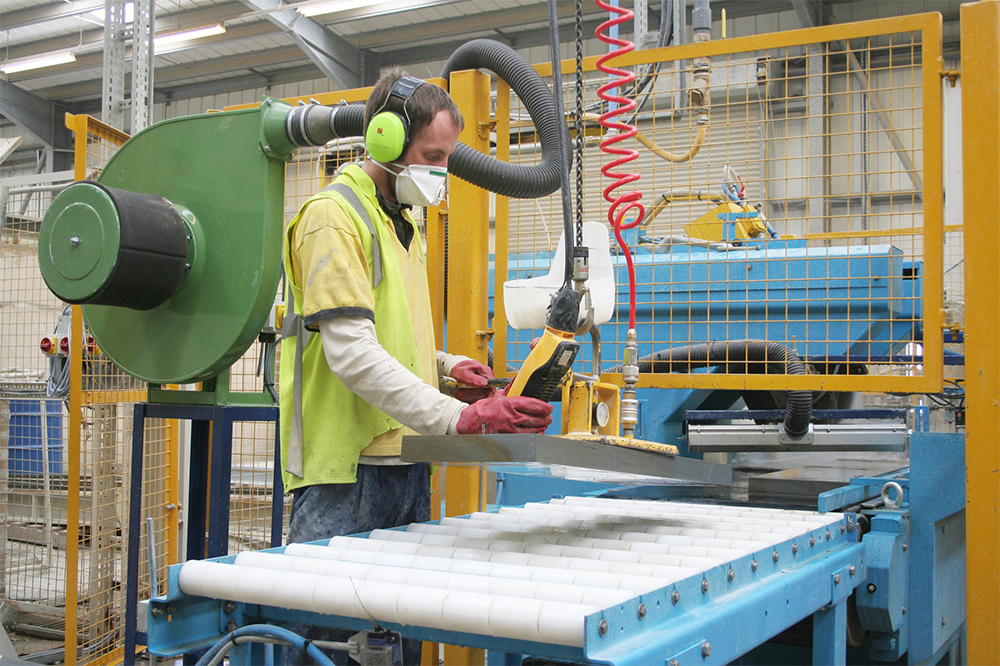
Identify the slab material and surface treatment before changing the process. Natural marble, granite, engineered quartz, and sintered surfaces should not automatically share one cleaning or heating recipe. Record the actual product, finish, resin or sealer treatment, and supplier restrictions.
Choose an acceptable reference surface from the same material and finish. Examine it under the lighting used for final inspection, including an oblique view that reveals streaks. Photograph existing veins, repairs, scratches, and gloss variations before the trial so they are not later counted as drying defects.
Define acceptance at the intended destination. A slab going to visual inspection may need a uniform appearance with no visible droplets. A slab going to bonding, coating, or sealing also needs to meet that process's surface and moisture requirements. A dry-looking face alone does not prove those requirements have been met.
Agree on when to inspect. An immediate check and another after the normal holding interval can distinguish marks visible at the dryer exit from changes that become apparent later. Keep the viewing conditions consistent rather than comparing a brightly lit trial sample with a slab in a dim storage area.
Use representative offcuts or approved trial slabs with the same finish and similar initial condition. The following comparison is a proposed troubleshooting method, not a report of a completed production trial. Keep the cleaning chemistry, washing method, and inspection conditions unchanged unless they are the variable being investigated.
First compare the normal final rinse with a fresh rinse of documented quality that the stone supplier accepts. Apply the same drying method to both. If the fresh-rinse sample has fewer marks, investigate the existing rinse supply, carryover, or cleaning residue before changing the dryer.
In a separate comparison, hold rinse conditions constant and compare the current drying method with the proposed water-removal arrangement. Keep the delay between rinsing and treatment comparable. This helps reveal whether prompt removal improves the appearance without confusing the result with a different water supply.
Repeat the comparisons rather than relying on one attractive sample. Record which face was treated, rinse conditions, washing chemistry, waiting time, drying method, and the resulting mark pattern. Natural variation makes matched samples and repeated observations more useful than a single before-and-after photograph.
Where a clean, soft cloth is approved for a small reference sample, it can provide a controlled comparison with mechanical drying. Use it only on a properly rinsed surface and replace it when contaminated. A hand-finished reference is useful evidence, but it does not demonstrate that manual wiping is practical at production throughput.
Keep this investigation separate from a purchase acceptance trial. It identifies the likely process contribution; it does not establish the capacity, air demand, or operating range of a proposed drying station.
Water spots can be deposits left when water evaporates. A ring-shaped outline is a reason to investigate the water and its drying history, not proof that the air supply is too weak. Removing water sooner may reduce the opportunity for deposits to remain, but dissolved material is not eliminated merely by blowing air over it.
A film or streak can also come from cleaning residue. Check detergent dosing and rinsing before increasing temperature or air delivery. Stronger chemical treatment is not an appropriate default response; some stone surfaces can be dulled or etched by unsuitable cleaners.
A dull patch that persists after approved cleaning needs a surface-condition assessment. Etching and scratches involve damage to the finish, and air knife drying will not restore that finish. Refer uncertain marks to the stone supplier or a qualified finishing specialist rather than repeatedly adjusting the dryer.
Patterns can help locate the source without proving it. A line that repeats at a roller position warrants a contact inspection. Spots appearing beneath an overhead support warrant a drip check. Mark the locations on a sketch and compare them with the equipment before deciding which component to alter.
If a patch changes during holding, document that change and investigate moisture and material condition. Do not automatically classify every dark area as remaining surface water or every pale area as a mineral deposit. The diagnosis should be specific enough to justify the corrective action.
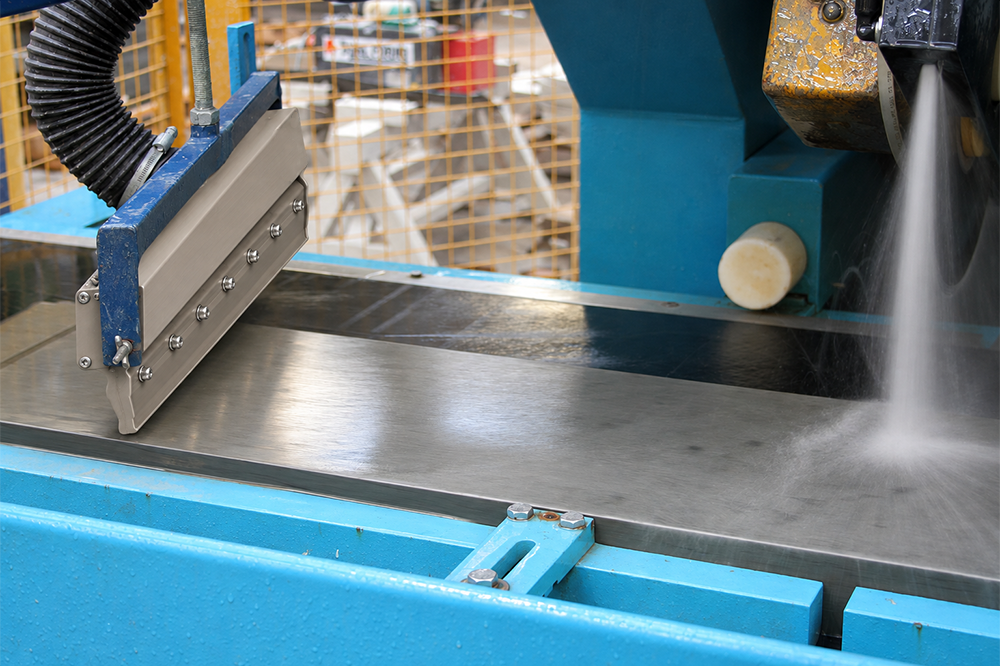
An air knife directs a sheet of air across an exposed surface. For slab drying, its role is to move free water toward a collection route. A useful layout answers two questions: which surface will the air reach, and where will the displaced water go?
On a horizontal line, trial an outlet direction that carries water toward an accessible edge and collection area. Watch for water gathering at the opposite edge or returning onto a treated area. The correct arrangement depends on slab presentation; there is no single mounting angle that suits every line.
Check coverage across the slab's occupied width, including permitted sideways movement. With multiple outlets, inspect the areas between their treatment zones as well as the center of each zone. Include the leading and trailing edges, where water removal may differ from the middle of a long slab.
Thickness changes alter the clearance from a fixed outlet. Retain settings for the intended thickness range, and verify that fixtures and guides keep the slab in the approved position. Do not improvise tilting or unsupported transfers to improve drainage; slab support and handling must remain suitable for the load.
The underside needs its own decision. Rollers and belts can shelter wet areas or transfer moisture back after the top face passes inspection. Identify whether underside dryness is required and assess access around the supports. A top-mounted air knife alone should not be credited with treating a hidden lower face.
Match the air supply to the complete arrangement. Ask for the operating duty with all outlets connected and working, not just a blower motor rating. Review intake location and filtration so workshop contamination is not introduced onto the washed surface.
Avoid using the station to blow off dry stone dust or accumulated slurry. Remove processing residue through the approved wet-cleaning process first. Airborne stone dust can present a silica exposure risk; the site must assess containment, extraction, cleaning, and operator access for the proposed installation. A blower-fed system does not remove the need for that assessment.
Once the trial identifies an acceptable rinse and water-removal combination, inspect what touches the slab afterward. Check rollers, belts, stops, lifting contacts, and packing separators against the observed defect pattern. A clean dryer exit is only one inspection location.
For stone slab drying before packing, compare the surface at the exit with its condition after the normal transfer and holding sequence. If a mark appears only after contact, investigate that contact rather than increasing the upstream air setting. Include the underside and edges where they matter to the customer's finish requirement.
Document the handling sequence used to dry stone slabs successfully, including any permitted drainage interval. Run at the required production rate and loading pattern. A result obtained by giving every slab extra manual attention should not be treated as an automatic-line result.
Keep drainage channels and splash collection accessible for cleaning. Inspect them during sustained operation, when water and residue have had time to accumulate. A drip from a wet support or a contaminated roller may not appear in a short trial on freshly cleaned equipment.
Heating, if proposed, needs separate approval for the stone product and any resin, coating, or backing involved. More heat cannot be assumed to prevent water spots. Confirm the permitted temperature conditions and the required moisture state with the material and downstream-process suppliers before adding a thermal stage.
Provide the drying-system supplier with the material and finish, slab dimensions and mass range, support arrangement, rinse details, target throughput, and available installation space. Include photographs of the defects and the controlled-comparison results.
Request an acceptance trial against the agreed reference finish. State which faces and edges are assessed, when inspection occurs, and what subsequent handling is included. Record outlet position, working clearance, conveyor speed, air setting, and incoming conditions so the result can be reproduced after changeover.
QXY Machinery supplies industrial air knives and integrated drying systems with configurable air delivery, conveyors, adjustable supports, splash protection, and liquid collection.
For a stone-slab inquiry, provide the support and load requirements alongside the surface-quality target. Ask QXY to review the proposed arrangement and trial scope. A general drying-system description does not establish suitability for a particular slab weight or guarantee a mark-free finish.
Can an air knife dry stone slabs before sealer application?
It may remove free surface water, but the sealer's preparation and moisture requirements still govern release. Confirm the required condition for the actual stone and product. Do not apply sealer solely because the face looks dry after blow-off.
Is deionized water necessary for every final rinse?
Not automatically. Compare the existing water with an approved alternative and assess the effect on the actual finish. Specify water treatment from the demonstrated problem and process requirements, rather than treating one water type as a universal solution.
Will a non-contact dryer prevent every scratch?
No. Removing a wiping contact does not remove risks from grit, guides, rollers, or handling equipment. Inspect the full route and the condition of contact surfaces. Existing scratches also remain after surface water is removed.
Should polished and textured slabs use the same settings?
Only if trials support that choice. Surface texture, thickness, presentation, and water retention can change the result. Establish an accepted reference for each finish and verify the rinse, drying, and handling sequence before sharing an operating recipe.
Need a custom air knife solution? Send us your application details, material requirement ,or air source type . Our engineering team will help you select the right model.

Shenzhen Qixingyuan Machinery Equipment Co., Ltd.
info@airknifecn.com
Building 8, Wanfeng Third Industrial Zone, Xinqiao Street, Bao'an District, Shenzhen, Guangdong, China


