

A wet patch beneath a tray at the cartoner does not tell you where the drying process failed. Water may have travelled there in the tray's base recesses, transferred from a wet conveyor, or dripped from a guide after the tray passed through the air stream.
Air knives can reduce water carryover by moving free surface water into a collection area before it reaches the next operation. For a ready-meal tray conveyor, the useful question is which surface carries the water across that boundary. Drying the lid alone may leave the main transfer route untouched.
This article focuses on external water around meal trays and their conveyors, especially sealed packs leaving a wet operation. It does not assume every ready-meal line washes its filled trays. The installation must follow the actual process, package design, and hygiene requirements.
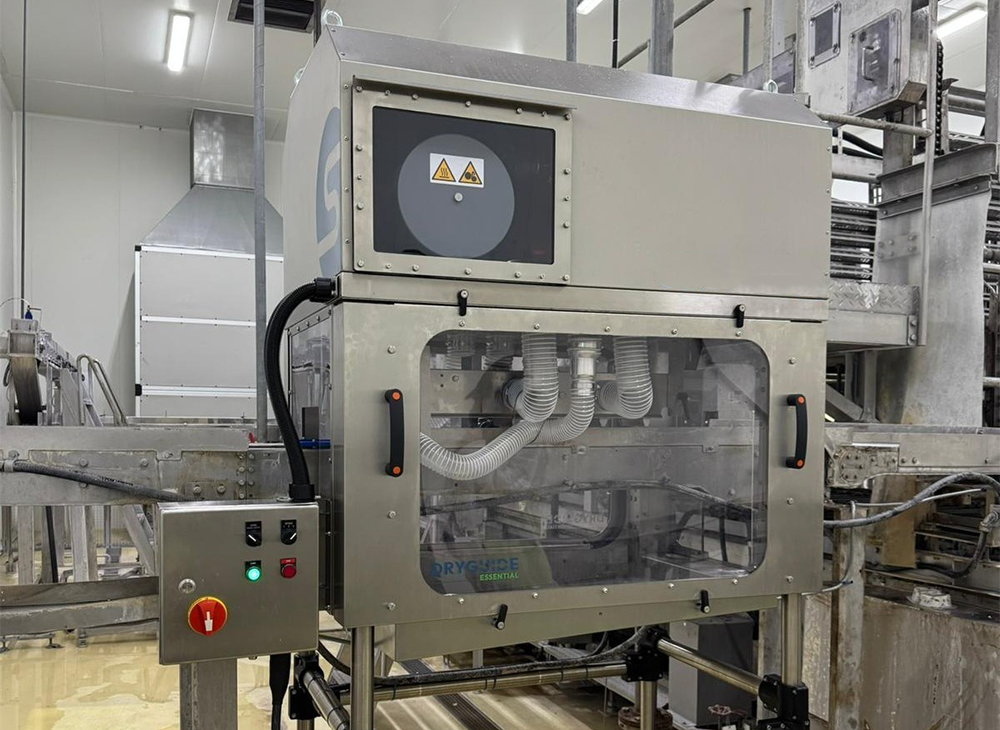
Sealed meal trays, empty reusable trays, and open filled trays present different decisions. Equipment selected for one condition should not be transferred to another simply because the containers have similar dimensions.
For an intact sealed pack, an air knife can be assessed for removing water from the lid, sidewalls, external rim, and base. The package still needs to tolerate the proposed handling and airflow. Include film movement, tray stability, and the condition of the closure in the trial.
An empty reusable tray or carrier leaving a washer needs attention to any surface that will contact food or clean packaging. Check how it drains and how it is stored or returned to production after drying. A surface that looks dry has not, by that observation alone, passed its cleaning and sanitation requirements.
An open filled tray creates a direct food-exposure problem. Air directed at its rim could move sauce, crumbs, allergens, or droplets across the food or sealing area. Such an application needs a separate review of the product, air quality, and hygienic controls. It should not be treated as ordinary external package drying.
Also establish whether the liquid is process water. Unexpected moisture around a closure could indicate leakage. If its origin is uncertain, follow the site's package inspection and segregation procedure before adjusting the dryer. Blowing away the evidence would leave the underlying defect unresolved.
The term ready meal does not define the food-safety classification. Products intended to be eaten directly and products requiring cooking may need different controls. Use the site's actual classification when deciding where the station belongs.
The lid is easy to inspect and often receives the first air stream. Tray geometry can place the remaining water elsewhere: beneath an external flange, around formed feet, between base ribs, or at a low point in a recessed bottom.
Look at the whole package in its operating orientation. Examine sample trays after the wet operation and after each transfer. A droplet that stays in a recess on a straight belt may be released when the tray changes direction or crosses a transfer plate.
An overhead knife can address exposed upper surfaces. Side-directed air may reach an external lip or wall. Access to the base depends on the conveyor and support arrangement; a solid belt blocks direct airflow from below while the tray remains on it.
An open conveyor or a designed transfer section may provide access to the underside, but supports still create sheltered areas. Any change must preserve stable transport and the required cleaning access. Do not create an uncontrolled gap or tilt a filled package solely to expose a wet corner.
The direction of removal matters as much as coverage. Air should move water out of the feature toward the collection area. An air stream that pushes liquid around a rim without giving it an exit may leave a different wet spot rather than solve the problem.
Allow for tray variation. A shallow tray, a deep tray, and a tray with a different foot pattern may require different outlet positions even when their top dimensions match. Record the approved settings against the packaging format rather than assuming one lid-width setting covers every pack.
Air supply must be checked for the arrangement as a whole. More outlets, longer active slots, and different connecting hoses change the required operating conditions. Ask for the supply requirement for the installed configuration instead of selecting by motor power or a pressure reading alone.
Consider a hypothetical line where trays leave the blow-off station with acceptable lids and bases, yet wet patches develop at the next conveyor. If the receiving belt is already wet, another knife above the tray may offer little improvement. The belt is now part of the carryover route.
Water can remain on the carrying surface, collect around belt features, or move with the return side of the conveyor. Guides and transfer components can also pass liquid back to the tray. Inspect these parts under sustained operation; an initially dry belt may become wet after repeated transfers.
Conveyor water removal may need its own position and collection arrangement. Depending on the belt construction, that could involve treatment after a wash section or on an accessible return section before the belt meets the packages again. Confirm the location with the conveyor supplier and the sanitation team.
A tray knife and a belt knife have different targets. The tray knife must reach package features without disturbing the pack. The belt treatment must address the belt surface and its water path without throwing liquid onto packages, bearings, sensors, or adjacent equipment.
Check the handover between conveyors as a separate location. A transfer plate can collect water even when both belts appear acceptable. A local drip may need repair or drainage rather than another air outlet.
When both routes contribute, deal with both. Otherwise, trays can wet the belt and the belt can wet later trays in a continuing cycle. The improvement should be judged after several normal transfers, not only as the package leaves the first air stream.
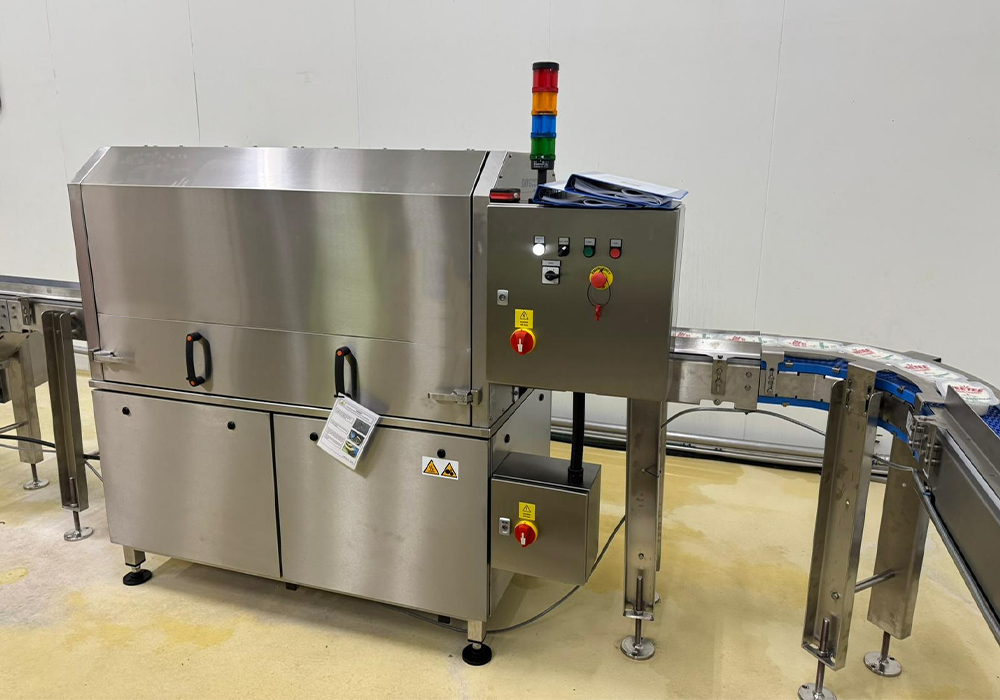
An air knife redistributes liquid. A successful station keeps that liquid within a reviewed collection area and provides a route out. If water lands on the floor, the next lane, or a clean packaging surface, carryover may have been relocated.
Plan the collection tray and drainage around the expected water load. Check low points, access for cleaning, and places where debris could restrict the outlet. Include the wettest expected production condition when assessing whether the collection arrangement works.
An enclosure can help control splash, but its internal surfaces must also drain. Inspect the roof, supports, and outlet area for accumulating droplets. A cover that later drips onto packages can undo the work of the air knives.
Review the direction of air leaving the station alongside the site's hygiene zones. Avoid moving wet air or spray toward exposed food or clean food-contact equipment. Any proposed extraction or connection to room ventilation needs to be assessed as part of that airflow plan.
The air source deserves the same review. Specify intake location, filtration, accessible air passages, and maintenance requirements for the intended contact. Do not assume that compressed air is suitable because it is available, or that a blower system is hygienically acceptable without checking its intake and downstream components.
Air blow-off removes free water; it does not replace cleaning or remove the need for sanitation verification. If sauce or food residue is present, increasing airflow can spread it. Correct the contamination source and follow the approved cleaning procedure before evaluating surface drying.
Choose the acceptance point according to the reason for the project. A labeler needs the specified label area in suitable condition for the selected adhesive. Coding equipment needs the print surface required by its process. A sleeve or carton operation may be affected by water released from the tray base after another transfer.
Write a measurable or clearly observable pass condition with the quality and packaging teams. Examples include no visible free droplets in agreed external features, no water transfer under a defined inspection method, or acceptable labeling and coding results. Different products may require different checks.
Compare the current process and proposed arrangement using similar tray formats, incoming wetness, loading, and speed. Record where water appears, the proportion of packs needing intervention, and downstream interruptions. If quantitative carryover measurement is needed, establish a controlled sampling method rather than weighing filled trays with uncontrolled product variation.
Use collection data carefully. More water in the dryer drain can mean better capture, but it can also reflect wetter incoming packs. Judge it against incoming conditions and water reaching the downstream boundary.
Trial the full lane arrangement and normal accumulation conditions. Side-by-side packs can shield edges, while unstable spacing can change exposure. Check lightweight formats and film behavior as well as the packages with the deepest recesses.
Assess a sustained run after the equipment has warmed up and the conveyor has reached its normal wet condition. Then repeat the important checks after cleaning and reassembly. The final settings should reproduce the result without depending on an operator continually moving the knives.
If labels improve but cartons remain wet, keep investigating the base and transfer route. If the packages pass but spray reaches another area, containment still needs work. Approval should cover package condition, downstream performance, and the destination of the removed water together.
QXY Machinery supplies air knives and integrated drying systems with configurable conveyors, blowers, adjustable supports, splash protection, water collection, and controls. Its published application scope includes trays, carriers, packaging containers, and food-packaging duties where suitable materials and cleaning requirements are specified.
For a ready-meal tray project, send QXY the package drawings, closure type, operating orientation, conveyor layout, wet-process details, and required downstream condition. Show the underside and external rim as well as the lid.
No. External airflow does not directly reach moisture inside an intact sealed pack. Internal condensation needs a review of product temperature, headspace, packaging, and the process conditions. Increasing outside airflow is not a demonstrated solution to that separate issue.
Treat it as a package with a possible route for air or liquid to reach the contents. Review the opening, airflow direction, and product exposure with the packaging and food-safety teams. Do not assume that a covered tray provides the same protection as an intact sealed pack.
Not automatically. Its suitability depends on what it contacted and the treatment, separation, and water-quality controls of the receiving process. Keep collection and reuse as separate design decisions and obtain approval for any recirculation arrangement.
No. It may remove visible liquid without correcting the seal. Leaking or suspect packs should follow the site's inspection and rejection procedure. Seal integrity must be evaluated independently of exterior dryness.
Review more than the outline dimensions. Check stiffness, surface features, film behavior, support requirements, and permitted air exposure. Trial the new package at the required production condition and retain a separate approved recipe if the settings differ.
Need a custom air knife solution? Send us your application details, material requirement ,or air source type . Our engineering team will help you select the right model.

Shenzhen Qixingyuan Machinery Equipment Co., Ltd.
info@airknifecn.com
Building 8, Wanfeng Third Industrial Zone, Xinqiao Street, Bao'an District, Shenzhen, Guangdong, China


