

Fruit can leave a wash section clean but still carry droplets into grading cups, transfer belts, and packing trays. If operators must slow the line or hold fruit for drainage, surface-water removal becomes a production constraint.
An Air Knife can help by directing a sheet of air across exposed fruit surfaces and moving free water away. Its value depends on what happens around that air stream: how fruit is presented, whether the underside becomes accessible, where displaced water drains, and whether fruit stays dry through packing.
The objective is a shorter, repeatable path from the final wet operation to acceptable packing condition. This is surface drying of fresh, whole fruit, not dehydration to produce dried fruit. A suitable installation must meet the packing requirement without adding unacceptable handling damage or disrupting temperature control.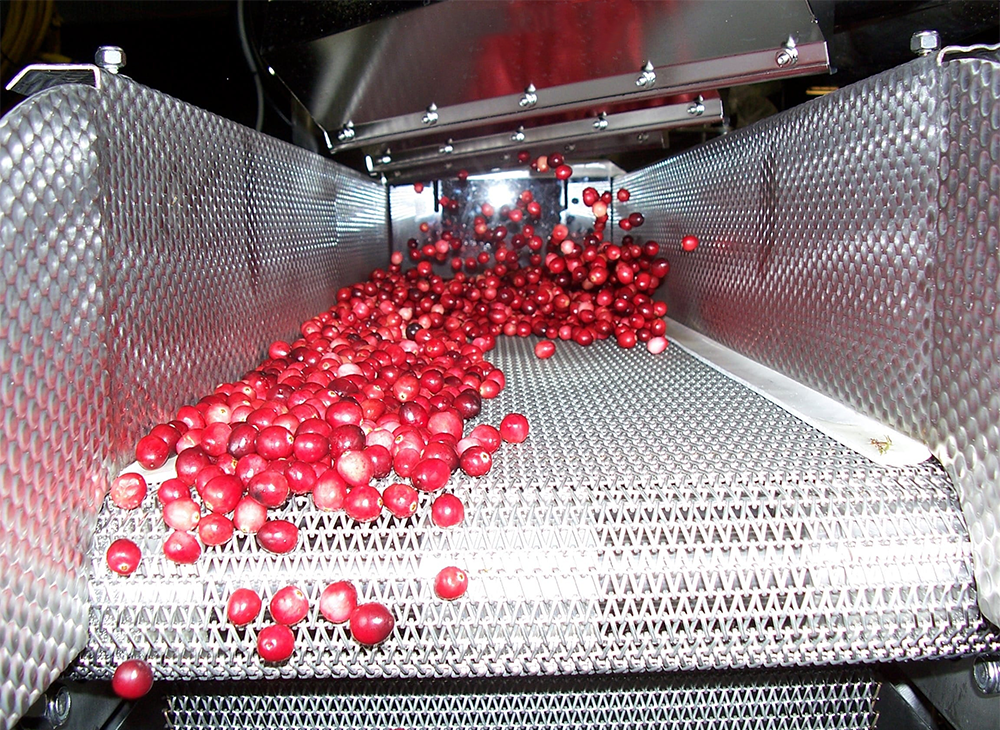
Walk the line from packing back toward washing. Look for water on fruit, in carrier cups, on brushes, and at conveyor transfers. A drying station can perform well at its outlet yet deliver wet fruit to packing if the next belt or support surface transfers water back onto it.
Place the main blow-off stage after the last intended wet process that requires surface-water removal. That might be a rinse or a water-based handling stage. If coating or waxing follows, confirm the required incoming surface condition and the coating's own drying requirements. Don't assume the same air setting suits both operations.
The position relative to optical sorting also needs review. If drying is upstream, check that the installation does not disturb fruit spacing, rotation, or camera presentation. If drying is downstream, assess the supports and transfers between the sorter and packer. The sorting equipment and the drying station must work with the same product flow.
Before adding more air, give free-draining water a route out. Check for pooled liquid and blocked drainage. Reducing the water entering the blow-off stage can be more useful than trying to force a large incoming water load through an unchanged drying space.
A top-mounted air knife mainly reaches the surfaces presented to it. The contact patch against a belt, the underside of a fruit, and recesses around stems can remain shielded. One dry-looking upper surface is not enough to approve the result.
For approximately round fruit, controlled rotation may expose additional areas to the airflow. On an existing roller or brush section, observe whether each fruit actually turns under normal loading. A crowded layer can prevent rotation and hide surfaces that were exposed during a lightly loaded trial.
A second air direction or a different support arrangement may be needed where rotation is unsuitable. Avoid introducing a drop or abrupt transfer just to reach the underside. The new handling step could create a quality problem while solving a moisture problem.
Fruit type, maturity, and condition matter. Cherries, for example, can suffer bruising from compression and impact. A setting that leaves firm fruit stable is not evidence that softer fruit will tolerate the same arrangement. Trial representative lots and inspect for movement, collisions, stem damage, and skin marks.
Keep the evaluation specific. Check whether fruit lifts, rolls unpredictably, or strikes guides when the air starts. If that occurs, review support, airflow direction, and operating level together. Reducing the force may help, but poor presentation can also require a mechanical change.
Air knives move liquid; they do not make the liquid disappear. Follow its path from the fruit to the collection area. Water that lands on the next fruit, a downstream belt, or a packing surface has only changed location.
Arrange the air direction and collection area so displaced water leaves the product path. Where needed, use splash containment that allows access for cleaning. Check drain capacity during the wettest expected operating condition rather than judging it from an empty, clean conveyor.
Avoid treating an enclosed tunnel as a complete solution by itself. Inspect whether spray accumulates on internal surfaces and drips back onto fruit. Review the movement of wet air around the entrance and exit, particularly where the packing area begins.
Air quality also belongs in the equipment assessment because the air reaches an edible product. Review intake location, filtration, the cleanliness of air passages, and maintenance access. For compressed-air equipment, include oil, particles, and moisture in the supply assessment. For blower-fed equipment, evaluate the intake environment and downstream components.
Have the site's food-safety team define the required air-quality controls and verification. An air knife is not a sanitizing treatment, and stainless steel construction alone does not establish hygienic suitability.
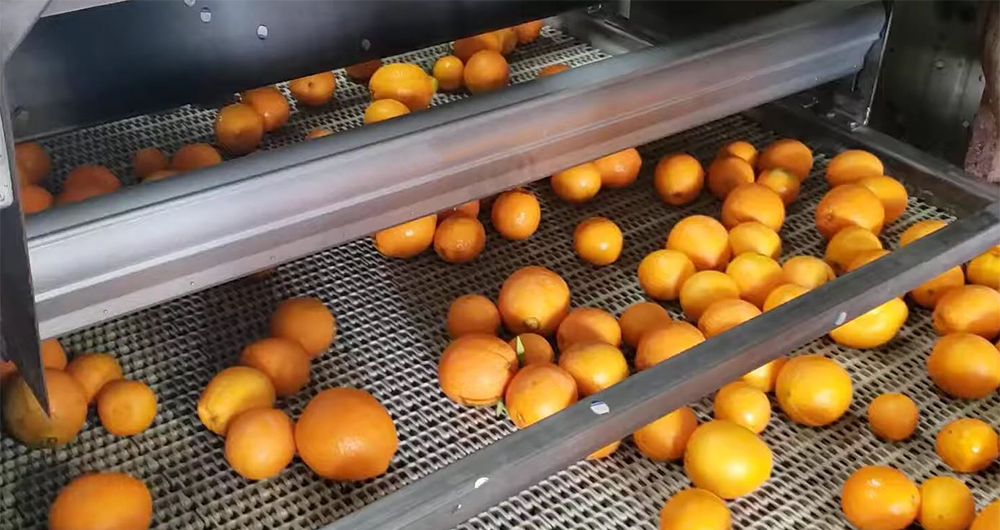
Size the working coverage around the occupied product lanes and their allowed movement. A wide belt carrying fruit in a narrow lane does not automatically require airflow across its full width. Several lanes need coverage of their outer limits as well as the areas between adjacent fruit.
Height variation changes the distance from an overhead outlet to the surface. If one batch contains large and small fruit, test both within the same arrangement. A fixed setting can be acceptable, but it must be demonstrated across the specified range.
As conveyor speed rises, a given surface spends less time in a fixed treatment zone. Increasing blower speed is not automatically the best response. Check whether a second exposure position, improved rotation, or better drainage would address the remaining wet area more directly.
Throughput also includes loading density. More fruit per minute can mean a faster belt, closer spacing, additional lanes, or some combination. Closer spacing may increase shielding even when belt speed stays constant. Record both conveyor speed and the actual product arrangement during trials.
Confirm the air supply for the complete proposed layout. Knife length, outlet design, the number of outlets operating together, and connecting ductwork affect the required duty. Ask for operating conditions for the assembled system, not just a blower motor rating.
Start commissioning within the equipment supplier's approved range and adjust one variable at a time. Record distance, angle, air setting, fruit presentation, and line speed. There is no single pressure or mounting distance that can be recommended for all fruit sorting lines.
Inspect fruit at the air knife outlet and again at the actual packing point. This separates incomplete blow-off from water acquired farther down the line.
If droplets appear after an initially acceptable result, check wet transfers and overhead drips first. Also check whether cold fruit is entering warmer, humid air. Moisture can condense on a sufficiently cold surface, so a dry outlet inspection does not guarantee that the surface will stay dry.
Don't respond to returning condensation by heating fruit without reviewing the postharvest process. Fruit temperature, packing-room conditions, and the subsequent cold chain need to be considered together. Measure the conditions at the point where moisture reappears.
Air blow-off may remove free water without a separate heater, but that does not mean the process has no temperature effect. Include fruit temperature in commissioning checks where it matters to product quality. Keep surface-water removal distinct from any requirement to cool the fruit itself.
Define the passing condition before comparing equipment settings. It might include no visible free droplets on agreed fruit surfaces and no observable water transfer to the selected packing material. The quality team should specify the inspection method, sampling plan, and acceptable variation.
Establish a baseline using the current process. Record the time from the final wet operation to the agreed packing condition, the throughput of acceptable product, and any holding or manual intervention. Keep a record of fruit type, size range, maturity, incoming wetness, and temperature.
Compare a proposed setup under similar incoming conditions. Include the fullest expected loading, the intended maximum line speed, and the fruit most likely to remain wet or move under the airflow. Inspect recessed areas and the underside, not only the most visible surface.
Assess handling quality after the site's agreed holding interval as well as immediately after treatment. Some damage may be easier to detect later. A shorter drying stage that increases rejected fruit is not a successful production improvement.
Finally, repeat the check after a product changeover and after normal cleaning and reassembly. The useful result is an operating recipe that another operator can reproduce. Claim a reduction in dry time only when the comparison supports it, and state the tested fruit and operating conditions alongside any published result.
QXY Machinery supplies industrial air knives and integrated air knife drying systems. Its published system options include blowers, conveyors, adjustable knife supports, splash protection, water collection, and controls, with layouts developed around product dimensions, production rate, and the required drying result.
For a fruit sorting line inquiry, provide the fruit type and condition, size range, conveyor or carrier arrangement, upstream wet process, target throughput, and available installation space. Include the site's cleaning requirements and the condition required at packing.
It may replace or reduce a stage whose job is removing free surface water, if trials meet the same packing requirement. A process that relies on evaporation, coating curing, or another heat-dependent function needs separate assessment. Compare the required result rather than equipment names.
Do not transfer them without a separate process review. Cut surfaces, juice leakage, product handling, and food-safety controls change the task. This guide addresses fresh, whole fruit; fresh-cut production requires its own validated handling and moisture-management approach.
Specify the stop response during integration. Stationary fruit can receive a different exposure from moving fruit. The controls should follow the equipment supplier's instructions and the site's assessed product limits, including the blower's permitted operating conditions if airflow is reduced or diverted.
No. A surface-drying check does not establish a shelf-life improvement. Any such claim needs storage and quality evidence for the fruit, packaging, and temperature conditions concerned. Blow-off also does not replace washing controls, sanitation, or temperature management.
Retain the approved settings and trial records for each product family, then review them when variety, maturity, fruit size, or incoming wetness changes. Recheck the packing result and damage rate before increasing speed. Use the new observations to update the operating recipe.
Need a custom air knife solution? Send us your application details, material requirement ,or air source type . Our engineering team will help you select the right model.

Shenzhen Qixingyuan Machinery Equipment Co., Ltd.
info@airknifecn.com
Building 8, Wanfeng Third Industrial Zone, Xinqiao Street, Bao'an District, Shenzhen, Guangdong, China


