

Fiber optic cable production includes wet stages even though the finished product must leave the line clean and dry. A freshly extruded loose tube or outer jacket commonly passes through water cooling. At the exit, a thin film can remain around the circumference, while larger drops collect below and travel toward measuring, marking, handling, or take-up equipment.
Here the air knife is normally a Ring air knife, also called an annular air knife. The cable passes through its center and receives airflow around the full circumference. A straight knife strikes one side and can miss water underneath. In this article, air knife for fiber optic cable production means mainly the ring design.
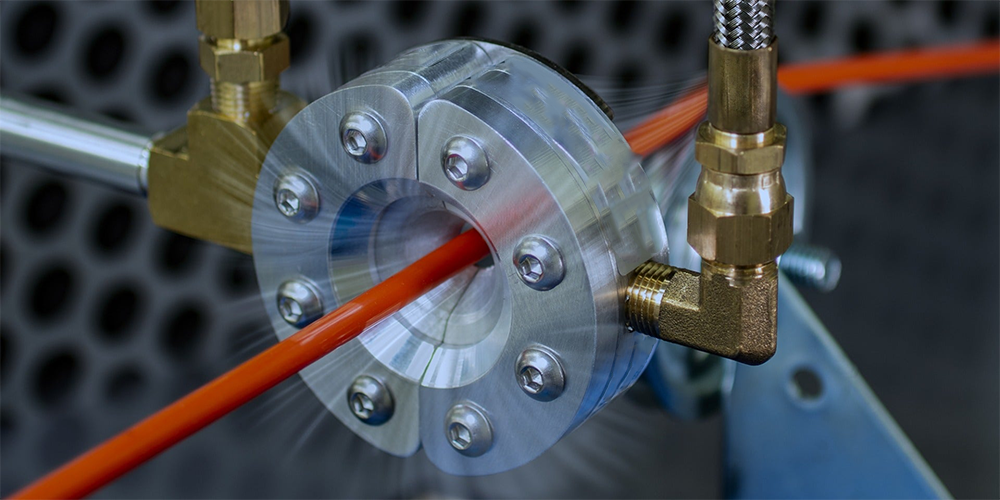
Upstream equipment controls extrusion and cooling. Downstream equipment expects a stable product with no moving water film. Maillefer lists water-cooling systems in fiber optic secondary-coating and sheathing lines; Rosendahl Nextrom also describes cooling in loose-tube and final-jacketing equipment. The ring belongs after the final water contact and before a dry surface is required.
The next step may be diameter measurement, inspection, marking, a capstan, an accumulator, or take-up. Write the drying target around that operation instead of a vague claim that the cable is “ dry.”
An annular air knife creates a circular sheet or cone of moving air. Its axial component pushes water toward a defined side instead of merely breaking the film into mist. The outlet treats the lower quadrant and the far side in the same pass.
The cable must still pass close to the ring centerline, and the plenum must distribute air around the bore. A damaged outlet, deposit, incorrect assembly, or undersized supply can leave one quadrant wet. The ring solves access; alignment and air delivery determine the result.
A ring air knife removes free cooling or rinse water, droplets, loosely held film, and already detached particles. It is not a substitute for washing. Dried minerals, polymer build-up, grease, jelly, or bonded contamination may only spread when pressure is increased. If residue remains after water moves, check water quality, bath control, rinse condition, and cleaning.
Cable designs can include gels, water-blocking materials, yarns, tapes, strength members, and several polymer layers. Assign the ring to one defined outside surface at one defined process stage.
The bore needs clearance for the largest cable or loose tube, ovality, runout, threading, and mounting tolerance. A bore chosen only from nominal OD may be too tight during startup or at a splice. An oversized bore wastes flow and can weaken liquid removal.
Give QXY the full OD range, maximum transient envelope, line speed, travel direction, and threading method. A solid ring suits a product that can be fed through it. A hinged two-part ring simplifies service when routine rethreading is impractical.
A cable that runs high in the bore has a short air path on one side and a long path on the other. This can cause impact or vibration nearby and a wet stripe opposite. More pressure can make the motion worse.
Use approved guides or capstans on both sides to control the path without a long unsupported span. Keep them outside the splash zone and avoid a tight bend in a hot jacket. Confirm centering during startup, normal speed, maximum speed, and acceleration. Video can reveal drift that is hard to see live.
The outlet should have a defined axial bias, usually driving water back toward the cooling trough or into a collection enclosure. Blowing toward the dry side can carry mist onto a gauge, printer, capstan, floor, or finished cable.
Allow gravity drainage before the ring when space permits. A non-marking exit seal may reduce the bulk load. Use splash panels and a sloped tray so water cannot rebound through the bore. Mist capture must not pull the cable off center.
Line speed sets exposure time. Published secondary-coating systems range from hundreds of meters per minute to much faster designs, so no universal pressure fits every line. Water load, bore clearance, outlet geometry, cable OD, jacket surface, and drainage also matter.
Start with the minimum flow that creates one continuous water-exit direction. Raise output in steps while watching the lower quadrant, cable motion, mist, and downstream result. Record inlet pressure under flow. Compressed-air pipework must resist plant pressure swings; blower systems need the volume and pressure required by the annular outlet.
Compressor oil, condensate, rust, or particles can leave a dry cable with a worse surface. Keep blower intake away from cooling mist and floor contamination. For compressed air, set filtration and condensate control from the downstream cleanliness requirement.
Do not add heat first. Fresh polymer dimensions, shrinkage, print behavior, and handling can change with temperature. If warmed air is considered, validate cable temperature and geometry through the full speed range.
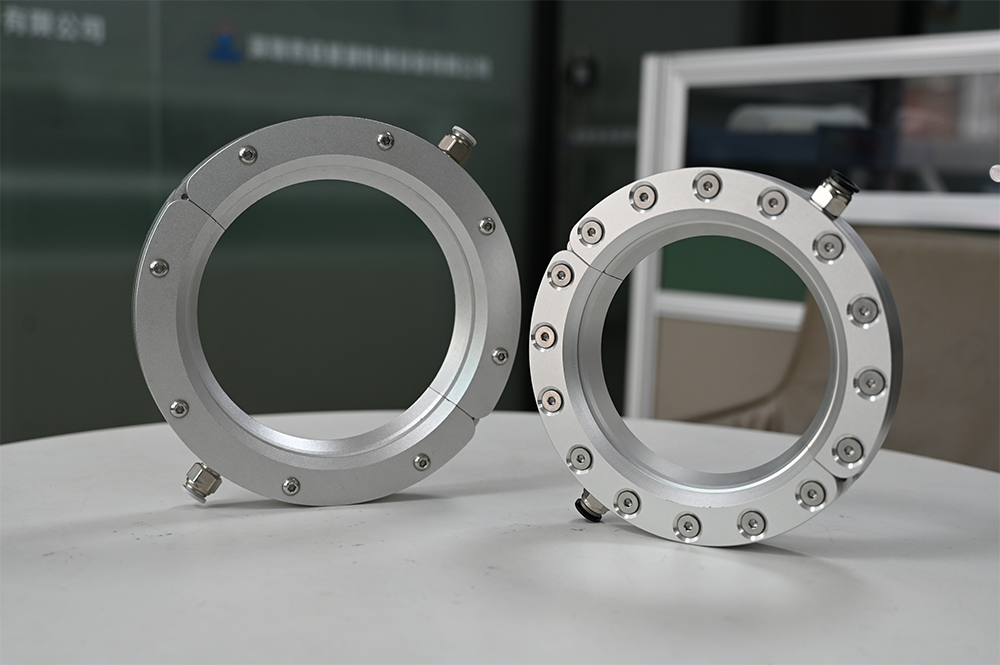
QXY Ring Air Knife - Project Reference | |
Airflow coverage | 360 degrees around a cable, tube, pipe, extrusion, or other round product |
Bore sizing | Custom inner diameter matched to the product OD, runout, threading method, and required clearance |
Construction | Solid ring or hinged two-part format for installation around long continuous products |
Available materials | Aluminum alloy or stainless steel; QXY also lists plastic, 304/316 stainless, and aluminum on its annular product page |
Air source | Configuration may be designed for compressed air or fan/blower supply; final sizing is application-specific |
Run the line at the slowest and fastest approved conditions with the ring off. Observe where the film breaks, where drops collect, and whether water leaves the trough in waves. Check every cable size. This shows the actual liquid load and prevents airflow from hiding an upstream drain or exit-seal problem.
Thread the cable, center it through the bore, and check clearance during starts, stops, and speed changes. Confirm that the ring, supports, guards, and drain tray cannot contact the product. Record the approved guide positions so maintenance can restore them.
Apply low air, verify the intended axial discharge direction, and raise output in small steps. Look for a continuous moving liquid front rather than a cloud of mist. If one quadrant stays wet, inspect centering and the outlet before adding pressure. Test the smallest and largest OD because the effective clearance changes with product size.
Use the next operation as the judge. For marking, check print contrast, transfer, adhesion, and delayed smearing under the plant method. For vision or diameter measurement, trend false rejects and unstable readings. For take-up, inspect the reel and floor for carried water after a sustained run. Repeat the check after a line stop because a stationary cable can collect drops differently.
Record cable family and OD, line speed, water condition, ring and bore, centerline, guide settings, air source, inlet pressure under flow, filter condition, and downstream test result. Add photographs of the accepted water path.
Recheck after the ring is opened or replaced, a guide moves, the OD range changes, or cooling conditions are modified. Small mechanical changes cause many drying failures.
An air knife for fiber optic cable production does not need to heat the cable or hit it with the strongest possible jet. It needs to move free water in one known direction, keep the cable centered and undamaged, and deliver the surface condition required by the next machine. The ring air knife is the natural geometry for that job because it treats the full circumference in one continuous pass.
QXY Machinery (Shenzhen Qixingyuan Machinery Equipment Co., Ltd.) is based in Shenzhen, China, and integrates R&D, design, production, and sales. The company has more than 10 years of focused experience in industrial air knife drying, water blow-off, cleaning, and cooling applications.
For cable, tube, pipe, and extrusion lines, QXY Machinery can supply custom ring air knives with application-specific inner diameters, solid or hinged construction, and aluminum or stainless-steel options. The wider product range also includes standard slot, compressed-air, blower, PVC, titanium, tornado, small-hole PCB, and air-to-air configurations.
Q: Why is a ring air knife better than a straight air knife for fiber optic cable?
A: A ring air knife surrounds the round product and directs air around the full circumference. This reaches the lower and hidden sides in one pass, even if the cable rotates or wanders slightly.
Q: Where should the ring air knife be installed?
A: Install it after the final intended water contact and before the first operation that requires a dry surface. The discharge should normally push removed water toward the wet side or a dedicated collection enclosure.
Q: How much clearance should there be between the cable and the ring bore?
A: There is no universal gap. The design must cover the full cable OD range, ovality, runout, threading, transient diameter, and mounting tolerance while keeping the air path effective. QXY sizes the inner diameter from project data.
Q: Can an annular air knife remove gel or dried process residue?
A: It can remove free water and loose material. It does not replace washing for grease, gel, dried minerals, polymer build-up, or firmly bonded contamination.
Q: Can the ring air knife blow directly on bare optical fiber?
A: This guide addresses coated loose tube and cable-jacket surfaces. Any airflow on bare fiber requires a separate, fiber-specific engineering and contamination review.
Q: Should the system use compressed air or a blower?
A: Either may be possible, depending on ring design, bore, flow demand, available utilities, cleanliness, noise, and duty cycle. The air source and annular outlet must be sized as one system.
Q: What information is needed to select an air knife for fiber optic cable production?
A: Provide cable construction, OD range, maximum transient envelope, line speed, cooling or rinse details, surface temperature, incoming water load, downstream test, air quality requirement, installation space, and threading method.
Need a custom air knife solution? Send us your application details, material requirement ,or air source type . Our engineering team will help you select the right model.

Shenzhen Qixingyuan Machinery Equipment Co., Ltd.
info@airknifecn.com
Building 8, Wanfeng Third Industrial Zone, Xinqiao Street, Bao'an District, Shenzhen, Guangdong, China


