

A process bath can meet its setpoint at the start of a shift and still run inefficiently. Every wet part, rack, basket, sheet, or strip transfers liquid when it moves to the next stage. The source bath loses useful solution. The receiving tank gains water, cleaner, acid, salt, oil, particles, or dissolved process chemistry that may not belong there.
Air knives reduce that transfer before the load crosses the boundary. They do not need to make every surface dry. Their job is to remove the controllable liquid film, direct it to an approved drain or recovery point, and lower the chemical load presented to the next tank.
A well-controlled bath holds concentration, pH, conductivity, temperature, cleanliness, and level with fewer corrections. Operators add less makeup chemistry. Rinse tanks take longer to reach their contamination limit. Filters, oil separators, and wastewater treatment receive a steadier load. Production loses less time to dumping, adjustment, and investigation.
Carryover works against all of these results. Drag-out removes liquid from one tank, while drag-in introduces that liquid to the next. The same liter can therefore create two control actions: replacing what left the source and correcting what entered the receiver. Air knives improve bath efficiency when they reduce both actions across a repeated production load.
List every wet transfer in the line. For each boundary, record the source liquid, receiving stage, part and carrier, transfer time, normal drain period, production rate, and the highest approved wet load. Add the receiving tank tolerance. A final rinse may accept almost no chemical carryover, while the next rinse in a cascade may be designed to accept a controlled concentration.
Then define the destination for removed liquid. Compatible solution may drain to the source tank. Diluted rinse water may go to an upstream rinse, a segregated recovery vessel, or treatment. Liquid containing mixed chemistry may need separate capture. This decision belongs to the process owner; it should not be created by the direction of the air jet.
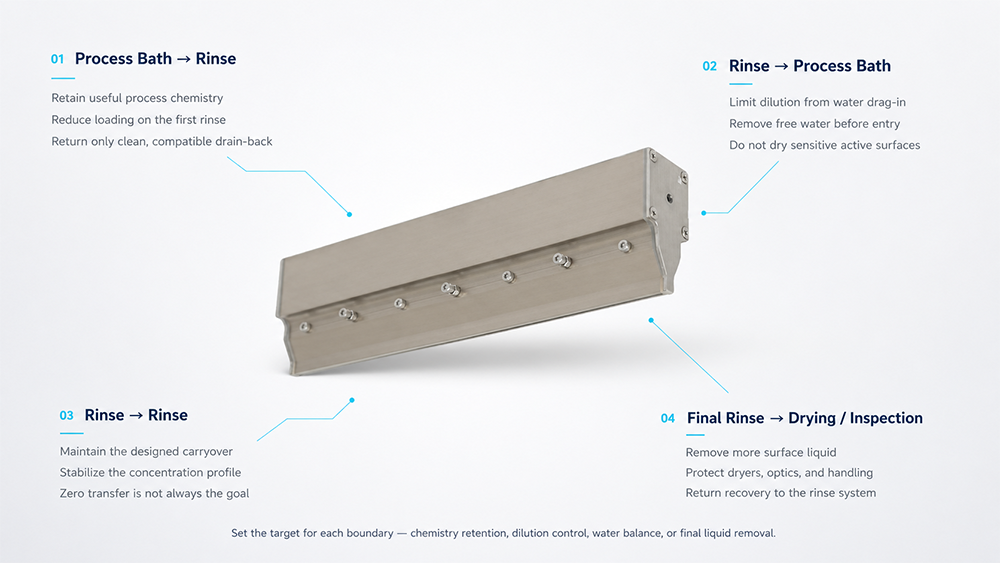
The main objective is to retain useful process chemistry and reduce loading on the first rinse. Examples include alkaline cleaning, acid activation, etching, conversion coating, plating, and chemical stripping. Drain-back is valuable, but only if the return cannot introduce dirt, rinse water, or another chemistry to the source bath.
Here the risk is drag-in. Water carried from the rinse can dilute a cleaner, acid, plating bath, seal, or coating solution. Air knives placed after the rinse reduce free water before entry, but the part must remain wet enough for the surface requirement. Some activated or freshly treated surfaces cannot tolerate drying or extended air exposure.
The liquid is less concentrated, yet it still sets the load on the next rinse. In countercurrent systems, controlled carryover is part of the water balance. The aim is not automatically zero transfer. The aim is a stable concentration profile that meets final cleanliness with the planned water flow.
At this boundary, liquid removal protects dryers, vision systems, handling stations, packaging, and later coating steps. The target is usually different from an inter-tank boundary: more complete surface removal may be needed, and recovered liquid normally returns to the rinse system rather than a chemical process bath.
Slow, smooth withdrawal leaves a thinner film than abrupt removal. A short drain pause lets streams and large drops return with no energy input. Airflow should begin after heavy runoff has fallen, then sweep the remaining film toward an open edge or drain surface. This sequence uses less air and creates less mist than attacking a fully loaded surface at high velocity.
Available time matters. Conveyor speed, hoist motion, indexing, and the physical distance between tanks define the removal window. If the window is too short, increasing pressure may simply atomize the liquid. A longer drain zone, better part tilt, or a second controlled angle can produce a more stable result.
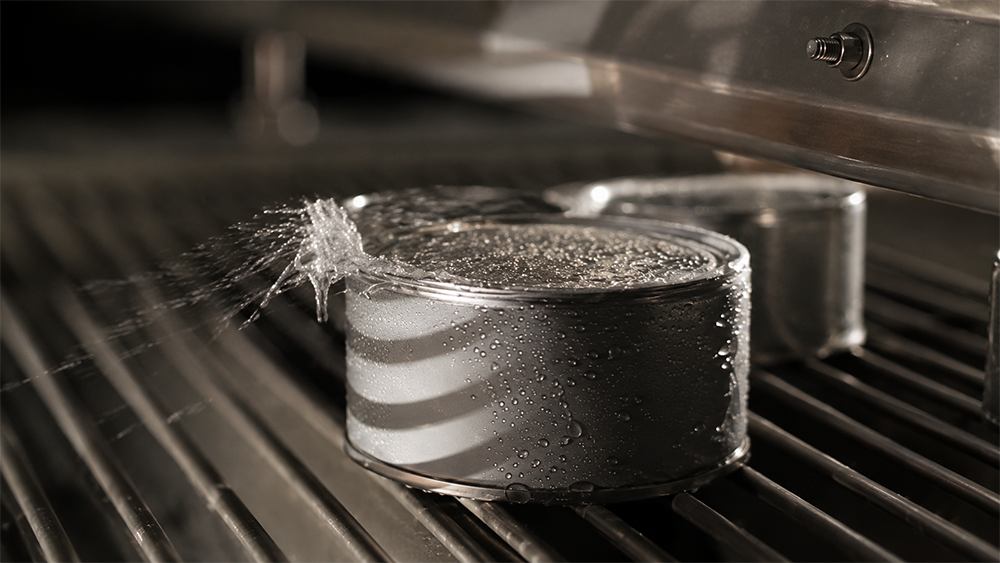
Broad vertical faces are straightforward. Horizontal ledges, cup shapes, bores, threads, seams, hollow sections, and nested parts retain much more. Air needs both access to the liquid and an escape path. Blowing into a blind pocket without an outlet can spread the liquid or trap it deeper.
The carrier must be included. Hooks, mesh, sleeves, rack insulation, basket corners, and conveyor contacts can release drops after the part surface has cleared. Dense baskets may need lower fill limits, indexing, rotation, or a second direction. Otherwise air removes liquid from the top layer and deposits it on lower parts.
This is why air knives should be tested with the worst approved load, not an easy sample. Coverage must include the left, center, and right positions, the highest and lowest part, and the complete carrier.
These are practical starting values for blower-driven QXY systems. Final settings must be established from actual liquid behavior, process tolerance, product clearance, exhaust performance, and material compatibility.
Control item | QXY starting point | Bath-efficiency purpose |
Knife-to-part distance | 20–50 mm for many blower-driven applications | Maintains useful impact while allowing clearance for product and carrier variation |
Impingement angle | 15°–45°, aimed toward the approved drain or capture zone | Moves liquid in a known direction instead of pushing it into the next tank |
Slot and pressure | 0.5–2 mm standard slot; 2–6 psi (0.14–0.42 bar) blower pressure | Provides a continuous air sheet; final values depend on liquid load, width, and mist limits |
Working width | Standard lengths 150, 300, 450, 600, 800, and 1,000 mm; custom lengths available | Covers the full wet envelope, including edge parts and carrier positions |
Inlet arrangement | Dual inlets normally used above 600 mm | Helps maintain distribution across wide conveyors and long racks |
Material | Aluminum, 304/316 stainless steel, PVC, or titanium after compatibility review | Matches splash, vapor, washdown, temperature, structural load, and contamination requirements |
The body, shim, fasteners, ducts, mounts, and nearby shields must tolerate splash, vapor, washdown, and cleaning chemicals. Aluminum alloy fits many low-exposure industrial positions. PVC can be practical near many low-temperature acid and alkaline wet zones. Stainless steel or titanium may be required where temperature, load, hygiene, or corrosion conditions demand them.
The air source also enters the process environment. Oil, condensate, rust, and particles can contaminate a bath or freshly treated surface. Use suitable filtration, drain the supply system, and inspect blower inlets. Exhaust capture and guarding must contain mist without pulling the air curtain away from its target.
Start with a stable baseline for a defined product mix. Record production count or area, bath additions, water makeup, titration corrections, pH or conductivity changes, rinse flow, filter service, sludge or waste volume, and unplanned bath adjustments. Where practical, weigh a dry load and the same load after the normal drain period to estimate retained liquid.
After installing air knives, compare the same metrics per 1,000 parts, per rack, per square meter, or per production hour. Normalizing the data matters because a busy week will use more chemistry even when transfer control has improved. Check trends long enough to include startup, steady production, bath-temperature change, and the most difficult product family.
• Confirm that source-bath makeup falls without concentration drift.
• Track whether the receiving bath needs fewer corrections or lasts longer.
• Check first-rinse conductivity or chemistry at the same production load.
• Inspect tank rims, guards, floors, exhaust surfaces, and adjacent stages for mist.
• Verify that surface quality, coating adhesion, cleanliness, and cycle time remain acceptable.
A system can clear the visible face while missing liquid in the carrier or internal features. It can push drops off the part but send them forward as mist. The air sheet may cover the conveyor center but leave wet edge positions. A drainboard can collect solution and then release it later because its slope, outlet, or cleaning condition is poor.
Process changes also weaken results. New baskets, different loading density, higher line speed, colder liquid, altered chemistry, a wider product, or a stronger exhaust setting can change the removal pattern. Include the boundary in change control and repeat the wet-load and tank-dashboard checks after relevant changes.
Installing equipment between every tank is rarely necessary. Start where the source chemistry is expensive, the receiving bath has a narrow tolerance, rinse water is high, contamination shortens bath life, or downstream defects are linked to carryover. One well-controlled boundary can reveal the data and installation rules needed for the rest of the line.
The final specification should state the liquid to remove, acceptable liquid remaining, destination, part and carrier envelope, line speed, available dwell, air source, material exposure, mist limit, and verification metric. That turns air knives from general blow-off devices into repeatable process controls.
QXY Machinery (Shenzhen Qixingyuan Machinery Equipment Co., Ltd.) is a high-tech enterprise integrating R&D, design, production, and sales. Based in Shenzhen, China, the company has more than 10 years of focused experience in industrial air knife drying, liquid removal, dust control, and wet-process equipment.
For liquid removal between process tanks, QXY Machinery supplies aluminum alloy, 304 and 316 stainless steel, PVC, titanium alloy, slot, small-hole, tornado, and dual-sided air knives. Length, slot width, inlet position, mounting, material, and air source can be matched to the tank layout, chemical exposure, work envelope, and required return direction.
A useful application request includes the process sequence, bath chemistry and temperature, receiving-tank limit, part and carrier drawings, wet width, transfer speed, drain area, exhaust arrangement, air source, and the metric used to confirm bath efficiency.
→ Contact QXY Machinery to review air knives for liquid control between your process tanks.
Q: How do air knives improve bath efficiency?
A: They reduce the liquid transferred on parts and carriers, helping the source bath retain chemistry and the receiving tank avoid dilution or contamination.
Q: Should air knives remove all liquid between every tank?
A: No. The acceptable residual liquid depends on the next process, surface condition, rinse design, and whether drying could cause staining, oxidation, or passivation.
Q: Where should removed liquid go?
A: Send it to an approved source tank, upstream rinse, segregated recovery vessel, or treatment path. Compatibility and volume balance must be confirmed first.
Q: Can air knives reduce drag-in as well as drag-out?
A: Yes. Removing rinse water before a process bath can reduce dilution. The surface must still meet the wetness and activation requirements of the next stage.
Q: Which process-tank boundaries should be prioritized?
A: Prioritize expensive chemistry, sensitive receiving baths, high rinse demand, short bath life, heavy wet loads, and boundaries linked to quality defects.
Q: How should liquid removal be measured?
A: Use retained-liquid mass or collected volume together with normalized bath additions, concentration corrections, rinse conductivity, water flow, waste load, and product quality.
Q: What causes an air knife system to lose effectiveness?
A: Common causes include slot buildup, blocked drains, changed part loading, poor edge coverage, incorrect angle, low airflow, excessive exhaust pull, and missed carrier pockets.
Need a custom air knife solution? Send us your application details, material requirement ,or air source type . Our engineering team will help you select the right model.

Shenzhen Qixingyuan Machinery Equipment Co., LTD.
info@airknifecn.com
Building 8, Wanfeng Third Industrial Zone, Xinqiao Street, Bao'an District, Shenzhen, Guangdong, China


