

Material selection is not a choice between “metal” and “plastic.” A chemical-resistant air knife must survive the actual solution, concentration, temperature, splash pattern, vapor, washdown method, and production duty. The same chemical name can create a mild environment at room temperature and a much harsher one when heated or allowed to dry on the surface.
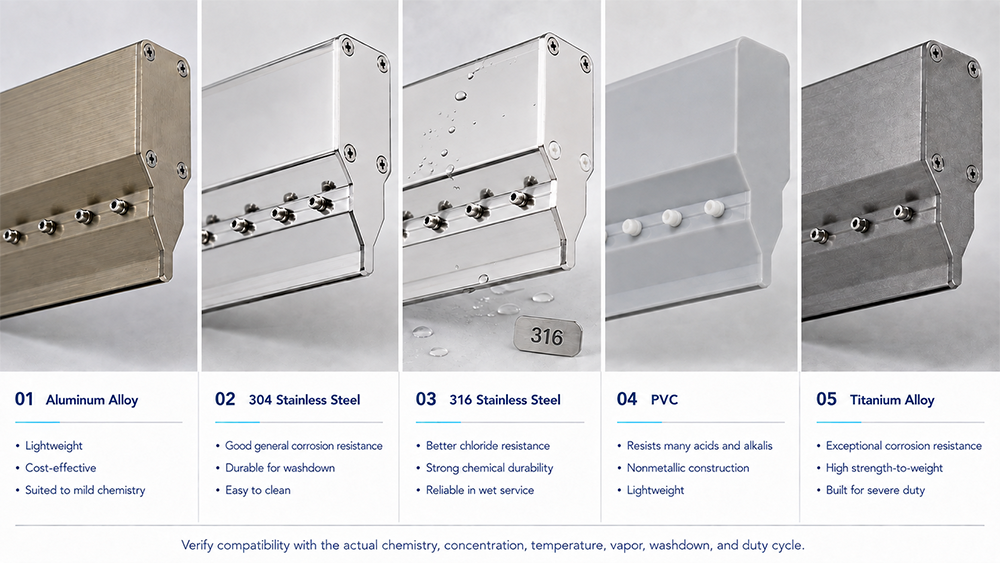
QXY Machinery offers Aluminum Alloy, 304 and 316 stainless steel, PVC, and titanium alloy options. Each has a valid operating window. The correct air knife material protects airflow performance, structural alignment, surface cleanliness, maintenance access, and service life without paying for corrosion resistance the process does not need.
Record the exact chemical and formulation, including concentrations during production, makeup, cleaning, and end-of-bath conditions. Mixed solutions can behave differently from their individual ingredients. Include contaminants carried in from parts, such as chlorides, metal fines, oil, or abrasive compound.
Record liquid, air, and surrounding vapor temperatures, plus short cleaning or sterilization peaks. Heat can accelerate corrosion, reduce polymer strength, and concentrate solution as it dries on a warm surface.
Separate occasional vapor, repeated splash, continuous wetting, immersion, high-pressure washdown, and clean-in-place contact. Note duration, drying periods, frequency, and places where solution can remain in crevices or under deposits.
Add mechanical requirements: knife length, mounting span, vibration, impact, air pressure, slot stability, clearance, and cleaning access. A resistant material that bends, creeps, or loses outlet geometry is still unsuitable.
The matrix is a screening tool, not a compatibility certificate. Final approval should use chemical-resistance data for the exact formulation and operating conditions.
Material | Useful starting point | Why it may fit | Review before approval |
Hard-anodized aluminum alloy | Dry zones and general industrial blow-off with low chemical exposure | Lightweight, rigid, economical, and available in long lengths | Strong acids or alkalis, chloride splash, damaged coating, repeated chemical washdown |
304 stainless steel | General wet cleaning and moderate washdown where the chemistry is known | Strong, durable, smooth, and easy to maintain | Chlorides, oxidizers, reducing acids, crevices, elevated temperature, chemical concentration |
316 / 316L stainless steel | More demanding wet zones, especially where added chloride resistance is useful | Molybdenum improves resistance to many chloride and reducing-acid conditions; 316L suits welded fabrication | Not universal for every acid; chloride concentration, temperature, dry-wet cycling, weld condition, and crevices |
PVC | Many low-temperature acidic, alkaline, plating, and metal-sensitive wet processes | Good resistance in many water-based chemicals, low weight, lower cost, metal-free construction | Strong solvents, high concentration, air temperature, pressure, impact, creep, and long-term rigidity |
Titanium alloy | High-value applications with documented corrosion beyond standard stainless options | High strength-to-weight ratio and strong resistance in many chloride and oxidizing environments | Exact alloy, reducing media, contamination, galvanic contact, fabrication, and premium cost |
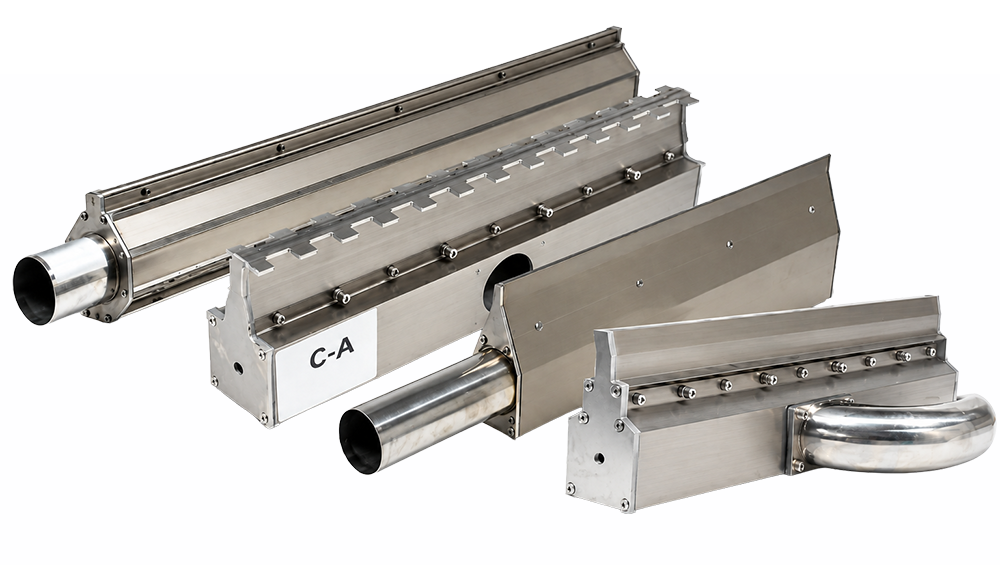
A hard-anodized aluminum air knife is light and sturdy. It is inexpensive and useful for everyday drying. QXY makes use of aluminum alloy for large‑surface blow‑off for electronics for packaging and for industrial jobs. Its light weight is helpful on spans and on frames that can be adjusted.
Anodizing makes the surface better. It does not protect aluminum from chemical damage. Strong acids, bases, chloride‑containing splashes, damaged coating and repeated harsh washdowns can harm the body or cause contamination. Keep aluminum away, from chemical areas unless the exposure has been checked and managed.
A 304 stainless steel air knife offers good strength, cleanability, and corrosion resistance for many water-based cleaners and general wet areas. It is often reasonable where exposure is moderate, temperatures are controlled, and chlorides or aggressive acids are low.
Do not approve 304 from the word “stainless.” Pitting can start at crevices, deposits, damaged surfaces, and points where chloride solution dries and concentrates. Check weld tint, fastener interfaces, stagnant runoff, and the actual cleaning agent. A smooth body with good drainage often lasts longer than the same grade in a poor geometry.
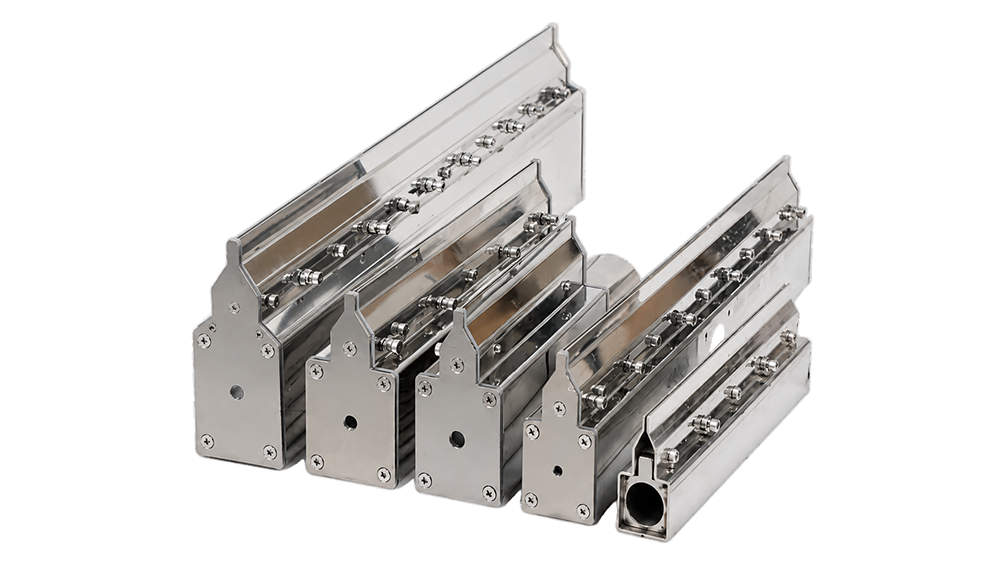
A 316 stainless steel air knife contains molybdenum, giving it better resistance than 304 in many chloride-bearing and reducing-acid environments. QXY positions 316 for more demanding wet and chemical process areas. The low-carbon 316L grade is commonly selected for welded construction because it reduces sensitization risk around welds.
316 is not automatically superior in every chemical. Nickel Institute guidance notes that alloy performance changes with the acid type, chloride level, temperature, crevices, stress, and wet-dry concentration. Some highly oxidizing acids can favor a different alloy response. Use a current compatibility source or a corrosion specialist rather than a simple 304-versus-316 rule.
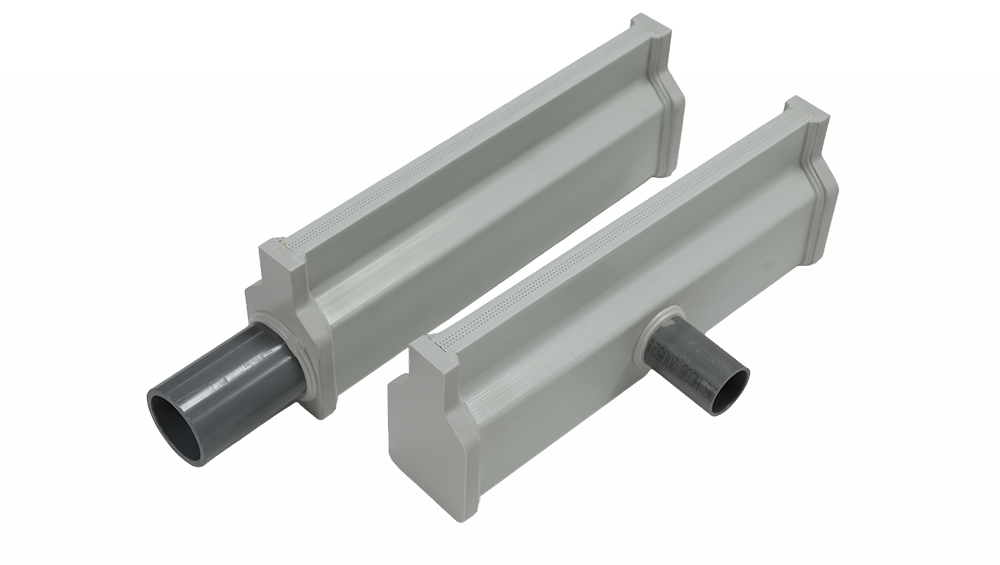
A PVC air knife works great in jobs that use low temperatures or water-based acid and alkaline processes. You can also use a PVC air knife in electroplating lines PCB processing and metal-sensitive environments. The PVC air knife is very light. It also usually costs less, than steel or titanium. QXY also offers custom length and inlet arrangements for chemical equipment layouts.
PVC selection must include temperature, pressure, solvent exposure, impact, and long-term rigidity. GF Piping Systems advises checking mixed chemicals together with temperature and pressure. Strong solvents, high air temperature, heavy mounting loads, or long unsupported spans may move the choice back to metal even when PVC resists the liquid.
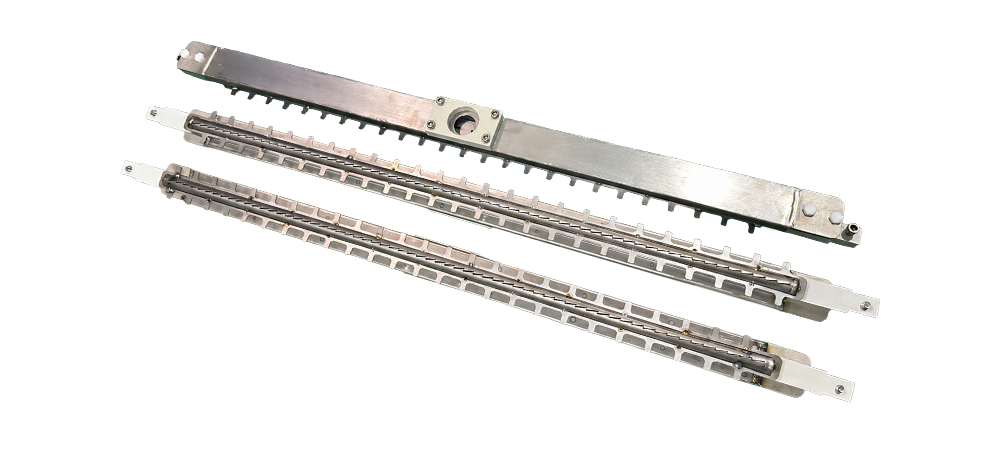
A titanium air knife combines a high strength-to-weight ratio with strong corrosion resistance in many chloride and oxidizing environments. TIMET notes broad resistance to oxidizing acids while also showing that performance can depend on acid purity and temperature. QXY uses titanium for high-value chemical applications where standard stainless steel has a documented limit or failure history.
Premium cost alone does not prove titanium is correct. Confirm the exact alloy and solution, especially in reducing media, mixed chemicals, or galvanic contact with other metals. Review fabrication, fasteners, joints, repair method, and contamination requirements before specifying it.
Review the slot shim, fasteners, fittings, seals, hoses, manifold, brackets, drain tray, guards, blower, adhesives, and gaskets. The least compatible component can control maintenance and contamination risk.
At mixed-material joints, trapped liquid can create crevice conditions and electrically connected metals may introduce galvanic risk. Keep runoff paths open, isolate materials where required, and avoid ledges that hold cleaner.
For precision or high-purity cleaning, the surface must tolerate the cleaning method and remain inspectable. Corrosion products, flaking coatings, exposed threads, and residue traps can compromise the process before airflow visibly changes.
A corrosion-resistant body does not correct poor coverage or an undersized blower. For many QXY blower-driven systems, 20–50 mm stand-off and a 15°–45° impingement angle are practical starting ranges. Standard slot gaps are commonly 0.5–2 mm, with working pressure around 2–6 psi (0.14–0.42 bar).
QXY standard lengths include 150, 300, 450, 600, 800, and 1000 mm, with custom lengths available. Knives longer than 600 mm normally use dual inlets. Material stiffness, thermal expansion, mounting span, and support design must keep the outlet aligned across the full working width.
Use the exposure map to remove unsuitable choices. Aluminum usually leaves when strong chemicals reach the body. PVC leaves when temperature, pressure, impact, or rigidity exceeds its range. Standard stainless grades leave when documented corrosion risk is too high.
Compare the shortlist on service life, cleanability, weight, support, fabrication, inspection, repair, contamination risk, and installed cost. A premium alloy may be justified where replacement requires draining a line. In an accessible mild zone, a simpler material may be better.
Give the supplier the chemical safety data, formulation, concentration range, temperatures, exposure mode, line drawing, air source, working width, and cleaning procedure. “Occasional acid vapor” is not enough for final approval.
Use published compatibility data as a screen. For mixed chemistry, unusual concentration, elevated temperature, or critical service, obtain written guidance from the chemical and material suppliers. A coupon or representative component exposure test can reveal swelling, softening, discoloration, pitting, coating damage, mass change, or loss of surface quality.
Test the complete operating cycle, including wet exposure, drying, washdown, startup, shutdown, and any cleaning peak. Inspect joints, welds, crevices, and supports. Confirm that the air knife still holds slot geometry and airflow distribution after exposure.
• Record chemical identity, concentration, temperature, contact time, and test duration.
• Include normal contaminants and the most aggressive approved cleaning recipe.
• Inspect the full assembly, not only a flat material coupon.
• Define rejection criteria before the test begins.
• Schedule early inspections after installation to catch local attack or deformation.
Common errors include choosing from the tank name, assuming 316 resists every acid, ignoring PVC temperature and span, specifying titanium without confirming the medium, or leaving carbon-steel fasteners and an incompatible shim exposed.
Maintenance chemicals also count. A mild rinse line may receive concentrated cleaner during washdown, so the specification must cover the most severe approved exposure, not only the longest one.
QXY Machinery (Shenzhen Qixingyuan Machinery Equipment Co., Ltd.) is a high-tech enterprise integrating R&D, design, production, and sales. Based in Shenzhen, China, the company specializes in industrial drying, dust removal, and water-blowing solutions and has more than 10 years of focused air knife experience.
QXY Machinery supplies aluminum alloy, 304 and 316 stainless steel, PVC, and titanium alloy designs for general drying, chemical cleaning, PCB wet processing, food and pharmaceutical production, electroplating, and other wet-process applications. Custom length, slot width, inlet, mounting, and material configurations are available.
A useful quotation request includes chemical type, concentration, temperature, exposure mode, washdown recipe, line width, air source, installation drawing, structural load, and required service life. QXY Machinery can use this information to recommend a starting material and configuration for final compatibility review.
Q: What is the best air knife material for chemical cleaning?
A: There is no universal best material. Choose from the exact chemical, concentration, temperature, contact mode, duration, contaminants, mechanical load, and cleaning method.
Q: Can an aluminum air knife be used near acids or alkalis?
A: Only after compatibility review. Hard anodizing helps, but strong acids, strong alkalis, chlorides, coating damage, and repeated washdown can attack aluminum.
Q: When should 316 stainless steel be selected instead of 304?
A: 316 is often preferred for more demanding wet service and many chloride-bearing conditions. It is not universal; check acid type, chloride, temperature, crevices, stress, and cleaning regime.
Q: Is PVC suitable for a chemical-resistant air knife?
A: PVC can fit many low-temperature acidic and alkaline water-based processes. Confirm solvents, concentration, air temperature, pressure, impact, mounting span, and long-term rigidity.
Q: When is titanium worth the higher cost?
A: Titanium is justified when documented corrosion risk or stainless failure makes its service life and reliability valuable. Confirm the exact alloy and complete chemical environment.
Q: Do fasteners and shims need the same compatibility review?
A: Yes. Fasteners, shims, seals, fittings, mounts, ducts, and drain surfaces can fail or contaminate the process even when the main body remains sound.
Q: How should air knife material compatibility be validated?
A: Use current compatibility data, supplier review, and representative exposure testing under the most severe approved cycle. Inspect corrosion, swelling, deformation, joints, and outlet stability.
Need a custom air knife solution? Send us your application details, material requirement ,or air source type . Our engineering team will help you select the right model.

Shenzhen Qixingyuan Machinery Equipment Co., LTD.
info@airknifecn.com
Building 8, Wanfeng Third Industrial Zone, Xinqiao Street, Bao'an District, Shenzhen, Guangdong, China


