

A multi-stage cleaning line can include washing, ultrasonic treatment, rinsing, blow-off, drying, inspection, and unload. Adding an Air Knife does not automatically make it faster. Throughput improves only when the knife removes time, variation, or interruption from the path that limits accepted parts per hour.
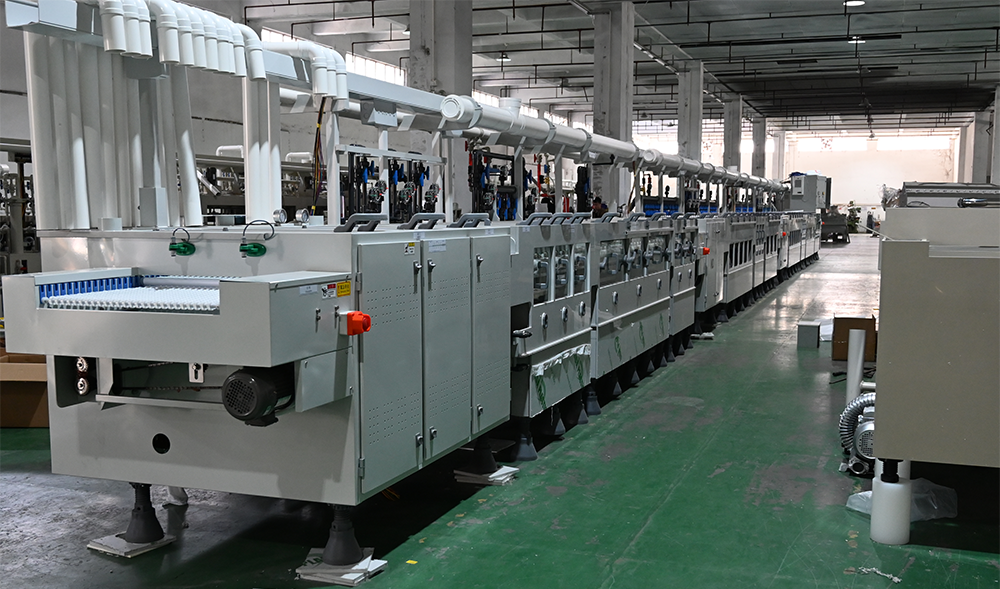
A dryer may look slow while the hoist schedule is the real constraint. A rinse tank may hold the queue because carryover forces service. The line may also lose output through wet-part rework. Air knives create capacity only when they relieve the limiting condition without adding dwell or quality problems.
Record occupied time, waiting time, and failures at each stage during full production. The constraint may be tank dwell, dryer residence, transfer equipment, an operator, inspection, bath service, or an unstable result.
Droplets at unload are a symptom. Capacity comes from the consequence: slower conveyor speed, hoist waiting, longer dryer holds, returned loads, or more bath correction. Identify which consequence blocks accepted output.
If ultrasonic dwell already sets the line rate, faster drying may create spare downstream time but no extra parts per hour. The air knife may still improve quality or energy use, but it has not increased throughput.
In an indexed line with stages working together, the longest required station cycle normally sets takt. Shortening a 40-second blow-off cannot help when washing needs 70 seconds. If drying limits every index, pre-removing bulk water can release capacity.
On continuous conveyors, speed is limited by the distance needed for the slowest treatment. An air knife supports faster travel only when water removal stays uniform and the next operation accepts the result.
A single hoist serves several tanks within a repeating schedule. A long drain pause or separate blow-off stop can delay another basket. The best layout works during an existing lift, drain, or horizontal move.
Parallel baskets keep several stations active, making balance more important. One wet load needing extra drying can block the next transfer. Stable blow-off reduces cycle variation as well as average drying time.
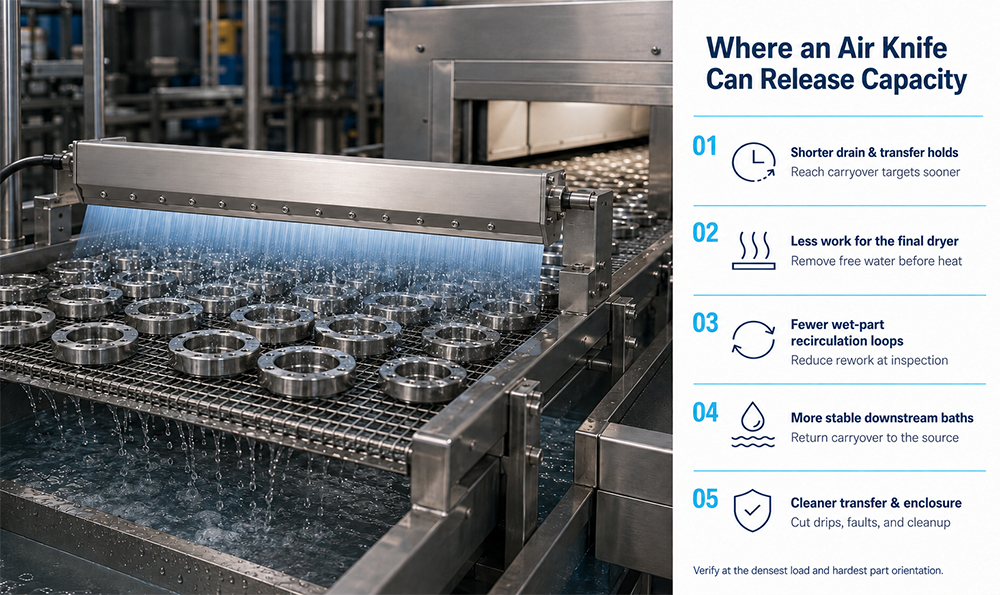
Parts are often held above a tank to reduce drag-out before transfer. An air knife can sweep free liquid back to the source tank during that existing drain window. If the same carryover target is reached sooner, the hoist or conveyor can move on. The gain must be verified at the densest load and most difficult part orientation.
An air knife removes free water as liquid. The hot-air or vacuum stage then handles a thinner film and trapped moisture rather than the full rinse-water load. If drying is the constraint, this can reduce the required residence or allow the station to accept the next carrier sooner. Heat should be adjusted only after the dry-part endpoint is confirmed.
A line may appear to meet takt while losing output at inspection. Loads with water in holes, under flanges, or between nested parts are sent back for blow-off or drying. A targeted air knife can reduce this hidden capacity loss. Count the avoided return trips, not only seconds removed from the normal recipe.
Carryover adds chemistry and liquid load to the receiving tank. Bath drift can increase rinsing, correction, filter load, or unplanned service. Returning liquid to the source tank helps the line stay available. This is an uptime gain rather than a faster nominal cycle, but it still raises accepted parts per scheduled hour.
Dripping baskets and uncontrolled mist wet sensors, guides, doors, and floors. Cleanup pauses and sensor faults reduce availability. A correctly captured air-knife zone keeps liquid in the process path. A poorly aimed jet does the opposite by atomizing solution and moving it into the next station.
The strongest throughput layout overlaps blow-off with time the line already spends lifting, draining, indexing, or moving through a short transfer tunnel. A separate stop can still be justified, but its added occupancy must be smaller than the time removed from the constraint. Calculate the net effect on the full repeating sequence.
For many blower-driven QXY applications, a 20–50 mm knife-to-part distance and 15°–45° impingement angle are useful starting ranges. Standard slot gaps are commonly 0.5–2 mm, with working pressure around 2–6 psi (0.14–0.42 bar). These values do not define throughput. They create an initial test condition that must clear the actual load at production speed.
Give water an exit route. Between tanks, angle the jet back toward the source stage. After the final rinse, direct it toward a controlled drain. If removed liquid collects on a flat guard or remains in the basket, the line carries the same load forward a few seconds later.
Mechanical clearance also sets the usable position. Include the tallest part, basket frame, hooks, swing, conveyor vibration, and abnormal stop recovery. A close aerodynamic stand-off is not useful if a carrier can strike the knife and stop the entire line.
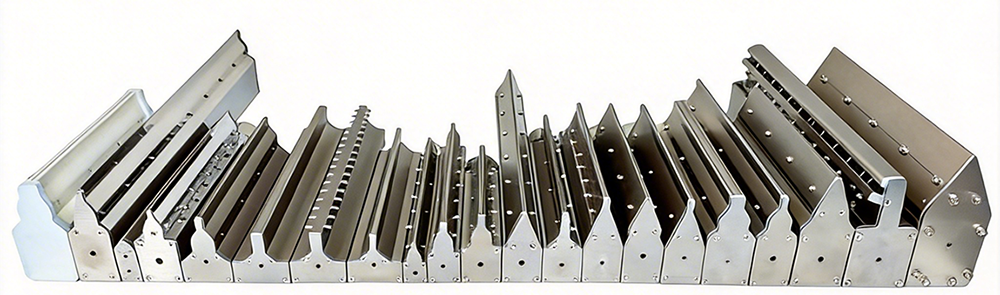
Throughput trials fail when the center sample dries and edge positions do not. QXY aluminum alloy air knives are factory calibrated for airflow uniformity of ±5% across the knife length. Installed performance also depends on duct balance, slot condition, inlet arrangement, and product shielding.
QXY standard lengths include 150, 300, 450, 600, 800, and 1000 mm, with custom lengths available. Knives longer than 600 mm normally use dual inlets. Size the wet width from the full carrier and product envelope. Test the left, center, and right positions at the fastest approved line setting.
Blower capacity must cover every knife that operates at the same time. Adding a second station to the same blower can lower velocity at both positions. Measure conditions at the knife inlet and check the blower operating point. Equal-looking duct branches do not guarantee equal airflow.
A repeatable load pattern makes fixed air knives effective. Open, single-layer parts expose the same surfaces each cycle. Dense baskets, mixed part families, and random orientation create shielding. The average load may pass while the worst load holds the dryer and breaks the schedule.
Blind holes and upward-facing pockets need a drainage strategy. Reorient the part, rotate or index the basket, add another air direction, or use focused air for critical features. More pressure across the outer surface does not empty a cavity that has no liquid exit path.
Small or light parts can move under an aggressive jet. Thin components may flutter and change conveyor presentation. The throughput setting must preserve part position and surface condition, or the line trades wet-part rework for handling and inspection failures.
Establish a baseline over representative production. Record accepted parts per hour, constraint-stage occupancy, average and maximum queue, wet-part rework, bath-service downtime, transfer delays, load mix, and air or energy condition. Keep quality criteria unchanged during the comparison.
• Run the densest approved carrier and the part family with the most trapped liquid.
• Include cold startup, normal temperature, shift changes, and filter loading.
• Measure the entire repeating line cycle, not only the blow-off station.
• Track false gains: faster index with more wet parts, mist, or bath drift.
• Confirm that upstream and downstream stations can accept the released capacity.
After the air knife is stable, reduce the constrained dwell or increase line speed in controlled steps. Stop at the first quality or scheduling failure, then restore an operating margin. If accepted parts per hour do not change, the project improved another metric or the constraint moved elsewhere. Report that result honestly.
No capacity gain appears when cleaning dwell remains the limit, the dryer has spare capacity, or loading and unloading cannot feed a faster line. An air knife may still reduce water use, chemistry loss, energy, corrosion risk, or cleanup.
A successful project can move the constraint to inspection or unload. Review line balance before adding more airflow. Throughput is a system result, not a permanent property of one component.
Aluminum alloy slot air knives suit general wide-area blow-off and dry zones. Stainless steel or PVC may be better near chemical splash, washdown, or corrosive tank environments, depending on chemistry and temperature. Tornado air knives suit complex 3D surfaces, while dual-sided arrangements treat both faces of flat products.
Blower-driven systems are usually practical for continuous, wide coverage. Compressed air can provide focused impact for holes or local features, but consumption and noise should be evaluated over the full duty cycle. The correct choice is the one that relieves the constraint with stable quality and acceptable operating cost.
QXY Machinery (Shenzhen Qixingyuan Machinery Equipment Co., Ltd.) is a high-tech enterprise integrating R&D, design, production, and sales. Based in Shenzhen, China, the company specializes in industrial drying, dust removal, and water-blowing solutions and has more than 10 years of focused air knife experience.
For multi-stage cleaning lines, QXY Machinery offers aluminum alloy slot air knives, stainless steel and PVC designs, tornado air knives, small-hole air knives, and dual-sided configurations. Custom lengths, slot widths, hole patterns, and inlet arrangements are available to match tanks, conveyors, baskets, part geometry, and simultaneous operating stations.
A useful throughput review includes the line sequence, station dwell times, transfer schedule, accepted-parts target, part and carrier envelope, chemistry, current queues and rework, air source, drain-back space, and dry-part requirement. QXY Machinery can use this information to match the air knife to the actual constraint.
→ Contact QXY Machinery to discuss an air knife system for your multi-stage cleaning line.
Q: Does adding an air knife always increase cleaning-line throughput?
A: No. It increases throughput only when it reduces a real constraint such as transfer hold, drying residence, wet-part rework, or bath-related downtime. Otherwise it improves another process metric.
Q: How is throughput different from cycle time?
A: Cycle time describes a stage or sequence. Throughput is accepted parts produced per scheduled hour. A shorter local cycle does not improve output if another station remains the constraint.
Q: Where should an air knife be placed in a multi-stage line?
A: Place it where free liquid causes constraint time or instability: over a source-tank drain-back zone, between rinse stages, or before the final dryer. Avoid adding a separate stop unless the net line cycle becomes shorter.
Q: Can an air knife shorten hot-air drying time?
A: Yes, when it removes bulk water before the hot zone. The dryer then handles a thinner film and trapped moisture. Verify the same dry-part endpoint before reducing residence or heat.
Q: How do air knives reduce rework?
A: Consistent blow-off can remove water from surfaces and targeted features before inspection or unload. The load pattern and air direction must be repeatable; hidden cavities may need rotation or focused air.
Q: What should be measured during a throughput trial?
A: Measure accepted parts per hour, constraint occupancy, queues, transfer delays, wet-part rework, downtime, load mix, and quality results. Record the full line cycle, not only the air-knife station.
Q: Can one blower supply air knives at several stages?
A: Yes, if the blower and ducts are sized for every knife operating at the same time. Balance branches and verify inlet conditions at each knife; adding a branch can weaken existing stations.
Need a custom air knife solution? Send us your application details, material requirement ,or air source type . Our engineering team will help you select the right model.

Shenzhen Qixingyuan Machinery Equipment Co., LTD.
info@airknifecn.com
Building 8, Wanfeng Third Industrial Zone, Xinqiao Street, Bao'an District, Shenzhen, Guangdong, China


