

A component can look clean when it leaves the wash tank and still fail after drying. A faint film appears under angled light. White marks form around a drain edge. A blind hole releases liquid during assembly. Ionic material remains even though no spot is visible. These failures are often described as residual cleaning solution, but the residue may come from several stages.
The Air Knife has an important role, but it cannot correct every cause. It can reduce cleaner carryover, push rinse water out of open features, and remove free liquid before final drying. It cannot turn contaminated rinse water into clean water or remove detergent that was never rinsed from the surface. Prevention starts by tracing the liquid path.
The endpoint depends on the next operation. Cosmetic parts may require no visible spots; hydraulic passages may need to be detergent-free. Bonding, coating, vacuum, optics, electronics, or medical work can set tighter limits for ions, non-volatile residue, particles, organics, or outgassing.
Define the acceptance method before changing the line. Use a test that represents downstream risk: controlled visual inspection, extraction conductivity, ion chromatography, total organic carbon where relevant, gravimetric non-volatile residue, particle analysis, or a validated functional test.
No residue limit fits every precision component. Set the target from the drawing, customer requirement, internal validation, material and geometry, or the needs of the next manufacturing step.
Surface appearance can guide the investigation, but it does not identify chemistry by itself. Confirm the suspected source with process samples or analysis.
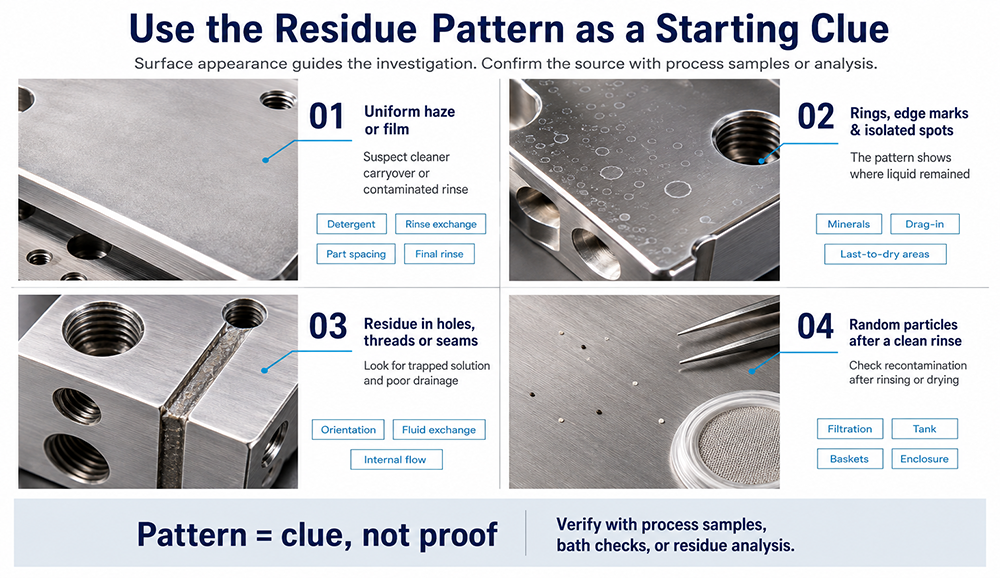
A broad film suggests that cleaner or contaminated rinse water remained across the surface. Review detergent concentration, rinse exchange, part spacing, agitation, and final-rinse condition. Increasing drying temperature may make the film more visible because water leaves while non-volatile material stays.
Marks around droplet edges often follow the last places to dry. Dissolved minerals, cleaner dragged into the rinse, or material already in the final rinse can concentrate as the droplet shrinks. The location shows where liquid remained; it does not prove which dissolved material formed the mark.
A feature-specific result points toward trapped solution, incomplete fluid exchange, or poor drainage. The outside can pass while a cavity holds wash chemistry through the rinse sequence. Part orientation and internal flow are more important here than stronger airflow over the external face.
Investigate filtration, tank cleanliness, baskets, handling, drying air, enclosure surfaces, and recontamination after drying. Airflow can remove particles, but it can also lift contamination from a dirty enclosure and place it back on the component.
The wash stage loosens and carries contamination in a cleaning solution. The rinse stage must replace that solution on the component with cleaner water. Complex or high-cleanliness parts may need more than one rinse, fresh-water overflow, counterflow, agitation, ultrasonic assistance, spray action, or a controlled final rinse.
A part leaving the wash tank brings a surface film and liquid trapped in features. If this load enters the first rinse unchecked, the rinse becomes a diluted wash bath. An air knife or controlled drain position above the source tank can return free cleaner before transfer. The jet must point back toward the source rather than sending detergent mist into the rinse zone.
The final rinse is the last liquid to touch the component. Its quality, point-of-use piping, tank condition, and exposure to upstream carryover directly affect what remains after water evaporates. Monitor the variables that matter to the process, such as conductivity, resistivity, pH, total organic carbon, particles, or change frequency. Use only the measurements relevant to the required cleanliness.
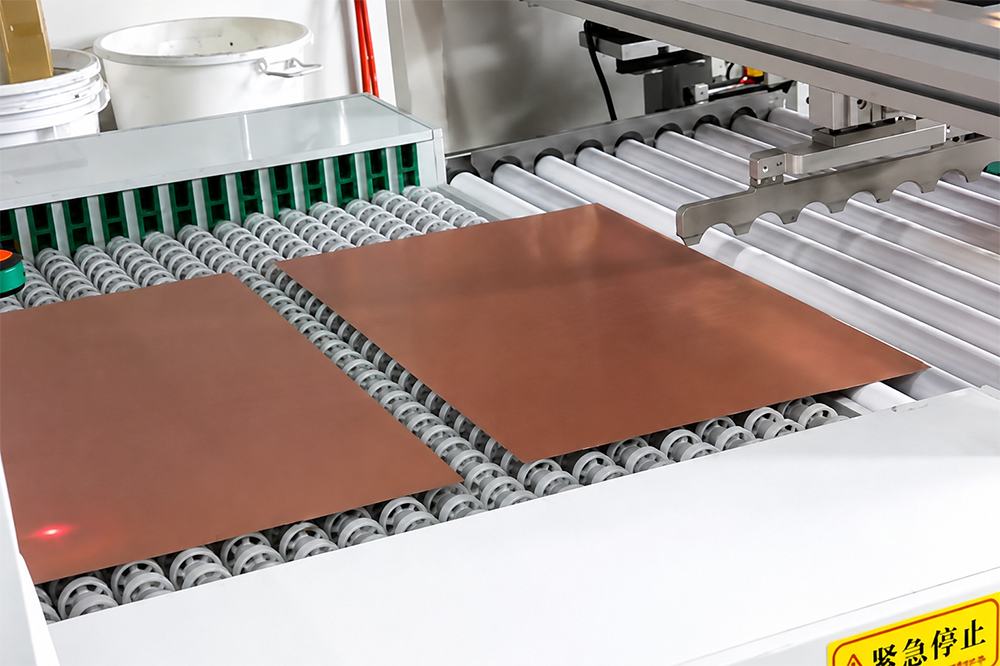
Use blow-off to reduce drag-out and return cleaner to the wash stage. This protects the rinse and lowers the amount of detergent that must be displaced later. Allow gravity drainage first, then sweep liquid toward a clear return path. Capture mist inside the wash boundary.
Reducing liquid transfer helps the next rinse stay cleaner. Direct water back to the rinse stage it came from. Do not add so much air that the solution becomes an aerosol and bypasses the drain-back zone. The cleanest downstream rinse should receive the smallest possible upstream liquid load.
The air knife now removes final-rinse water rather than wash chemistry. Direct runoff to a clean drain and keep the jet away from earlier tanks. Use clean, filtered air where supply contamination could land on the precision surface. The part should enter final drying with a thin, uniform moisture load and minimal trapped liquid.
A slot air knife can sweep open parts toward an edge across the full load width. Upper and lower knives can treat two critical faces. Keep fixtures from catching runoff and dripping onto lower surfaces.
Blind holes need fluid exchange during wash and rinse. Orient them to fill when immersed and drain when lifted. Upward holes become cups; downward holes may trap air. Horizontal or indexed orientations often improve both cleaning and drainage.
A fixed air sheet cannot reach every corner. Add another direction, rotate the basket, scan the knife, or use focused air for a critical bore. Tornado air knives can help with 3D surfaces. Move liquid out, not deeper.
Avoid nesting. Shielded contact points restrict rinse exchange and retain liquid. A repeatable single-layer load or dedicated fixture improves cleaning, rinsing, blow-off, and validation.
For many blower-driven QXY applications, a 20–50 mm stand-off and 15°–45° impingement angle are practical starting ranges. Standard slot gaps are commonly 0.5–2 mm, with working pressure around 2–6 psi (0.14–0.42 bar). Precision parts still require trials because surface finish, feature size, part stability, and allowable mist vary.
Use the lowest stable setting that clears the required liquid. Excess air can atomize contaminated solution, move small components, make thin parts flutter, or draw dirty enclosure air into the clean zone. Control runoff and extraction before raising velocity.
Coverage must include every approved load position. QXY aluminum alloy air knives are factory calibrated for airflow uniformity of ±5% across the knife length. QXY standard lengths include 150, 300, 450, 600, 800, and 1000 mm, with custom lengths available. Knives over 600 mm normally use dual inlets to support distribution.
A clean final rinse can be lost through dirty piping, stagnant dead legs, a contaminated basket, or carryover from an upstream stage. Keep the final-rinse loop and tank surfaces inside the cleanliness-control plan. Sampling only the incoming water may miss contamination added at the point of use.
Blower or compressed air can introduce oil, water, particles, or material from ducts and filters. Define air quality from the component requirement. Locate blower inlets away from tank vapor and floor dust, maintain filtration, clean the knife slot and enclosure, and inspect for condensate.
Post-clean handling matters too. Gloves, trays, packaging, cooling areas, and inspection fixtures can recontaminate a qualified part. Separate a true cleaning residue from contamination added after the line by sampling components at several handoff points.
Take matched samples after the wash, each rinse, final blow-off, dryer, and clean handling step. Use the same part family, load pattern, solution age, drain time, and operating temperature. A control blank from the final rinse and a clean fixture sample help separate water, equipment, and part contributions.
• Map residue location on the component before cleaning the evidence away.
• Check source-tank carryover and each rinse for the relevant chemical indicator.
• Tilt or section test parts to expose liquid held in blind features.
• Compare air knife on/off samples without changing the rinse recipe.
• Inspect after drying and again after a defined hold, because hidden liquid can emerge later.
Change one cause at a time. Improve rinsing before increasing dryer heat. Correct orientation before adding pressure. Clean the air and enclosure before blaming the detergent. Once the failure disappears, repeat the trial across solution life, the densest load, cold startup, normal temperature, and all approved part positions.
Aluminum alloy slot air knives suit general clean dry-off zones with low chemical exposure. Stainless steel may be better near washdown or aggressive cleaning solutions. PVC can suit some acid or alkaline positions where temperature stays within the material limit. Titanium is reserved for highly corrosive conditions that exceed stainless capability.
Material compatibility must cover the body, shim, fasteners, ducts, and mounting hardware. Select from the actual chemical concentration, temperature, vapor, splash, contaminants, and cleaning procedure. Precision cleanliness also requires surfaces that can be inspected and maintained without shedding contamination.
QXY Machinery (Shenzhen Qixingyuan Machinery Equipment Co., Ltd.) is a high-tech enterprise integrating R&D, design, production, and sales. Based in Shenzhen, China, the company specializes in industrial drying, dust removal, and water-blowing solutions and has more than 10 years of focused air knife experience.
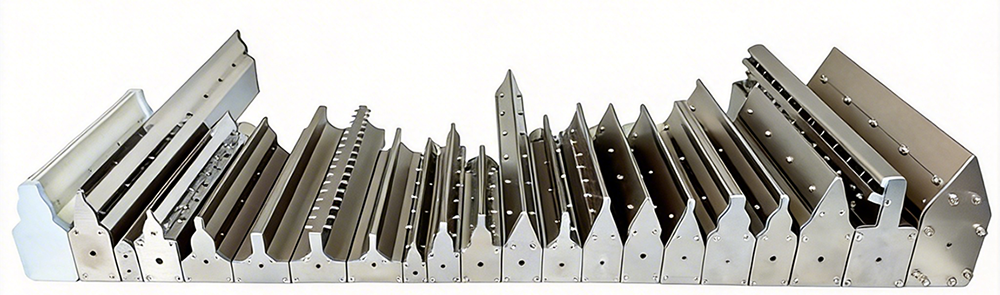
For precision component cleaning, relevant QXY products include aluminum alloy slot air knives, stainless steel and PVC designs, tornado air knives, small-hole air knives, and dual-sided configurations. Custom length, slot width, hole pattern, and inlet arrangements are available to match tanks, baskets, part geometry, chemical environment, and clean-zone requirements.
A useful application review includes the cleaning chemistry, rinse sequence and water quality, required residue endpoint, part and fixture drawings, load pattern, trapped-liquid features, air source, drain-back area, dryer, and downstream process. QXY Machinery can use this information to match airflow to the complete residue-control process.
→ Contact QXY Machinery to discuss an air knife system for precision component cleaning and rinsing.
Q: Can an air knife remove detergent residue from a precision part?
A: It can remove liquid that contains detergent, especially before transfer to the rinse. It cannot remove detergent already dried on the surface or replace an adequate rinse sequence.
Q: Why does residue appear only after drying?
A: Water evaporates while dissolved or suspended material remains. Drying can concentrate detergent, minerals, organics, or particles into a visible film or edge mark.
Q: Can clean-looking parts still have ionic residue?
A: Yes. Ionic contamination may not be visible. Use an extraction, conductivity, ion chromatography, or another validated method when ionic cleanliness affects reliability or downstream processing.
Q: How should blind holes be rinsed and dried?
A: Orient them so they fill during immersion and drain during lifting. Use agitation or ultrasonic rinse where needed, then add another air direction, basket motion, or focused air to remove trapped final-rinse water.
Q: Where should the final air knife be installed?
A: Place it after the final rinse and a controlled drain position. Direct runoff to a clean drain, protect the final rinse from blowback, and keep mist away from the dryer and clean handling area.
Q: What air quality is needed for precision component blow-off?
A: The air must meet the component requirement. Use clean, oil-free, filtered air where oil, particles, water, or duct contamination could redeposit on the surface.
Q: How can the source of residue be identified?
A: Collect matched samples after each process stage, map residue location, test the relevant chemical indicators, and use rinse blanks. Change one variable at a time and confirm the result across normal production conditions.
Need a custom air knife solution? Send us your application details, material requirement ,or air source type . Our engineering team will help you select the right model.

Shenzhen Qixingyuan Machinery Equipment Co., LTD.
info@airknifecn.com
Building 8, Wanfeng Third Industrial Zone, Xinqiao Street, Bao'an District, Shenzhen, Guangdong, China


