

An air knife can work well in spring and still leave water behind in summer. The same line can dry cleanly during a dry winter shift and then show mist, water marks, corrosion, or label problems when the rainy season starts. The air knife has not necessarily failed. The drying environment has changed.
Seasonal temperature and humidity can affect air knife drying performance because drying is not only about air velocity. It also depends on how much water the surrounding air can hold, how warm or cold the product surface is, whether the surface is close to the dew point, how much liquid enters the drying zone, and whether the blower is taking in stable air.
When it comes to QXY Machinery drying, people usually start with basic settings. For example, the distance between the knife and the product is usually 20 to 50 mm. The angle at which the air hits the product is typically between 15 and 45 degrees. The slot where the air comes out is usually 0.5 to 2 mm wide. The pressure from the blower is usually between 2 and 6 psi. These are just starting points for QXY Machinery drying. You will probably need to make some changes as the seasons change because this can affect how well QXY Machinery drying works. You may need to adjust the QXY Machinery drying system a bit to get it just right.
Air knife drying has two parts. The first part is when the air sheet takes away the water from the surface of the product. Then the rest of the water, which is just a thin film or tiny drops, needs to either evaporate or drain away before the product can move on to the next step. The amount of moisture in the air, the temperature of the air, and the temperature of the surface all have an impact on how well this second part works.
Warm air can hold water vapor than cold air. However if the air is already very humid it is already carrying a lot of moisture. When the air around the product is close to being full of water the water on the product evaporates slowly.
An air knife can still remove most of the surface water from the product.. It may leave a thin layer of water behind on the product. This can cause problems like water spots labels that do not stick well to the product or it can take longer for the product to dry completely.
It is also an idea to check the dew point of the air. The dew point is the temperature at which the water vapor in the air starts to turn into water on a surface. If a product or a panel or a bottle or a metal part or even a part of the conveyor belt is cooler, than the dew point of the surrounding air water vapor can collect on it as water after the air knife has passed by the product.
Operators may think the air knife missed a spot. In fact, the surface may just be getting wet again from the air. This is why air knife drying needs to be checked carefully. If the product isn't dry enough, it can cause problems at the next step.
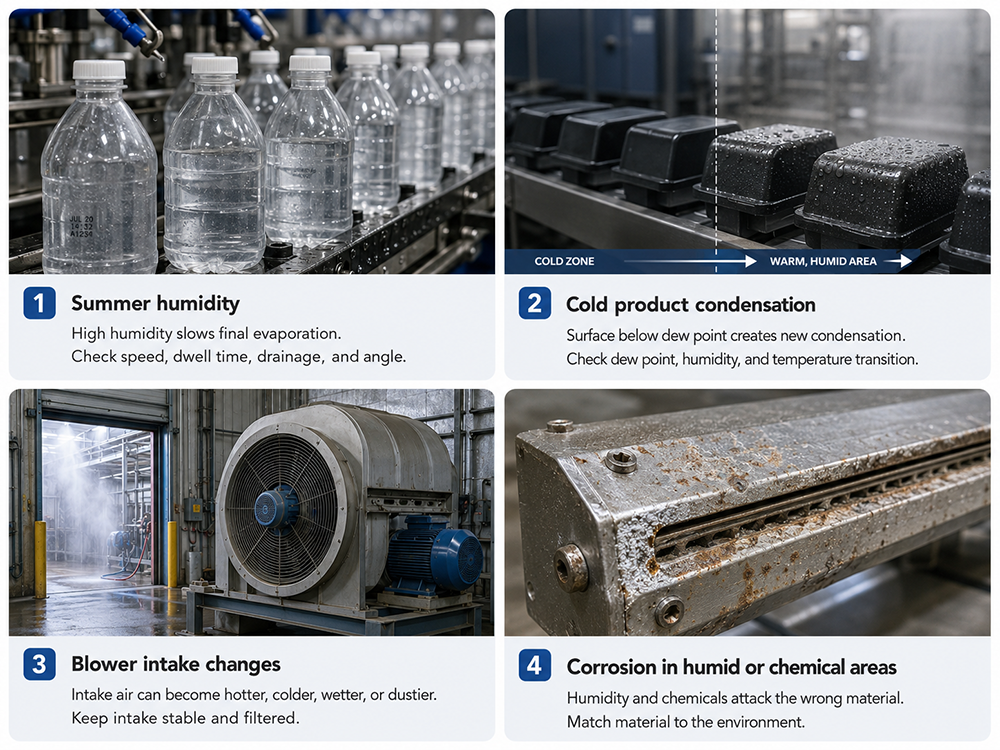
Seasonal issue 1: Summer humidity reduces drying margin
What you may see: After the air knife, the product may look dry at first. But water marks are still there. Labels may lift or fail to stick. Inkjet codes may blur. Moisture can also stay around corners, grooves, caps, or edges.
Why it happens: The air knife can remove the main layer of water. In humid weather, the small droplets and thin water film left behind evaporate more slowly. The air already contains a lot of moisture, so it cannot take up more water as easily.
What to check: Check line speed, drainage, splash-back, and whether the product has enough time to dry before the next step. Also check the knife angle. The air should push water away from the clean area, not break it into a fine mist. Raising pressure is not always the right answer in summer.
Seasonal issue 2: Cold products get wet again
What you may see: Parts look dry right after the air knife, but moisture shows up again later. This happens more often when the product moves into a warmer, more humid room.
Why it happens: The product surface may be colder than the dew point of the air around it. When that happens, moisture in the air condenses on the surface after blow-off. This is new water. It is not rinse water that the air knife missed.
What to check: Warm the product if you can, or warm the air in the drying area. Cut down the time between the cold zone and the warm zone. Control humidity, and measure the dew point near the line. Room temperature by itself does not tell you enough.
Seasonal issue 3: Blower intake air is not stable
What you may see: The same setting works one day and not the next. Drying performance can shift from day to night, from season to season, or when doors, exhaust fans, or ventilation systems switch on.
Why it happens: The blower may be pulling in air that has changed. The air could be hotter, colder, wetter, dustier, or just less stable than before. Both air density and moisture content affect how well a part dries.
What to check: Keep the blower intake air as steady and clean as you can. Don't place the intake near steam, wash-down mist, hot exhaust, open doors, or chemical vapor. During humid or dusty periods, check filters more often and replace them sooner.
Seasonal issue 4: Humid or chemical areas cause corrosion
What you may see: White oxidation, rust spots, pitting, or rough patches on the air knife body or near the slot.
Why it happens: Moisture, chemical vapor, chlorinated cleaners, salt, acids, and alkaline liquids will attack the wrong material over time. Once corrosion reaches the slot area, the opening may stop staying even. Airflow uniformity drops along with it.
What to check: Match the air knife material to the actual working environment. Aluminum alloy handles most dry or mild industrial lines fine. For wash-down areas, wet processes, chloride exposure, or chemical environments, stainless steel 304/316, PVC, or titanium is usually the better choice.
A line with a generous drying margin may run well all year. A line with a narrow margin will reveal problems when temperature or humidity moves against it. The air knife may be slightly too far from the product, angled too directly, underfed at the center, or too short for the wet area. In dry weather, the line gets away with it. In humid weather, the defect becomes visible.
Common weak points include:
· Knife-to-product distance beyond the useful impact range.
· Angle that pushes water backward or creates mist instead of drainage.
· Slot gap that is not matched to water load and line speed.
· Uneven airflow from unbalanced ducting, clogged filters, or single-inlet feeding on a long knife.
· Product temperature lower than the room dew point.
· No drain path, causing water to sit on rails, guards, or product edges.
· Material choice that cannot tolerate high humidity or cleaning chemicals.
In beverage and food packaging, summer humidity often shows up as label failure, blurred inkjet coding, water around caps, or moisture that comes back after bottles or cans have already dried. Stainless steel air knives tend to be the better pick in these areas. Wash-down processes and cleaning chemicals are just part of the job there, and stainless holds up to that in a way plain aluminum doesn't.
In PCB and electronics wet processing, seasonal humidity increases corrosion risk and may slow drying around holes, edges, and panel surfaces. If water remains inside through-holes, QXY's small hole air knife design can be considered. In chemical stations, PVC, stainless steel, or titanium may be needed depending on exposure.
In LCD glass, sheet metal, and flat panel drying, humidity and dew point can affect water marks and inspection quality. A line that looks dry at the air knife may show marks later if the product surface is cold or if evaporation is too slow. Uniform airflow matters because a small low-flow zone can become obvious under humid conditions.
A simple seasonal checklist can prevent many false conclusions. Do it before replacing the blower or ordering a larger air knife.
1. Record temperature and relative humidity near the air knife, not only at the office wall thermometer.
2. Check dew point when cold products enter a warm or humid production area.
3. Compare drying results at the start of shift, mid-shift, and after wash-down or door opening.
4. Inspect the air knife distance and angle. Use 20-50 mm and 15-45 degrees as practical starting references for many applications.
5. Check whether line speed increased during peak season without giving the drying zone more time.
6. Clean filters and inspect blower intake location. Keep intake away from steam, mist, hot exhaust, dust, and chemical vapor.
7. Inspect the slot for corrosion, residue, dents, or uneven adjustment.
8. Check whether water has a drain path and whether shields are trapping moisture near the product.
Setting | Seasonal Guidance |
Knife-to-product distance | 20-50 mm is a practical starting range for many drying applications. Re-check after seasonal changes in product temperature or liquid load. |
Impingement angle | 15-45 degrees from the surface, usually angled with the conveyor direction so water moves away from the clean area. |
Slot width | 0.5-2 mm is standard for many industrial drying applications. The final setting depends on liquid load, line speed, drying distance, air source, and product shape. |
Working pressure | 2-6 psi (0.14-0.42 bar) for many blower-driven systems. Seasonal fixes should not start with pressure alone. |
Airflow uniformity | +/-5% across knife length for QXY standard aluminum air knives. Uniformity matters more when high humidity leaves less drying margin. |
Material choice | Use stainless steel 304/316, PVC, or titanium where humidity, wash-down, chloride, acid, alkali, or chemical exposure can corrode the air knife. |
About QXY Machinery
QXY Machinery (Shenzhen Qixingyuan Machinery Equipment Co., Ltd.) is a high-tech company that works on industrial drying, dust removal, and water-blowing solutions. The company handles R&D, design, production, and sales in-house. With more than 10 years in the air knife field, QXY Machinery has built a stable technical base and its own R&D system.
QXY Machinery makes more than 15 standard air knife types, including aluminum alloy air knives, stainless steel 304/316 air knives, PVC air knives, titanium alloy air knives, small-hole PCB air knives, ring air knives, tornado air knives, and air-to-air configurations. For seasonal drying problems, QXY can look at material choice, airflow uniformity, slot width, mounting distance, angle, blower supply, and product geometry before recommending any changes.
Based in Shenzhen, China, QXY Machinery supports standard lengths from 150 mm to 1000 mm, as well as custom lengths up to 6 m. The company also supports custom hole patterns, custom slot widths, inlet layout adjustments, and material selection for PCB, LCD glass, food processing, beverage, pharmaceutical, printing, textile, and hardware production lines.
Q: Why does air knife drying get worse in humid weather?
A: High humidity slows evaporation after the air knife removes free water. The surface may look almost dry but still have a thin film or small droplets left behind, which can cause water marks, label issues, or delayed drying.
Q: Can cold products become wet again after air knife drying?
A: Yes. If the product surface is below the dew point of the surrounding air, moisture can condense on the surface after blow-off. This may look like failed drying, but it is often new condensation.
Q: Should I increase air pressure in summer?
A: Not as the first step. Higher pressure may create mist or splash-back. Check angle, distance, drainage, line speed, blower intake air, and humidity before increasing pressure.
Q: What seasonal settings should operators check first?
A: Check knife distance, angle, line speed, blower filters, intake air location, drain direction, and product temperature. For many QXY applications, 20-50 mm distance and 15-45 degrees angle are practical starting references.
Q: Does humidity affect air knife material selection?
A: Yes. High humidity plus chemicals, chloride, salt, acid, or alkaline exposure can corrode the wrong material. Stainless steel 304/316, PVC, or titanium may be needed in wet or chemical environments.
Q: Can airflow uniformity matter more in humid seasons?
A: Yes. When humidity leaves less drying margin, low-flow zones become more visible. Check inlet balance, duct leakage, filters, slot condition, and whether long knives need dual inlets.
Q: What information should I send QXY Machinery for seasonal drying help?
A: Send product type, line speed, liquid load, current air knife length, slot width, distance, angle, air source, seasonal temperature and humidity, dew point if available, and photos of the drying zone.
Need a custom air knife solution? Send us your application details, material requirement ,or air source type . Our engineering team will help you select the right model.

Shenzhen Qixingyuan Machinery Equipment Co., LTD.
info@airknifecn.com
Building 8, Wanfeng Third Industrial Zone, Xinqiao Street, Bao'an District, Shenzhen, Guangdong, China


