

Splash-back is one of the most frustrating air knife problems on a wet production line. The air knife is strong enough to move water, but the water does not leave the process cleanly. It bounces back onto the product. It forms mist around the conveyor. It wets a surface that was already dry. It lands on sensors, bearings, labels, guards, or operators.
The first reaction is often to add more air. That usually makes the problem worse. Splash-back is not just a power issue. It is usually a setup problem: the air knife may be too close, the angle may be incorrect, the pressure may be too high, the drainage path may be blocked, or the line speed may not give water enough time to leave the surface.
A good air knife setup shears liquid away. It does not hammer straight down into the wet surface. For many QXY Machinery drying applications, a practical starting point is 20-50 mm knife-to-product distance and a 15-45 degree impingement angle, with airflow angled in the direction of conveyor travel. The final setting still depends on the liquid load, product shape, line speed, and what the next process can tolerate.
When a high-speed air sheet hits a surface, it puts a lot of force into the film on that surface. The high-speed air sheet is really good at breaking up the film if the high-speed air sheet is blowing in the direction of the liquid film. The high-speed air sheet then moves the drops of water towards the edge or a drain or a special area where the water can collect. If the high-speed air sheet hits the water straight on, the water can do some pretty weird things. The water can bounce back up. Turn into tiny drops or even move in the wrong direction. This is not what we want the high-speed air sheet to do to the water. We want the high-speed air sheet to move the water in the direction.
Splash-back often shows up as one of these symptoms:
· Mist around the air knife, especially near the impact point.
· Water droplets returning to the already-dried area.
· Wet streaks downstream of the air knife.
· Water blown onto guide rails, sensors, bearings, or machine guards.
· Product movement, vibration, or label/cap disturbance.
· Residue buildup at the outlet slot because wet debris is pushed back toward the knife.
The fix is to control the water's path. Every adjustment should answer one question: after the air hits the wet surface, where does the liquid go?
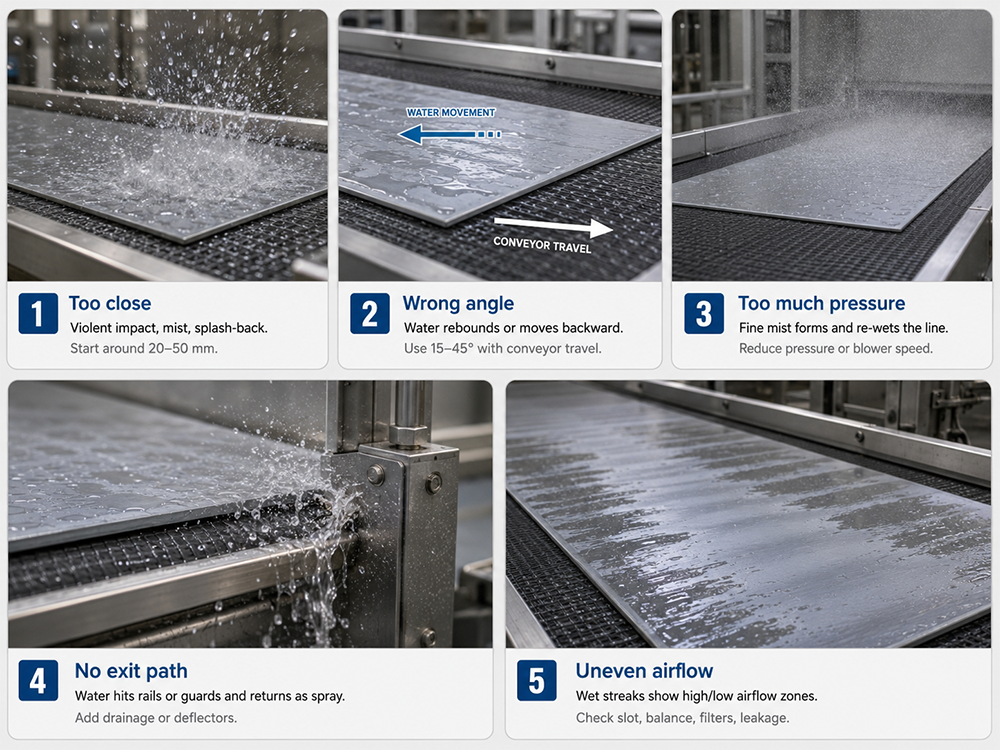
Problem 1: The air knife is too close
You see: The impact point is violent, mist forms immediately, and droplets bounce back toward the knife.
Cause: A very short distance increases local impact force. The air does not have enough space to form a useful shearing action, especially on heavy water load or uneven surfaces.
Fix: Move the knife back in small steps. Use 20-50 mm as a practical starting range for many drying duties. Keep enough clearance for raised parts, fixtures, vibration, and product variation.
Problem 2: The angle pushes water backward
You see: The surface dries briefly, then water returns from the impact zone or moves against conveyor travel.
Cause: The air is hitting too close to 90 degrees or is angled against the liquid escape direction. Instead of shearing water off, it drives water into the surface and rebounds it.
Fix: Set the air knife at a shallow working angle. QXY commonly uses 15-45 degrees from the product surface, angled with conveyor travel so liquid is pushed away from the clean zone.
Problem 3: Too much pressure creates mist
You see: The product is mostly dry, but fine droplets hang in the air or settle back onto the product and nearby machine parts.
Cause: Airflow is stronger than the water path can handle. The air breaks the liquid into small droplets rather than moving it as a controlled sheet or stream.
Fix: Reduce pressure or blower speed, widen the drain path, adjust angle, or add a first-stage removal point. For blower-driven systems, QXY commonly references 2-6 psi at the knife inlet.
Problem 4: The line has nowhere for water to go
You see: Water leaves the product but hits a rail, guard, wall, sensor bracket, or conveyor part and returns as spray.
Cause: The air knife is doing its job, but the line layout blocks the water path. Splash-back comes from the surrounding machine structure, not only the product surface.
Fix: Give the water an exit route. Add a drip tray, drainage slot, deflector, side shield, or collection area. Aim the air toward a place where liquid can leave the process safely.
Problem 5: Uneven airflow creates wet streaks
You see: Some areas dry well, while others stay wet and throw droplets downstream.
Cause: The slot gap, inlet balance, ducting, filter condition, or knife length is creating high- and low-airflow zones. A strong zone may splash while a weak zone fails to clear water.
Fix: Check slot condition, inlet balance, duct leakage, filter loading, and blower capacity. Knives over 600 mm often need dual inlets, and QXY standard aluminum knives target about +/-5% airflow uniformity.
1. Mark the wet area before and after the air knife. Note whether water rebounds at the impact point, from an edge, or from a nearby machine part.
2. Check distance. Start around 20-50 mm where practical, then adjust based on product shape, liquid load, and safety clearance.
3. Check angle. Avoid direct 90-degree impact on wet surfaces unless the process has a clear reason for it. Use a shearing angle that moves water away.
4. Check drain direction. Make sure water is pushed toward a drain, catch pan, open edge, or collection area.
5. Check pressure. Reduce force if the air knife is turning water into mist instead of moving it off the product.
6. Check the slot. Look for residue, dents, uneven gaps, or field adjustments that changed the outlet geometry.
7. Check airflow balance. Inspect hoses, manifolds, filters, leaks, and inlet placement, especially on long air knives.
8. Check the next process. If labelers, coders, inspections, or conveyors sit too close together, add a shield or a longer drying zone.
The same air knife setting will not work on every wet surface. A flat glass panel, bottle shoulder, PCB panel, meat tray, metal part, and textile web all move water differently.
· Flat surfaces usually respond well to distance and angle correction.
· Raised edges and grooves may need a second local knife, tornado air knife, or adjusted product orientation.
· Round bottles and cans may need multiple knives aimed at shoulder, cap, and label zones.
· Heavy water load may need a first-stage drain, vacuum assist, or longer exposure time before final drying.
· Food, beverage, and pharmaceutical lines may need stainless steel 304 or 316 construction, cleanable geometry, and splash shields.
· PCB chemical areas may need PVC, stainless steel, or titanium material depending on chemical exposure and temperature.
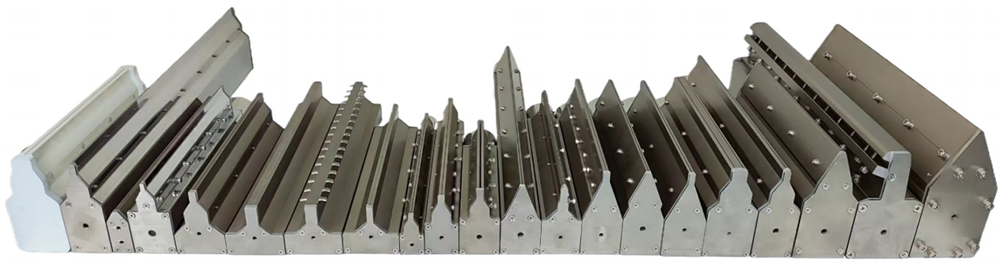
If the water problem is located in holes, pockets, or recesses, a standard slot knife may not be the only answer. QXY's product range includes small hole air knives for PCB through-hole drying, tornado air knives for complex 3D surfaces, ring air knives for cylindrical products, and air-to-air configurations for two-sided flat products.
Setting | Practical Guidance |
Knife-to-product distance | 20-50 mm is a practical starting range for many drying applications. Too close can cause splash-back, mist, vibration, product movement, or residue buildup. |
Impingement angle | 15-45 degrees from the surface, angled with conveyor travel, so air shears liquid away instead of pushing it back onto the clean area. |
Slot width | 0.5-2 mm standard for many industrial drying duties; final setting depends on water load, line speed, distance, and air source. |
Working pressure | 2-6 psi (0.14-0.42 bar) for many blower-driven systems. More pressure is not always the right fix for splash-back. |
Length and inlets | Standard lengths: 150 / 300 / 450 / 600 / 800 / 1000 mm; custom to 6 m. Knives over 600 mm often use dual inlets for balanced airflow. |
Drain direction | Air should move water toward a drain, catch pan, edge, or collection area, not into guards, sensors, bearings, or already-dried surfaces. |
QXY Machinery (Shenzhen Qixingyuan Machinery Equipment Co., Ltd.) is a high-tech enterprise integrating R&D, design, production, and sales, specializing in drying, dust removal, and water-blowing solutions for industrial applications. With over 10 years of focused expertise in the air knife field, QXY Machinery has developed a mature technical foundation and a complete in-house R&D system.
QXY Machinery makes a lot of air knives. They have over 15 kinds, including ones made from aluminum, stainless steel, and other materials. QXY Machinery can help people figure out why their air knives are not working right. They look at things like how far apart the knives are, the angle they are at, and how fast the line is moving.
QXY Machinery is a company in Shenzhen, China. They can make air knives in sizes from 150 mm to 1000 mm. They can also make custom sizes, up to 6 meters. QXY Machinery can do a lot of custom things,s like make hole patterns or change the width of the slots. They work with people who make circuit boards, glass for computers, food, drinks, medicine,ne and other things. They also work with people who print and make textiles and hardware. QXY Machinery helps people who have production lines for these things.
FAQ
Q: Why does my air knife splash water back onto the product?
A: There are a few reasons why this happens. The distance might be too short. The angle is not right. Maybe the pressure is too high, or there is no way for the water to drain. It could also be because the air is not flowing evenly or there are machine parts nearby that are reflecting the water back onto the product.
Q: Should an air knife hit a wet surface at 90 degrees?
A: No, that is not usually an idea. When the air knife hits the surface at 90 degrees, it can push the water into the surface. It makes droplets bounce back. Most of the time it works better if the air knife hits the surface at an angle like 15-45 degrees and it is aimed in the direction the conveyor is moving.
Q: What is a good air knife distance to prevent splash-back?
A: For a lot of drying applications, a good distance to start with is 20-50 mm. If the air knife is too close, it can cause splash-back. Make a mist. If it is too far away, it might not be able to get rid of all the water.
Q: Does more air pressure fix splash-back?
A: Not always. Sometimes more pressure can make the splash-back worse because it turns the water into a mist. First, you should check the angle, distance, and direction of the drain. Make sure the air is flowing evenly before you try increasing the pressure.
Q: How can I stop water from landing on sensors or bearings?
A: You can aim the airflow towards a drain or a collection area. You can also add shields or deflectors to protect the parts. Another thing you can do is move the components away from where the water is spraying. Try not to blow water into the machine guards or rails.
Q: Can uneven airflow cause splash-back?
A: Yes. Uneven airflow can cause some areas to splash while other areas remain wet. Check the slot gap, inlet balance, duct leaks, and filter condition.You should also think about whether you need inlets for long air knives.
Q: When should I use a different air knife type?
A: Use another design when the surface shape creates the problem. Small hole knives help PCB through-holes, tornado knives help recesses and edges, ring knives help round products, and air-to-air knives help two-sided flat parts.
Need a custom air knife solution? Send us your application details, material requirement ,or air source type . Our engineering team will help you select the right model.

Shenzhen Qixingyuan Machinery Equipment Co., LTD.
info@airknifecn.com
Building 8, Wanfeng Third Industrial Zone, Xinqiao Street, Bao'an District, Shenzhen, Guangdong, China


