

A standard straight air knife is often the first choice for industrial drying and blow-off. It gives a continuous sheet of air across a product path. For flat panels, sheets, bottles in a stable position, conveyor parts, and many surface drying jobs, that is exactly what the line needs.
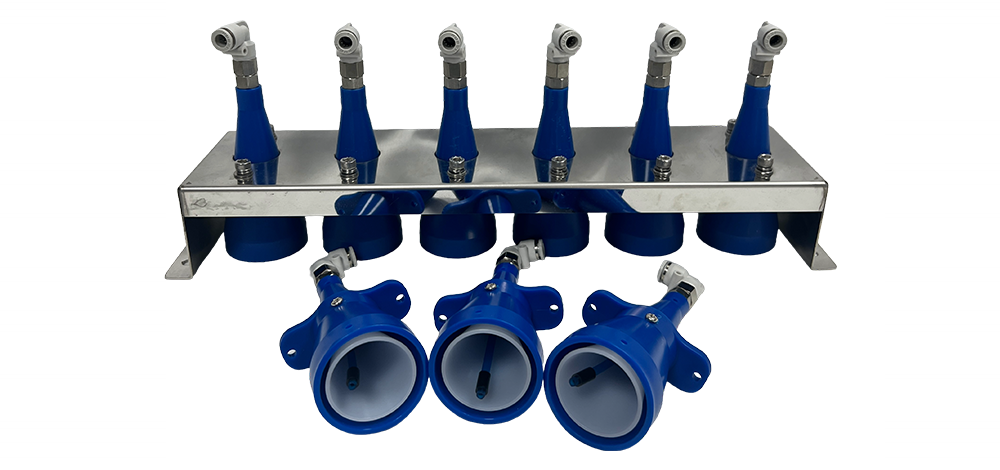
A tornado air knife solves a different problem. It is used when a flat air curtain cannot reach the places where water, dust, chips, or residue remain. The issue may be a recessed groove, a raised edge, a corner, a fixture shadow, a pocket, or a product shape that changes as it moves through the line.
The decision should not be based on which design sounds stronger. It should be based on what the airflow must touch. If the target is a broad flat surface, a straight air knife is usually simpler and easier to control. If the target has 3D geometry that keeps trapping liquid or particles after a straight knife, a tornado air knife may be the better tool.
Two products in the same industry can need different air knife designs. A flat glass panel and a shaped plastic tray are both production parts, but the airflow problem is not the same. A PCB panel surface and a PCB through-hole area are not the same either.
Before choosing between a tornado air knife and a standard straight air knife, look at the surface where the defect remains.
· Is the problem on one open flat face, or inside a recess?
· Does water stay at an edge, shoulder, lip, hole, groove, or pocket?
· Does a fixture, clamp, guide rail, or conveyor part block direct airflow?
· Does the product rotate, wobble, tilt, or change position as it passes the drying zone?
· Is the target area narrow and local, or is it a full-width surface?
These questions matter because airflow follows the geometry in front of it. A straight slot creates a controlled linear sheet. That sheet is good at sweeping across an exposed surface. It is less effective when the target sits behind a raised feature or inside an uneven shape.
A standard straight air knife is built for linear coverage. It creates a continuous air curtain along the knife length. On the right line, this gives stable, repeatable drying with simple adjustment.
Use a standard straight design when the part has an open surface and the line needs even coverage across width. Common examples include LCD glass cleaning, sheet metal blow-off, flat food packages, bottle label panels, web drying, conveyor cleaning, and general surface drying after rinsing.
QXY's standard aluminum alloy air knives are designed around this type of duty. The standard slot range is 0.5-2 mm for many industrial drying tasks. Standard lengths include 150, 300, 450, 600, 800, and 1000 mm, with custom lengths up to 6 m. For long straight knives, inlet balance matters. QXY standard aluminum air knives target about +/-5% airflow uniformity across the knife length, and knives over 600 mm commonly use dual inlets.
The straight design is usually easier to size, easier to mount, and easier to explain to maintenance teams. If it dries the part fully, there is no reason to make the airflow more complex.
A tornado air knife uses rotating or turbulent airflow instead of a simple linear air sheet. The goal is not to create the cleanest flat curtain. The goal is to attack the surface from changing directions so air can reach edges, recesses, uneven shapes, and local pockets.
QXY's tornado air knife reference describes it as a better fit for complex 3D surfaces, recessed areas, product edges, and fixture cleaning. In practical terms, it can help when a normal slot knife blows across the top of the part but leaves water or debris behind in hidden areas.
That does not mean a tornado air knife is automatically better. Rotating airflow can be harder to predict on a wide flat surface. If a line needs clean, full-width coverage with no high and low spots, a standard straight air knife often remains the better starting point.
The strongest reason to choose a tornado air knife is a repeated defect that remains after straight-line blow-off. The product may look dry on the main face, but water sits in a groove. Dust stays behind a raised rib. Machining chips collect near a fixture. A cap shoulder dries on one side but not the other.
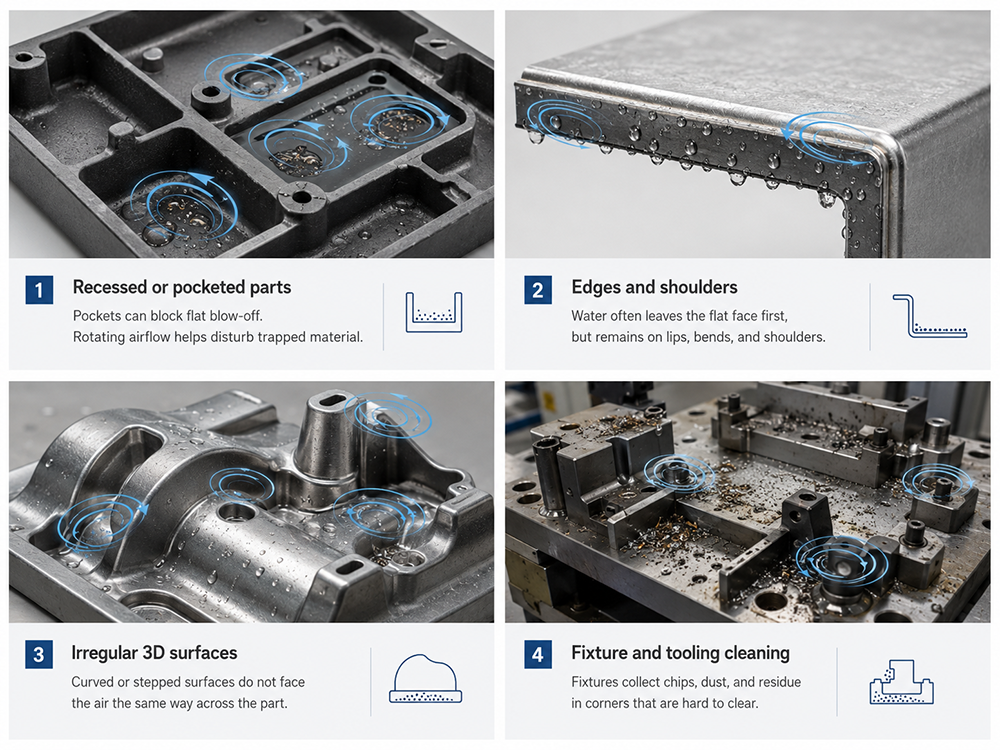
Molded trays, castings, machined housings, stamped parts, and fixtures can have pockets that block a flat air sheet. Rotating airflow gives the air more chance to disturb material sitting inside these areas.
Edges are common failure points. Water breaks away from a flat surface but clings to a lip, bend, bottle shoulder, cap edge, or panel corner. A tornado air knife can be used as a local finishing stage after a straight knife has removed most of the water.
Some parts do not present the same angle to the air knife across the whole width. The surface may curve, step, tilt, or pass through the air zone in a different orientation each cycle. A rotating air pattern may give more contact than a single-direction sheet.
Production fixtures collect dust, chips, coolant, powder, or product residue in corners. A straight slot may pass over the fixture surface without clearing the hidden area. A tornado air knife can be useful where the cleaning target is the fixture, not only the product.
A tornado air knife should not replace a straight air knife just because a line has a drying problem. Many drying issues come from poor distance, wrong angle, weak blower sizing, uneven slot gap, bad inlet balance, or an air knife that is too short for the product width.
For flat surfaces, the first correction is usually to fix the straight system. Check the knife-to-product distance, normally 20-50 mm for many drying applications. Check the impingement angle, often 15-45 degrees in the travel direction. Check whether the air knife is long enough to cover the wet area, and whether a knife over 600 mm has enough inlet support.
Use a standard straight air knife when the line needs predictable full-width airflow, lower setup complexity, easy visual alignment, and uniform coverage across sheets, panels, films, webs, containers, or flat conveyor products.
Before switching from a standard straight design to a tornado air knife, run a few checks. They prevent the team from solving the wrong problem.
1. Mark the wet or dirty area after the existing air knife. If the remaining defect is random across a flat surface, the problem may be air balance. If it always sits in a groove, edge, or pocket, geometry is likely the issue.
2. Check distance and angle. A straight knife mounted too far away or pointed too flat may fail even on simple surfaces.
3. Check line speed. A faster line may need a longer exposure zone, a second knife, or a different mounting position.
4. Check the air source. A rotating design still needs enough air volume and pressure to reach the target.
5. Check containment. More aggressive local airflow may move water or debris into nearby sensors, bearings, labels, or clean areas.
6. Check whether a combined design is better. Many lines use a straight air knife for the main surface and a tornado air knife for the difficult edge or recess.
One common mistake is treating tornado airflow as a universal upgrade. It is not. It is a special airflow pattern for special geometry. If the process needs wide, even surface coverage, the standard straight design usually gives better control.
Another mistake is using only higher pressure to solve a geometry problem. More pressure may move more water from the easy area while the recess stays wet. It may also create splashback, noise, and energy waste.
A third mistake is ignoring mounting space. A tornado air knife may need a different angle, local position, or guard design. If the machine frame blocks the useful airflow path, the part will still be difficult to dry.
Selection Item | Practical Meaning |
Standard straight air knife | Best for flat or nearly flat surfaces, wide sheets, panels, containers, conveyor blow-off, and continuous linear drying. |
Tornado air knife | Rotating/turbulent airflow for complex 3D surfaces, recessed areas, product edges, fixture shadows, and non-flat geometries. |
Standard slot range | 0.5-2 mm for many industrial drying tasks; set at factory per order. |
Straight knife uniformity | +/-5% airflow uniformity across knife length for QXY standard aluminum air knives. |
Common straight lengths | 150 / 300 / 450 / 600 / 800 / 1000 mm; custom lengths up to 6,000 mm. |
Working distance | 20-50 mm is a common target for many drying and blow-off applications. |
Material options | Aluminum alloy standard for many dry industrial duties; stainless steel, PVC, titanium, and other materials selected by environment. |
About QXY Machinery
QXY Machinery (Shenzhen Qixingyuan Machinery Equipment Co., Ltd.) is a high-tech enterprise integrating R&D, design, production, and sales, specializing in drying, dust removal, and water-blowing solutions for industrial applications. With over 10 years of focused expertise in the air knife field, QXY Machinery has developed a mature technical foundation and a complete in-house R&D system.
QXY Machinery produces over 15 standard air knife types, including aluminum alloy, stainless steel 304/316, PVC, titanium alloy, small hole PCB air knives, ring air knives, tornado air knives, and air-to-air configurations. For lines with irregular parts, recessed surfaces, edge drying problems, or fixture cleaning needs, QXY can help compare a tornado air knife with a standard straight air knife before the design is finalized.
Based in Shenzhen, China, QXY Machinery supports standard lengths from 150 mm to 1000 mm and custom lengths up to 6 m. The company also supports custom hole patterns, custom slot widths, inlet layout adjustments, and material selection for PCB, LCD glass, food processing, beverage, pharmaceutical, printing, textile, and hardware production lines.
Q: What is a tornado air knife used for?
A: A tornado air knife is used for complex 3D surfaces, recessed areas, product edges, fixture cleaning, and non-flat geometries where a standard straight air curtain cannot reach the problem area well.
Q: Is a tornado air knife better than a standard straight air knife?
A: Not always. A tornado air knife is better for difficult geometry. A standard straight air knife is usually better for wide, flat, continuous surfaces that need even linear coverage.
Q: When should I keep using a standard straight air knife?
A: Keep using a straight design when the target is a flat sheet, panel, web, conveyor product, bottle label area, or other open surface where full-width uniform airflow is the main requirement.
Q: Can a tornado air knife fix wet edges after straight air drying?
A: It can help when water remains at lips, bends, shoulders, grooves, and corners. Many lines use a straight air knife for the main surface and a tornado air knife as a local finishing stage.
Q: Does a tornado air knife need more air pressure?
A: Not necessarily. The correct air supply depends on the design, distance, target area, and required force. More pressure alone will not fix poor mounting angle or blocked airflow.
Q: What should I check before switching to a tornado air knife?
A: Check the remaining wet area, product shape, mounting distance, angle, line speed, air source, splash direction, and whether the defect is caused by geometry or by poor straight-knife setup.
Q: Can QXY Machinery customize tornado air knife materials and layout?
A: Yes. QXY Machinery can support material selection, custom layout, inlet configuration, and application-specific design across tornado, straight, ring, small hole, and air-to-air air knife types.
Need a custom air knife solution? Send us your application details, material requirement ,or air source type . Our engineering team will help you select the right model.

Shenzhen Qixingyuan Machinery Equipment Co., LTD.
info@airknifecn.com
Building 8, Wanfeng Third Industrial Zone, Xinqiao Street, Bao'an District, Shenzhen, Guangdong, China


