

A custom-length industrial air knife looks simple on a drawing. One long body, one narrow slot, one air supply connection. On the production line, the details become less simple. The knife has to cover the product. It has to fit the machine frame. It has to receive enough air across the full length. It has to blow water, dust, chips, powder, or coating in the right direction without creating new problems.
Many ordering mistakes start with one sentence: "We need a 1,200 mm air knife." Length matters, but it is not enough. A 1,200 mm air knife with the wrong inlet position may have a weak center. A knife that is too long may waste blower capacity at the edges. A knife that is too short may leave wet stripes. A knife that cannot be mounted at the right angle may never dry well, even if the body length is correct.
Before ordering a custom-length industrial air knife, check the actual product width, conveyor width, line speed, wet area, mounting space, air source, material requirement, and cleaning environment. These checks help the supplier design the air knife around the process instead of forcing the process to accept a catalog shape.
The first question is not "How long should the air knife be?" The first question is what the air knife must remove. A line drying rinse water from PCB panels has different needs from a line blowing dust off sheet metal. A bottle line before labeling needs focused drying around shoulders, caps, or label panels. A glass or LCD line may need even coverage across a wide flat surface.
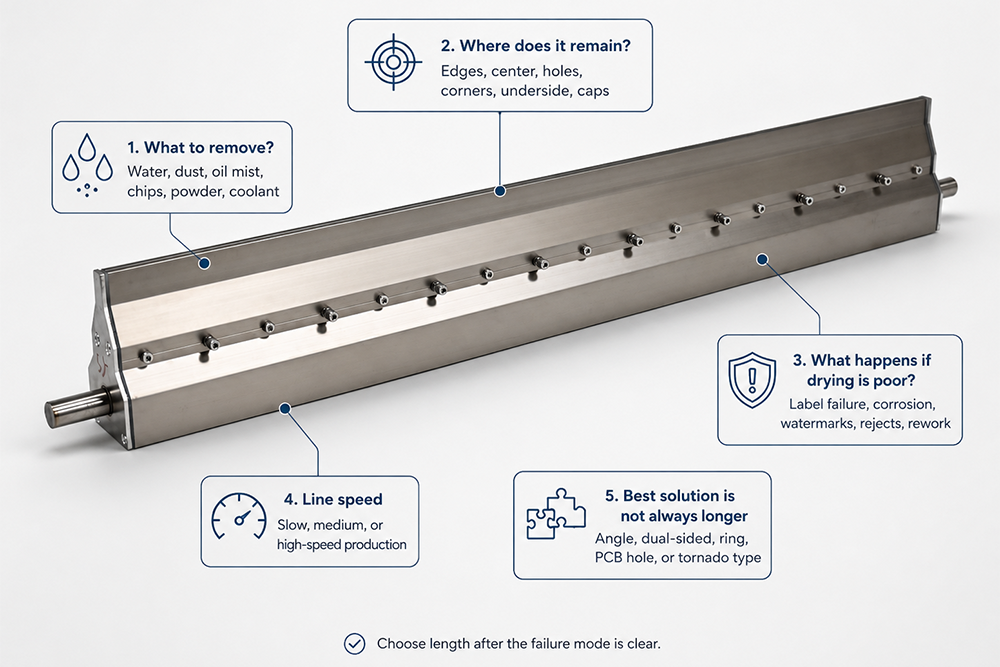
Describe the problem in practical terms before choosing length.
· What is being removed: water, oil mist, chemical carryover, dust, chips, powder, coolant, or loose particles?
· Where does the problem remain: edges, center, holes, corners, underside, bottle neck, cap area, or full surface?
· What happens if drying is poor: label failure, corrosion, watermarking, dust attraction, rejected inspection, poor coating, or manual rework?
· How fast the product moves: slow inspection conveyor, medium packaging line, or high-speed continuous production?
Once the failure mode is clear, length can be chosen with better judgment. A longer air knife is not always the answer. Sometimes the process needs a different angle, dual-sided knives, a ring air knife, a small hole PCB air knife, or a tornado air knife for recessed shapes.
Custom length should be based on the actual area that needs air coverage, not only the outside width of the machine. Measure three widths: product width, wet width, and available conveyor width.
Product width is the maximum width of the part. Wet width is the area where liquid or debris must be removed. Conveyor width is the space the air knife can safely cover without hitting guards, rails, sensors, or operators. These numbers are often different.
For example, a PCB may be 600 mm wide, but the conveyor opening may be 650 mm. A 700 mm air knife may give useful margin at both edges. For a wide panel line, the required blade may be much longer, but then inlet balance becomes more important. QXY's standard lengths include 150, 300, 450, 600, 800, and 1000 mm, with custom lengths available up to 6,000 mm.
Do not add too much extra length without reason. Air leaving the slot outside the useful target area still consumes blower capacity. It may also blow water toward rails, guards, bearings, or sensors.
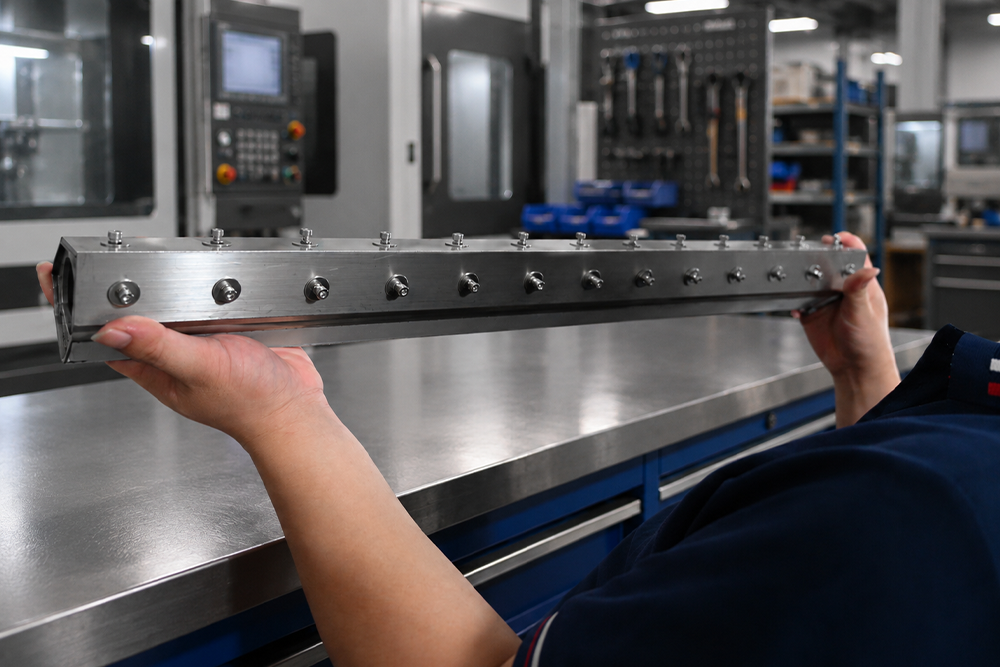
A single long air knife is attractive because it looks clean and simple. On wide lines, though, one long blade may not be the best answer. Long bodies need stronger attention to rigidity, inlet balance, slot consistency, mounting support, and shipping protection.
Multiple shorter knives may be better when the line has separate lanes, uneven product spacing, tight machine frames, or maintenance access limits. They can also let operators adjust each zone separately. The tradeoff is more pipework, more brackets, and more points to balance.
Use one long knife when the target is a continuous flat width and the machine can support it properly. Consider multiple knives when the product path is divided, the drying target is only in certain zones, or the frame makes a full-width blade hard to install.
Length affects air distribution. As an air knife becomes longer, one inlet may not feed the full slot evenly. The far end can become weak, the middle can lose impact force, or the inlet side can over-blow compared with the opposite side.
QXY's common reference is direct: standard aluminum air knives up to 600 mm commonly use one inlet, while knives over 600 mm often use dual inlets to help keep airflow balanced. The standard inlet diameter is 50 mm for many models, with other sizes available. For large-bore designs, inlet size and position may be changed to match the blower, manifold, and machine layout.
Do not treat dual inlets as a decoration. They need a balanced air supply. A Y-split manifold, equal hose lengths where possible, proper duct sizing, and low-pressure-loss routing all affect the final result. If one side receives more air than the other, the knife may still show uneven drying.
For custom-length orders, send a sketch showing where the blower or compressed air source is located. Also note whether the inlet must be on the end, side, bottom, or rear because of nearby machine guards or pipe routing.
The slot gap controls how the air sheet exits the knife. A smaller gap can create a sharper air sheet but may need cleaner air and careful factory setting. A larger gap can move more volume but may use more blower capacity. The right setting depends on line speed, water load, working distance, product shape, and air source.
QXY's common slot range for many industrial drying tasks is 0.5-2 mm, set at the factory per order. For PCB surface drying, 0.5-1.5 mm is often used as a reference range. For general industrial drying, 0.5-2 mm is common. The slot should not be adjusted casually in the field unless the design allows it and the operator knows how to check uniformity.
Blower-driven systems often work around 2-6 psi (0.14-0.42 bar) at the knife inlet. Compressed air systems may use plant air at higher pressure, but the running cost can be much higher if the design wastes air. For a custom-length industrial air knife, the supplier should know whether the air source is a blower, compressed air, or an existing plant manifold.
Length is only one part of the order. Material choice can decide whether the air knife lasts, stays clean, and survives the local environment.
Aluminum alloy air knives are common for general industrial drying, blow-off, packaging, electronics assembly, and dry zones with low chemical exposure. QXY's standard aluminum alloy air knife uses a hard-anodized surface and a dual-deflector internal design for uniform exit velocity.
Stainless steel air knives are better for food processing, beverage bottling, pharmaceutical packaging, chemical washdown, wet zones, and hygienic environments. Grade 304 works for many general food and water-based applications. Grade 316 is the safer choice where chloride, salt, acidic products, meat, seafood, dairy, or stronger cleaning chemicals are present.
PVC air knives can be useful near acid or alkaline chemical areas where aluminum would corrode and temperature is not high. Titanium alloy air knives are reserved for highly corrosive environments where stainless steel has documented limits. The supplier should know the liquid, cleaning chemical, temperature, and contact risk before recommending material.
A custom-length air knife can be built correctly and still fail if there is no room to install it at the right angle. Measure the available space around the conveyor before confirming the drawing.
For many drying and blow-off applications, QXY uses 20-50 mm as a common knife-to-product working distance. Beyond about 60 mm, the air impact can drop enough to affect drying. The usual impingement angle is 15-45 degrees from the product surface, angled in the direction of conveyor travel so water is sheared away instead of pushed backward.
Check the following before the order is released.
· Can the air knife be mounted 20-50 mm from the target without touching products or fixtures?
· Can the angle be adjusted after installation?
· Will the air blow water into a drain, shield, or collection area instead of onto bearings or sensors?
· Is there space for hose bends, manifolds, clamps, and service access?
· Will the bracket support the full length without sagging or vibration?
· Can operators remove or clean the air knife without dismantling half the machine?
A good inquiry saves time. It also reduces the risk of receiving an air knife that looks correct but underperforms on the line. Send the supplier a short process summary, not just a length.
1. Product details: shape, maximum width, height, material, surface type, and whether both sides need drying.
2. Conveyor details: belt width, product path width, line speed, product spacing, and whether the line is continuous or indexed.
3. Drying or blow-off target: water, dust, chips, chemical liquid, oil mist, powder, coating edge, label area, holes, or recessed zones.
4. Required air knife length: product width, wet width, desired edge margin, and any maximum machine-frame limit.
5. Air source: blower, compressed air, existing manifold, available pressure, flow capacity, pipe diameter, and distance from source to knife.
6. Installation layout: photos, sketch, available height, mounting side, inlet direction, drain direction, and nearby guards or sensors.
7. Material and environment: water, chemical, temperature, washdown, food contact, cleanroom needs, corrosion risk, and surface finish requirement.
8. Expected result: acceptable dryness level, inspection requirement, downstream process, and current problem if replacing another drying method.
Item to Confirm | QXY Reference / Ordering Note |
Standard lengths | 150 / 300 / 450 / 600 / 800 / 1000 mm |
Custom length range | Custom lengths up to 6,000 mm for wide conveyors, panels, sheets, and special machines |
Slot width | 0.5-2 mm standard for many industrial drying tasks; set at factory per order |
Air inlet | 50 mm standard inlet; dual inlets commonly used for knives over 600 mm |
Airflow uniformity | +/-5% across knife length for QXY standard aluminum air knives |
Working pressure | 2-6 psi (0.14-0.42 bar) for blower-driven systems |
Working distance | 20-50 mm for many drying and blow-off applications |
Custom options | Length, slot width, hole pattern, inlet direction, inlet quantity, material, mounting method, and surface finish |
About QXY Machinery
QXY Machinery (Shenzhen Qixingyuan Machinery Equipment Co., Ltd.) is a high-tech enterprise integrating R&D, design, production, and sales, specializing in drying, dust removal, and water-blowing solutions for industrial applications. With over 10 years of focused expertise in the air knife field, QXY Machinery has developed a mature technical foundation and a complete in-house R&D system.
QXY Machinery produces over 15 standard air knife types, including aluminum alloy, stainless steel 304/316, PVC, titanium alloy, small hole PCB air knives, ring air knives, tornado air knives, and air-to-air configurations. For custom-length industrial air knife projects, QXY can match blade length, slot width, inlet direction, inlet quantity, material, mounting method, and airflow layout to the real production line.
Based in Shenzhen, China, QXY Machinery supports standard lengths from 150 mm to 1000 mm and custom lengths up to 6 m. The company also provides custom hole patterns, custom slot widths, and application support for PCB, LCD glass, food processing, beverage, pharmaceutical, printing, textile, and hardware production lines.
Q: What is the best length for a custom industrial air knife?
A: The best length depends on product width, wet width, conveyor opening, and edge margin. The air knife should cover the target area without wasting too much air outside the useful drying zone.
Q: When does a custom-length air knife need dual inlets?
A: As a QXY reference, standard aluminum air knives up to 600 mm commonly use one inlet, while knives over 600 mm often use dual inlets to help maintain balanced airflow across the full slot.
Q: Can QXY Machinery make air knives longer than 1000 mm?
A: Yes. QXY's standard lengths include 150, 300, 450, 600, 800, and 1000 mm, and custom lengths can extend up to 6,000 mm depending on material, design, inlet layout, and application needs.
Q: Should I order one long air knife or several shorter air knives?
A: Use one long knife for continuous flat coverage when the frame can support it. Use several shorter knives when the line has separate lanes, tight access, divided drying zones, or different adjustment needs across the width.
Q: What slot width should I choose for a custom air knife?
A: For many industrial drying tasks, QXY uses a 0.5-2 mm standard slot range set at the factory. The right slot depends on line speed, water load, air source, working distance, and product shape.
Q: What working distance should I design around?
A: For many drying and blow-off applications, 20-50 mm is a practical knife-to-product distance. Longer distances can reduce impact force and may cause weak drying, especially at higher line speeds.
Q: What drawing or information should I send before ordering?
A: Send product width, conveyor width, line speed, drying problem, air source, available mounting space, preferred inlet direction, material requirement, photos of the line, and a sketch showing the target area.
Need a custom air knife solution? Send us your application details, material requirement ,or air source type . Our engineering team will help you select the right model.

Shenzhen Qixingyuan Machinery Equipment Co., LTD.
info@airknifecn.com
Building 8, Wanfeng Third Industrial Zone, Xinqiao Street, Bao'an District, Shenzhen, Guangdong, China


