

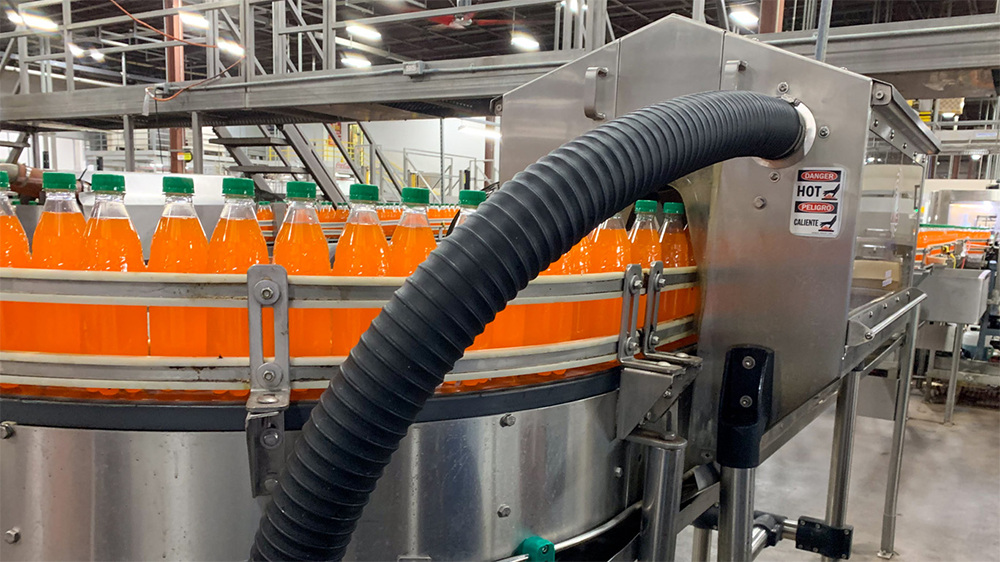
Many production lines run more than one product size. A bottle line may switch between short and tall containers. A tray line may run several widths. A PCB washer may process different panel sizes. A packaging line may change product height, shape, and spacing during the same week.
One air knife station can often handle multiple product sizes. But it cannot do that just because the air knife is long enough or the blower is strong enough. The station needs a defined process window. The product sizes must stay inside a range where air coverage, mounting distance, angle, air volume, drainage direction, and clearance still work.
Before using one air knife station for several SKUs, review the largest product, smallest product, wettest product, tallest product, fastest line speed, and hardest-to-dry feature. The weak case usually decides whether one station is practical.
A multi-size air knife station works when the differences between products are manageable. Width changes may be easy if the air knife already covers the full wet area. Height changes are more sensitive because distance and angle change quickly. Shape changes can be harder again, especially if one product has grooves, shoulders, caps, holes, or recessed areas that a flat air curtain cannot reach.
Think of the station as a controlled drying zone. It has limits:
· Minimum and maximum product width.
· Minimum and maximum product height.
· Product spacing and line speed range.
· Wet load range after washing, rinsing, cooling, or coating.
· Allowed air knife distance and angle for each product family.
· Blower or valve settings that operators can repeat.
Do not start with the average product. Start with the full product envelope. List the smallest, largest, tallest, shortest, widest, narrowest, lightest, and most fragile product that will pass through the station.
Then review what actually needs drying. The widest product may not be the hardest case. A narrow product with a deep cap shoulder, raised edge, through-hole, or recessed label panel may need more careful airflow than a wide flat product.
For each product size, record product width, height, target drying area, wet area, required dryness, line speed, and product stability. If a product can move, tip, vibrate, or rotate under airflow, the station must be adjusted around that risk.
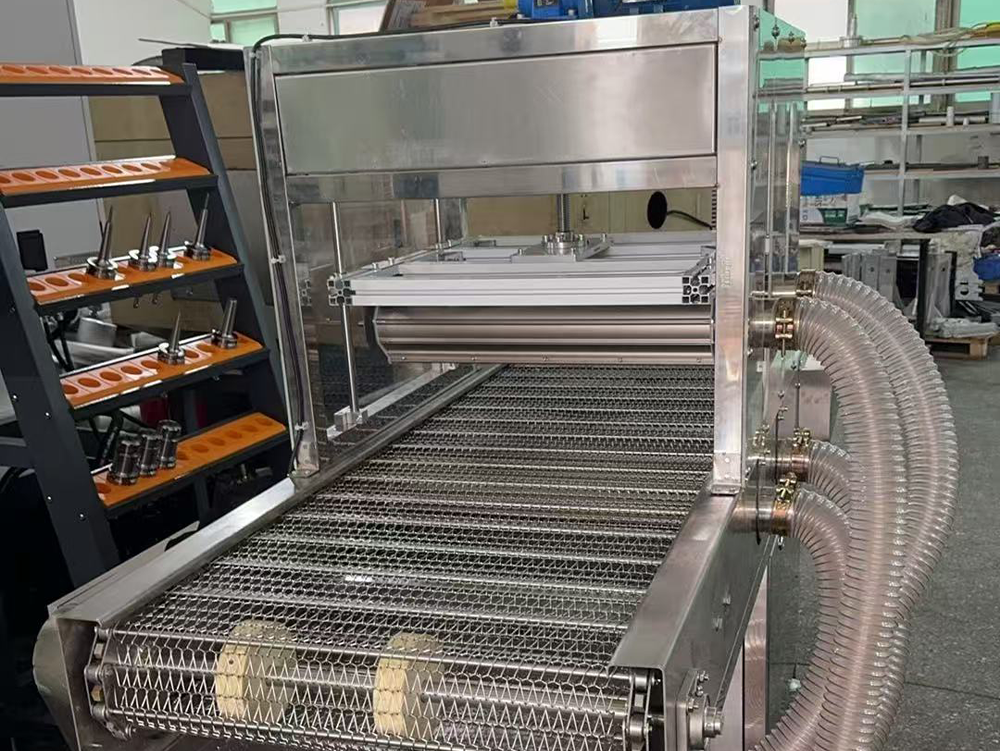
An Air Knife should cover the useful wet area, not simply the conveyor width. Too short leaves wet edges. Too long wastes air and may blow water into rails, guards, sensors, or nearby products.
QXY standard lengths include 150, 300, 450, 600, 800, and 1000 mm, with custom lengths up to 6 m. For multi-size production, choose the air knife around the widest product that genuinely needs airflow. If smaller products run centered on the conveyor, the station may work well. If smaller products run against one guide rail, the air knife may waste air on one side and miss the real wet zone on the other.
For wide or long knives, airflow balance matters. QXY references dual inlets for knives over 600 mm because one inlet may not feed the full slot evenly. A multi-size station with uneven coverage will become harder to control during changeover.
Height change is often the real limit. A 30 mm height difference can move the product outside the best impact zone if the air knife is fixed. For many QXY drying applications, 20-50 mm is a practical knife-to-product distance. The common angle reference is 15-45 degrees from the product surface, angled with conveyor travel.
If one product is much taller than another, the air knife may be too close to the tall product and too far from the short product. Too close can cause splash-back, mist, product movement, and clearance problems. Too far can leave water behind.
A good multi-size station usually needs adjustable brackets, marked positions, or servo/handwheel adjustment. Operators should not guess the angle every time a new SKU runs.
The largest product is not always the wettest product, but it often sets the air volume requirement. A wide product may need more coverage. A faster product may need stronger or longer exposure. A product with pockets, holes, caps, or raised edges may need a second knife, air nozzle, tornado air knife, ring air knife, or air-to-air configuration.
QXY's general blower-driven reference is 2-6 psi at the air knife inlet. Standard slot width for many industrial drying tasks is 0.5-2 mm. Some adjustable QXY models support wider edge-gap ranges for broader product families, but field adjustment should still be controlled. Opening the slot too far can waste air; closing it too far can reduce coverage or create a setup that is too sensitive to dirt and alignment.
If one product size requires much more air than the others, use repeatable blower speed or valve settings. Do not make operators adjust by sound or feel.
A multi-size station only works if changeover is repeatable. The first shift and second shift should not create different drying results because one operator remembers the angle differently.
Use simple controls where possible:
· Scale marks for height and angle.
· Mechanical stops for common product families.
· Saved blower speed or valve positions.
· Documented distance from knife outlet to product surface.
· Test strips or inspection points after each changeover.
· A short setup sheet showing product size, line speed, air setting, bracket position, and expected dry area.
The goal is not to make the station complex. The goal is to prevent small setup drift from becoming wet labels, water marks, rejected boards, failed coding, or manual rework.
One air knife station is not always the right answer. Splitting the duty can be cheaper than forcing one station to cover every condition.
Consider more than one station when:
· Product heights are too different to keep a useful distance and angle.
· One product needs top drying while another needs side, bottom, or 360-degree drying.
· Small products blow out of position under the air setting needed for large products.
· The widest product needs dual inlets or a long knife, but narrow products need focused local air.
· One product has holes, grooves, caps, or recessed edges that a straight air knife cannot reach.
· Hygienic or chemical requirements differ by product family.
In these cases, a second knife, adjustable side knife, ring air knife, tornado air knife, small hole air knife, or separate recipe-based station may give better stability than one over-stretched setup.
Review Item | QXY Reference / Practical Meaning |
Coverage width | QXY standard lengths include 150 / 300 / 450 / 600 / 800 / 1000 mm, with custom lengths up to 6 m. Choose around the widest useful wet area, not only conveyor width. |
Distance range | 20-50 mm is a practical knife-to-product distance for many drying duties. Multi-size stations need brackets that can repeat this range. |
Angle range | 15-45 degrees from the product surface, normally angled with travel direction, helps water move away from the clean zone. |
Slot width | 0.5-2 mm standard for many industrial drying tasks. Some QXY adjustable models support wider adjustment ranges for different wet loads. |
Air supply | 2-6 psi (0.14-0.42 bar) for many blower-driven systems. Different product sizes may need repeatable blower or valve settings. |
Long knives | Knives over 600 mm often need dual inlets for balanced airflow across the full length. |
About QXY Machinery
QXY Machinery (Shenzhen Qixingyuan Machinery Equipment Co., Ltd.) is a high-tech enterprise integrating R&D, design, production, and sales, specializing in drying, dust removal, and water-blowing solutions for industrial applications. With over 10 years of focused expertise in the air knife field, QXY Machinery has developed a mature technical foundation and a complete in-house R&D system.
QXY Machinery produces over 15 standard air knife types, including aluminum alloy, stainless steel 304/316, PVC, titanium alloy, small hole PCB air knives, ring air knives, tornado air knives, and air-to-air configurations. For multi-size production lines, QXY can help review product envelope, wet area, line speed, mounting distance, angle, slot width, inlet layout, material, and changeover method.
Based in Shenzhen, China, QXY Machinery supports standard lengths from 150 mm to 1000 mm and custom lengths up to 6 m. The company also supports custom hole patterns, custom slot widths, inlet layout adjustments, and material selection for PCB, LCD glass, food processing, beverage, pharmaceutical, printing, textile, and hardware production lines.
Q: Can one air knife station handle multiple product sizes?
A: Yes, if all product sizes stay inside a defined drying window for width, height, distance, angle, airflow, line speed, and wet load. The full product envelope must be reviewed first.
Q: What should I check first for a multi-size air knife station?
A: Start with product width, height, wet area, target drying location, line speed, product stability, and the hardest-to-dry feature. Do not design around the average product only.
Q: Does air knife length need to match the widest product?
A: It should cover the widest useful wet area, not necessarily the full conveyor width. Too short leaves wet edges, while too long may waste air and blow water into machine parts.
Q: How do product height changes affect air knife drying?
A: Height changes alter knife-to-product distance and impact angle. If the distance moves outside the useful range, one product may splash while another remains wet.
Q: Should operators adjust slot width for every product size?
A: Only if the air knife design and process plan allow it. Slot changes should be documented and repeatable. Many problems are better solved first by checking distance, angle, and air supply.
Q: When is one air knife station not enough?
A: One station may not be enough when products differ greatly in height, shape, wet load, drying side, material sensitivity, or required airflow direction.
Q: What information should I send QXY Machinery?
A: Send all product sizes, line speed, conveyor width, wet area, current drying problem, air source, available space, material environment, and photos or sketches of the station.
Need a custom air knife solution? Send us your application details, material requirement ,or air source type . Our engineering team will help you select the right model.

Shenzhen Qixingyuan Machinery Equipment Co., LTD.
info@airknifecn.com
Building 8, Wanfeng Third Industrial Zone, Xinqiao Street, Bao'an District, Shenzhen, Guangdong, China


