

Drying often becomes the slowest stage in an automated parts washer. Wash and rinse may finish on time, yet water remains on ledges, inside pockets, or between parts in a basket. Raising dryer temperature adds heat load and may still leave droplets in sheltered areas.
An air knife changes the job before evaporation begins. A high-velocity air sheet pushes free water toward the machine drain. The downstream dryer then handles a thin film and fewer trapped droplets, not the full rinse-water load. That is the main reason an Air Knife can shorten the drying cycle.
“Dry” changes with the next operation. A stamped bracket going to a storage bin may only need no visible droplets. A machined housing may need dry blind holes to prevent corrosion or fluid carryover. Parts going to painting, adhesive bonding, welding, leak testing, or machine vision need a more controlled surface condition.
Cycle time should be measured to that endpoint. Start the clock when the part leaves the final rinse and stop it when all critical surfaces pass the agreed test. A shorter tunnel residence is not a gain if water appears later when the part is tilted, warms up, or reaches the assembly station.
Write the acceptance method before adjusting airflow. Checks may include fixed-light visual inspection, absorbent paper at holes and seams, part mass, a suitable surface-moisture method, or a downstream coating trial. Rotate complex samples during the check to expose hidden water.
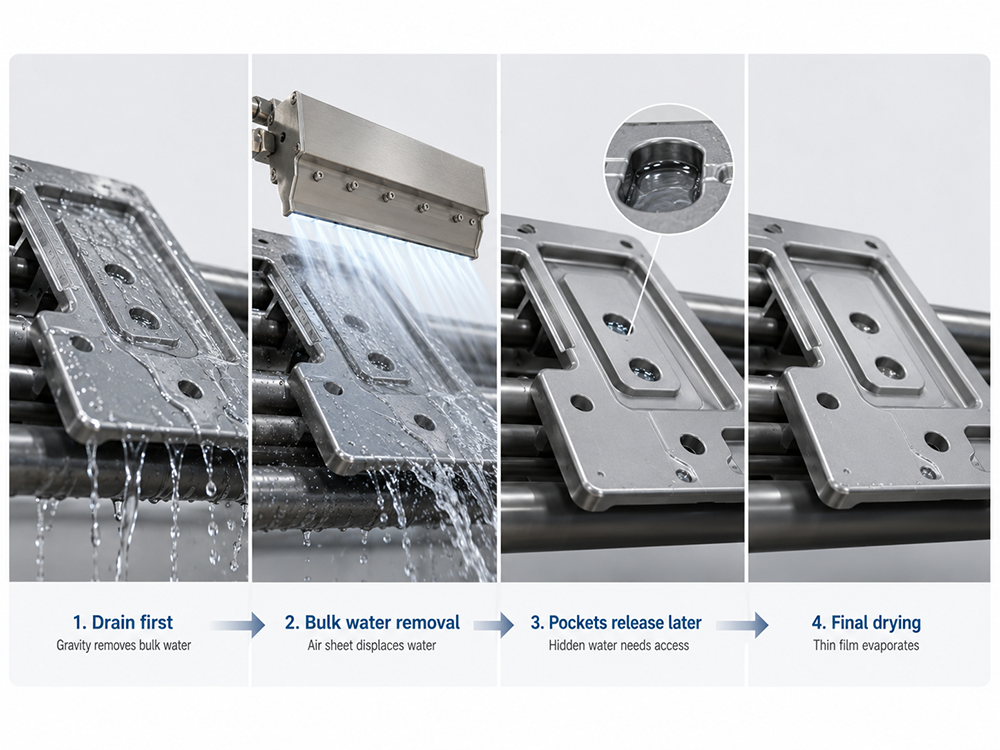
At the final rinse exit, gravity should get the first opportunity. A short drain position lets sheets of water run off without consuming blower power. Part orientation matters more than many teams expect. A horizontal flange becomes a tray; the same flange tilted a few degrees may empty on its own.
The air sheet applies shear to the surface and drives the remaining water toward an edge or drain side. This is displacement, not only evaporation. It works quickly on broad faces, rims, conveyor belts, and exposed contours because the jet acts across the full width instead of treating one small point at a time.
Bulk removal also breaks up heavy beads that would otherwise need a long heated dwell. The part enters the next stage with less water mass. Heated air can then work on a thin film, small residual droplets, and moisture released from sheltered geometry.
A straight air sheet cannot reach every blind hole, undercut, or nested contact point. Air may pass over the opening while water stays behind a lip. Better part orientation, a second knife from another direction, a focused jet, rotation, indexing, or a short dwell between blow-off passes may be required. The goal is to open a drainage path, not to keep raising pressure against a closed pocket.
Some moisture remains as a thin film or in surface texture. Ambient or heated air removes this last fraction. Because the air knife has already removed the heavy load, the finishing stage can often use less residence time. Whether heat can be reduced or eliminated depends on the dryness requirement, part temperature, material, geometry, and washer environment.
 The time saving comes from a smaller evaporation task. Pushing a droplet off the part and returning it to the wash system avoids the time and energy needed to turn it into vapor. Surface air velocity also disturbs the humid boundary layer, helping the remaining film evaporate.
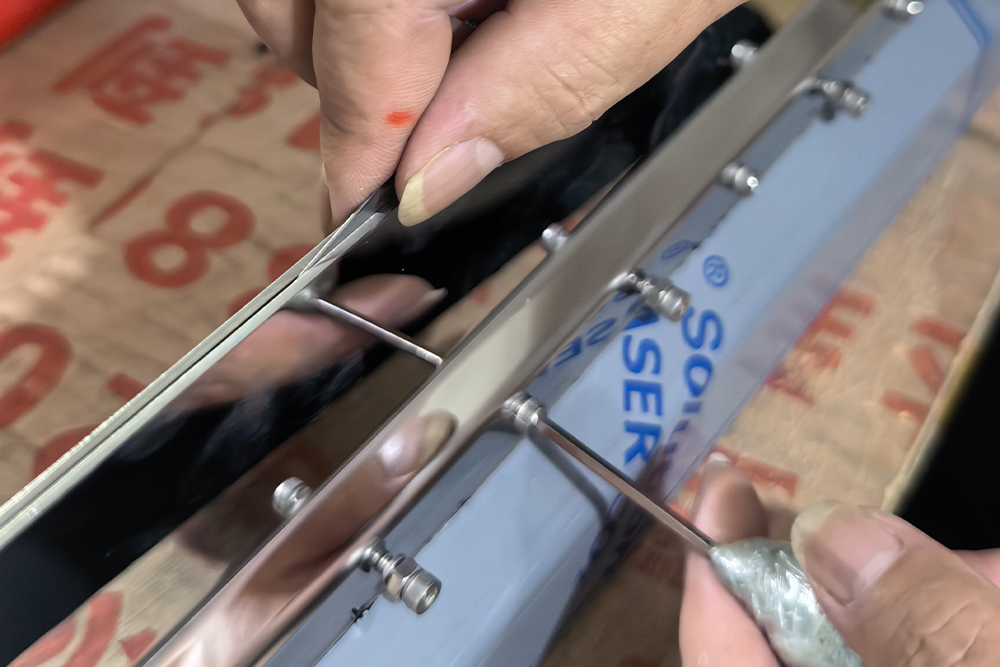
Coverage matters as much as peak force. A narrow blast may dry the center while leaving wet bands at the edges. A continuous air knife can apply a more even air sheet across the conveyor. QXY aluminum alloy air knives are factory calibrated for airflow uniformity of ±5% across the knife length, which helps limit repeating wet zones when the duct and installation are also balanced.
The air knife also acts earlier in the process. Water removed immediately after the final rinse has less time to collect in carriers, drip onto lower parts, or travel into the heated section. A clean transition between rinse, drain, blow-off, and finishing dry prevents one stage from rewetting the next.
Flat stampings, sheet-metal components, covers, and open brackets usually respond well to one or two slot air knives. The jet should sweep water toward a free edge. If both faces matter, upper and lower knives can treat the part in one conveyor pass.
Housings, valve bodies, gears, and turned parts retain water in features that a wide sheet may not enter. Present the openings to the airflow and give displaced water an exit. A mix of a slot knife for the outside and focused air for critical holes is often more effective than using one device for every surface.
A basket can block the jet and parts can shield one another. Water blown from the top layer may land on the layer below. Reduce stacking, control part orientation, or index and rotate the basket between passes. If the load pattern changes every cycle, drying time will also change.
More impact is not always useful. Thin stampings can flutter, small parts can move, and retained water can atomize into mist. Airflow should be strong enough to move water but stable enough to preserve part position and keep mist inside the collection zone.
Install the first knife after the final rinse and a deliberate drain position. Keep the air direction away from the clean rinse zone so removed water cannot return to the part. Angle the jet toward a drain edge and provide guards or a collection surface for the water it removes.
For many blower-driven QXY drying applications, a knife-to-part distance of 20–50 mm and an impingement angle of 15°–45° are practical starting points. Standard slot gaps are commonly 0.5–2 mm, with blower working pressure around 2–6 psi (0.14–0.42 bar). These values are not a finished recipe. Conveyor speed, stand-off variation, part movement, water chemistry, and geometry determine the final setting.
Cover the entire load width, including the outermost part positions. QXY standard lengths include 150, 300, 450, 600, 800, and 1000 mm, with custom lengths available. Knives over 600 mm normally use dual inlets. Long duct branches need balanced flow so the center and edges reach the same dry endpoint.
Direct runoff to a drain or recovery area. Manage mist so it cannot condense downstream and rewet parts. Filter the air supply where the blower, duct, or plant air could contaminate the cleaned surface.
An air knife and a heated dryer divide the work. The knife moves free water; heat handles thin films, surface texture, and moisture that emerges from internal features. Blow-off first may allow a shorter heated dwell or lower heat input.
Do not assume the air knife can always replace heat. Parts with high thermal mass, fine porosity, deep blind features, or a strict coating-ready endpoint may still need a finishing stage. Test the combined process at cold startup and after the washer reaches normal temperature. Warm parts can make a weak blow-off setup look better than it is.
Run a baseline with the current washer settings and record the time to the real dryness endpoint. Note part family, load density, orientation, rinse temperature, line speed, blower condition, and dryer settings. Then add or adjust the air knife while changing one major variable at a time.
• Check the first, middle, and last part positions in the load, not only an easy sample.
• Inspect immediately after drying and again after tilting or a short waiting period.
• Repeat at the fastest conveyor speed and the densest approved load pattern.
• Track wet-part failures, rework, and downstream defects as well as residence time.
• Confirm that mist, noise, part movement, and air demand remain acceptable.
Shorten the finishing dwell in controlled steps until the first failure appears, then restore a reasonable process margin. This test produces a defensible cycle time for the actual part. It is more useful than applying a generic drying-time reduction percentage from a different machine.
An aluminum alloy slot air knife is a practical choice in a general dry-off zone and is listed in the QXY catalog for ultrasonic cleaning-machine drying, hardware cleaning, and automotive-parts cleaning. Stainless steel is better where wash chemistry, corrosion, or frequent washdown reaches the knife. PVC may suit acid or alkaline proximity when the temperature is within the material limit.
Complex parts may need a tornado air knife or a mixed arrangement that combines wide coverage with focused air. A blower-driven system is commonly used for large-area, continuous drying. Compressed-air designs suit localized high-impact work, narrow spaces, or holes, but air consumption and noise should be evaluated over the full production duty cycle.
QXY Machinery (Shenzhen Qixingyuan Machinery Equipment Co., Ltd.) is a high-tech enterprise integrating R&D, design, production, and sales. Based in Shenzhen, China, the company specializes in drying, dust removal, and water-blowing solutions and has more than 10 years of focused air knife experience.
For automated parts washing systems, QXY Machinery supplies aluminum alloy slot air knives, stainless steel air knives, PVC air knives, tornado air knives, small-hole designs, and dual-sided configurations. Custom length, slot width, hole pattern, and inlet arrangements are available to match washer width, part geometry, air source, and process environment.
QXY Machinery supports equipment builders and manufacturers with product selection and application matching. The specification should be based on the final rinse, required dry endpoint, part family, carrier layout, conveyor speed, available installation space, and the downstream operation.
Q: Where should an air knife be installed in an automated parts washer?
A: Install it after the final rinse and a short drainage position. Aim the airflow toward a free edge or drain and away from the clean rinse zone. Leave enough room to capture runoff and mist.
Q: Does an air knife dry parts by evaporation?
A: Its main job is to displace free water while it is still liquid. The airflow also helps the remaining thin film evaporate, but bulk water removal is usually the larger time-saving mechanism.
Q: Can an air knife replace a heated drying tunnel?
A: Sometimes, for open parts and a modest dryness requirement. Parts with blind holes, high thermal mass, textured surfaces, or strict coating requirements may still need heated finishing. Verify with production samples.
Q: Why are parts still wet after a strong air knife pass?
A: Water may be trapped behind a lip, inside a blind hole, between nested parts, or under a basket contact point. Change orientation, add another airflow direction, reduce load density, or use focused air for the sheltered feature.
Q: What distance and angle should be tested first?
A: For many blower-driven applications, QXY uses 20–50 mm stand-off and a 15°–45° angle as starting ranges. The final position must clear water across the actual part and load at production speed.
Q: Is compressed air or a blower better for parts drying?
A: A blower-driven air knife suits wide, continuous coverage. Compressed air can provide focused impact for a small area or hole. Compare air demand, noise, duty cycle, coverage, and the dry-part result before selecting.
Q: How should drying cycle time be measured?
A: Measure from final-rinse exit until every critical surface reaches the defined dry endpoint. Test the densest load, difficult part positions, cold startup, normal operating temperature, and the fastest approved line speed.
Need a custom air knife solution? Send us your application details, material requirement ,or air source type . Our engineering team will help you select the right model.

Shenzhen Qixingyuan Machinery Equipment Co., LTD.
info@airknifecn.com
Building 8, Wanfeng Third Industrial Zone, Xinqiao Street, Bao'an District, Shenzhen, Guangdong, China


