

Every part leaving a cleaning tank takes some liquid with it. A thin film coats the surface. Drops sit on horizontal ledges. Bores, seams, baskets, and rack contacts hold more. When that liquid enters the next tank, it changes the downstream bath and removes useful chemistry from the upstream one. This movement is often called carryover or drag-out.
An Air Knife placed at the tank boundary can remove much of the free liquid before the part crosses into the next stage. The aim is not simply to make the part look dry. The aim is to push liquid back toward the source tank, capture it, and prevent the air stream from turning the same liquid into mist that travels forward.
Carryover changes two tanks at once. The source tank loses solution and may need more chemical makeup. The receiving tank gains that solution and can drift away from its intended concentration, pH, conductivity, cleanliness, or rinse quality. The exact effect depends on the chemistry, but the direction is always the same: uncontrolled liquid transfer makes bath control harder.
The cost can appear outside the tanks. Extra rinse water may be needed to hold the next stage within limits. Filters load faster. Foam or residue may increase. A coating or conversion stage can receive parts with the wrong surface condition. The washer may still run, yet quality variation and chemical use slowly rise.
Carryover is also load-dependent. One open bracket may drain well. A dense basket of machined parts can transfer far more liquid per cycle. A stable process therefore needs a defined load pattern or a control method that still works at the highest approved carryover condition.
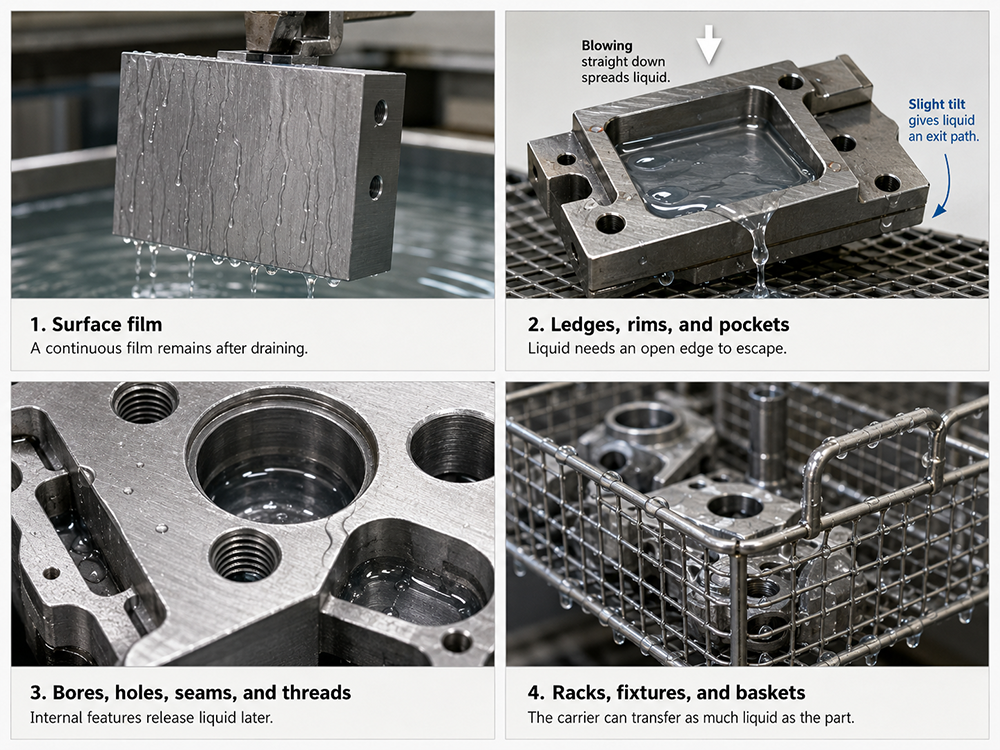
A continuous film stays on any wetted face after the part leaves the bath. Film thickness changes with liquid properties, part speed, surface condition, temperature, and the time allowed to drain. Broad vertical faces usually give an air knife a clear path to sweep this liquid downward.
Horizontal features behave like small trays. Air can move the liquid, but only if the jet points toward an open edge. Blowing straight down into a pocket may spread the liquid without giving it an exit. A slight part tilt can sometimes remove more carryover than a large pressure increase.
Internal features can release liquid after the main surface has already crossed the tank boundary. A slot air knife may clear the outside while a bore remains full. Reorientation, a second air direction, focused air, indexing, or a drain pause may be required for the critical feature.
The carrier can hold as much liquid as the parts. Mesh intersections, hooks, sleeves, and contact points collect drops that later fall into the next tank. Include the rack or basket in every carryover test. A dry sample part on a wet carrier is not a controlled transfer.
The best location is normally just after the part leaves the source tank, above the tank itself or above a sloped drain-back section connected to it. Gravity removes the easiest liquid first. The air knife then sweeps the remaining film and drops toward the return path.
Angle the air back toward the source tank rather than forward toward the next bath. The removed liquid needs a solid collection surface or open return area. Guards should stop splash without creating a shelf that holds liquid and drips later. If the conveyor passes through an enclosure, manage the internal air direction so mist does not bypass the drain-back zone.
The available dwell is set by conveyor speed and the length of the boundary zone. A short gap may require more than one knife angle or a change in part orientation. Extending the drain-back zone can be more effective than forcing all removal into a single high-impact point.
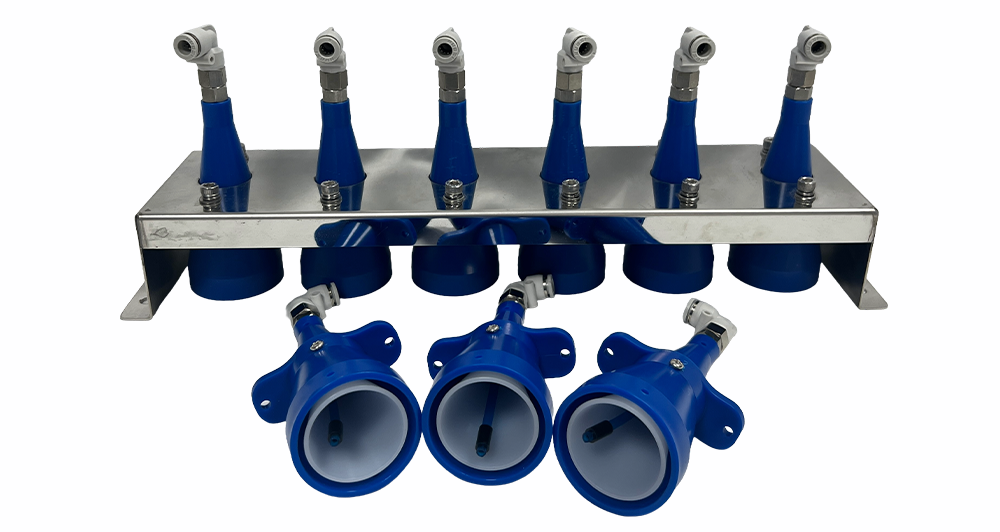
For sheet metal, covers, open brackets, and broad machined faces, a slot air knife provides continuous coverage across the load. Set the knife so its air sheet reaches the outermost part positions. If both faces carry liquid, use upper and lower knives or change part presentation.
A tornado air knife can improve access to recessed and irregular surfaces. Focused compressed air or a small-hole design may suit specific bores and narrow gaps. These devices should complement wide-area blow-off, not create an uncontrolled cloud inside the transfer zone.
Air follows open paths through a basket and may miss shielded parts. Reduce nesting, keep a repeatable load pattern, or rotate and index the basket. Liquid blown from the top layer must have a route out of the carrier; otherwise it lands on lower parts and leaves the machine in the same load.
For many blower-driven QXY applications, a 20–50 mm knife-to-part distance and a 15°–45° impingement angle are practical starting ranges. Standard slot gaps are commonly 0.5–2 mm, with blower working pressure around 2–6 psi (0.14–0.42 bar). Carryover control may need a different final angle from a drying application because the target is a specific return direction.
A smaller stand-off usually keeps the air sheet more concentrated, but product height variation must be considered. A knife mounted too close can be struck by parts or racks. A knife too far away loses surface impact and may spread liquid as mist before it reaches the drain-back area.
Use enough velocity to move the film and droplets, then stop. Excess air can atomize solution, create foam, cool a heated bath surface, move lightweight parts, or drive vapor and mist into the next zone. Blower-driven air knives suit wide, continuous coverage. Compressed air is better reserved for focused features where the duty cycle and air demand are acceptable.
A dry center and wet edges create uneven carryover. QXY aluminum alloy air knives are factory calibrated for airflow uniformity of ±5% across the knife length. The installed result also depends on duct balance, inlet position, slot condition, and whether the product blocks part of the air sheet.
QXY standard lengths include 150, 300, 450, 600, 800, and 1000 mm, with custom lengths available. Knives over 600 mm normally use dual inlets. Check liquid removal at the left, center, and right load positions. Average performance can hide one wet band that repeatedly contaminates the receiving tank.
The air knife body, shim, fasteners, duct, and nearby supports must tolerate splash, vapor, and cleaning chemicals. Aluminum alloy is useful in general industrial positions with low chemical exposure. Stainless steel is a stronger choice near washdown, alkaline or acidic cleaners, and corrosive process areas when the selected grade is compatible with the actual chemistry.
PVC can be a cost-effective option near acid or alkaline tanks where temperature remains within its limit. Titanium is reserved for highly corrosive conditions that exceed stainless steel capability. Material selection should be reviewed against concentration, temperature, contaminants, cleaning method, and expected exposure time. Do not select only from the tank name.
Start with a repeatable part, carrier, drain time, and line speed. One direct method is to weigh the dry load, run it through the source tank, apply the defined drain period, and weigh it again. The wet-minus-dry mass estimates retained liquid. Repeat enough cycles to see normal variation. Where weighing is impractical, collect and measure drips from a controlled load or use a removable catch tray in the transfer zone.
The air knife should reduce liquid leaving the source boundary, but tank data confirms whether that reduction matters to the process. Track the source-tank makeup rate, receiving-tank concentration or conductivity where appropriate, rinse-water demand, filter loading, and chemical additions. Keep production volume and load mix with the record so the trend is comparable.
• Test the densest approved basket and the part orientation with the deepest pockets.
• Measure all conveyor positions and include the carrier in the result.
• Run the test at cold startup and at normal bath temperature.
• Inspect guards, drains, and the next tank for mist or delayed dripping.
• Confirm that reduced carryover does not damage parts, disturb racks, or create unacceptable noise.
There is no universal acceptable carryover value. The limit comes from the receiving tank tolerance, chemical cost, water target, downstream quality requirement, and the variation the washer can hold during normal production.
Watch where the removed liquid goes. If the part surface clears but the next tank still drifts, solution may be leaving on the rack, collecting behind a guard, or traveling as fine mist. A forward-facing jet can make the part look dry while sending chemistry downstream through the enclosure.
Repeatability is another clue. If some loads perform well and others do not, the cause is often part orientation, basket density, height variation, or a shielded conveyor position. If all loads weaken over time, inspect the slot, filters, blower inlet, ducts, drains, and buildup on the collection surfaces.
QXY Machinery (Shenzhen Qixingyuan Machinery Equipment Co., Ltd.) is a high-tech enterprise integrating R&D, design, production, and sales. Based in Shenzhen, China, the company specializes in industrial drying, dust removal, and water-blowing solutions and has more than 10 years of focused air knife experience.
For carryover control between cleaning tanks, relevant QXY options include aluminum alloy slot air knives, stainless steel air knives, PVC air knives, titanium alloy air knives, tornado air knives, small-hole designs, and dual-sided arrangements. Custom lengths, slot widths, hole patterns, and inlet configurations are available to match conveyor width, part geometry, chemical environment, and air source.
QXY Machinery supports equipment builders and manufacturers with product selection and application matching. A useful specification includes the bath chemistry, temperature, exposure, part and carrier drawings, transfer speed, load pattern, available drain-back area, and the required downstream bath stability.
Q: What is carryover between cleaning tanks?
A: Carryover is liquid transported from one tank to the next on parts, racks, baskets, films, drops, or mist. It is also called drag-out in many cleaning and finishing processes.
Q: Where should an air knife be installed for carryover reduction?
A: Place it after the part exits the source tank and above that tank or a connected drain-back zone. Aim removed liquid toward the source, not toward the receiving tank.
Q: Can an air knife remove liquid from blind holes?
A: A wide slot knife may not reach every blind hole. Reorient the part, add a second direction, use focused air, or allow a drain pause. The hole also needs a path for displaced liquid to leave.
Q: Is higher air pressure better for reducing drag-out?
A: Not always. Excess velocity can atomize solution, create foam, move parts, and send mist downstream. Use the lowest stable setting that clears the required surfaces and returns liquid to the drain-back area.
Q: Which air knife material should be used near chemical tanks?
A: Choose from the actual chemical, concentration, temperature, contaminants, and exposure. Stainless steel, PVC, or titanium may be needed where aluminum is unsuitable. Confirm compatibility before specification.
Q: How can carryover reduction be measured?
A: Use wet-versus-dry load mass, collected drip volume, source-tank makeup, receiving-tank concentration or conductivity, rinse-water demand, and chemical additions. Keep load and production conditions consistent.
Q: Should an air knife be installed between every tank?
A: Not automatically. Prioritize boundaries where chemistry loss, contamination, water use, or downstream quality has the highest cost. Confirm that the transfer space can return liquid and control mist.
Need a custom air knife solution? Send us your application details, material requirement ,or air source type . Our engineering team will help you select the right model.

Shenzhen Qixingyuan Machinery Equipment Co., LTD.
info@airknifecn.com
Building 8, Wanfeng Third Industrial Zone, Xinqiao Street, Bao'an District, Shenzhen, Guangdong, China


