

Deburring leaves different material states. Cutting or brushing can leave loose chips. Vibratory finishing leaves media and compound slurry. High-pressure water deburring leaves wet passages. Some burrs remain attached. An air knife helps only when the remaining material can move with air and has a safe exit.
Air knives therefore appear in two positions. A pre-wash knife removes loose dry chips; a post-rinse knife removes water and released debris. Neither replaces a deburring process that failed to detach the burr.
An attached burr is still part of the workpiece. Airflow does not provide the controlled cutting, fracture, brushing, abrasion, or high-pressure water action needed to remove it. If edge defects remain, correct the deburring tool, media, cycle, pressure, access, or part presentation before evaluating blow-off.
Once a chip or burr fragment is detached, an air knife can move it from an open surface. Effectiveness depends on chip mass, shape, oil adhesion, static, magnetic attraction, and whether the air has a route under the particle. The collection system must capture the chip instead of sending it into another station.
Mass finishing and abrasive deburring can leave media fines mixed with water and compound. A pre-wash air knife may remove free material, but dried or sticky slurry needs washing and rinsing. After the rinse, blow-off can remove the remaining water and particles already loosened from the surface.
Air can displace pools and heavy drops, but it does not reliably remove a bonded oil film. An oily chip may stay attached or move to a new location. Degreasing chemistry, spray impact, immersion, ultrasonics, filtration, or oil separation must do the cleaning work before final air blow-off.
Free rinse water is a strong air-knife application. Moving it while liquid avoids a long evaporation load and reduces dripping into inspection, assembly, leak test, coating, or packaging. The rinse must already meet the cleanliness requirement; the air knife cannot separate dissolved contamination from the water.
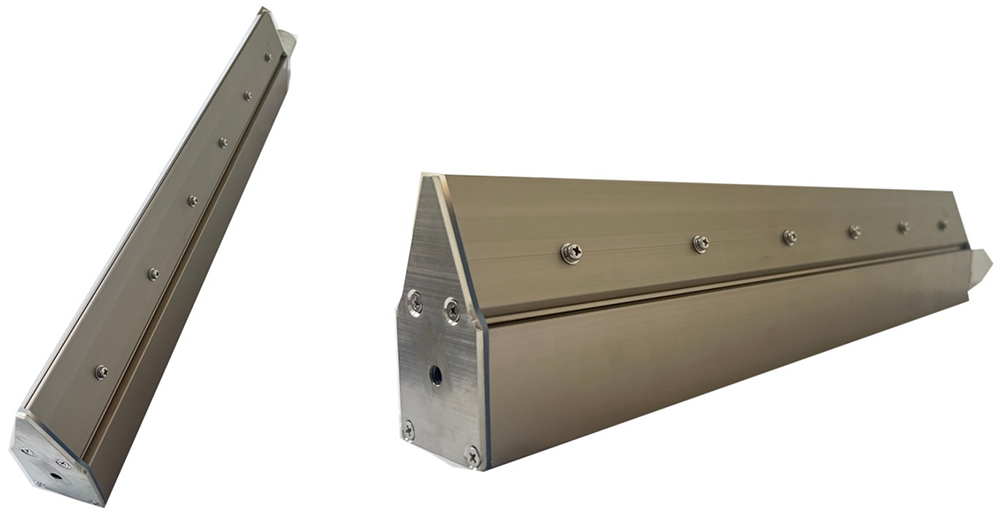
A pre-wash knife can remove loose dry chips, broken media, and dust before they enter the washer. This can reduce the solids reaching spray nozzles, tanks, filters, and baskets. It works best when debris is free, surfaces are open, and an enclosure with extraction or collection is available.
The same position is less useful when cutting oil holds chips to the surface or when debris sits inside narrow passages. Aggressive air may turn metal fragments into projectiles or spread oily contamination around the cell. Guarding, extraction, and a defined collection direction are required.
The post-rinse knife removes water, loosened fines, and chips that the washer has carried toward an opening. It can prepare the part for inspection, assembly, corrosion protection, coating, leak testing, or packaging. Runoff belongs in a controlled drain, not back into the clean rinse or onto the conveyor.
A knife placed only after the wash but before rinsing can reduce chemical carryover, yet another rinse will wet the part again. Define each knife by its job: solids pre-cleaning, chemistry return, intermediate rinse separation, or final water removal.
Automated deburring lines commonly separate deburring, part separation, washing, and drying. The wash stage removes abrasive compound, fines, oil, and material from recesses that a broad air sheet cannot reach. Filtration and chip collection keep removed debris from returning to the part.
High-pressure water deburring and aimed washing are used where burrs or chips remain in holes and internal galleries. Immersion and ultrasonic cleaning can exchange fluid through complex passages. The air knife should receive a part that is already deburred and rinsed to the required chemical condition.
If the washer discharge repeatedly carries visible chips, investigate the deburring result, wash direction, nozzle access, tank agitation, filters, and part orientation. Increasing final blow-off may hide the symptom without correcting solids recirculation inside the washer.
Flat plates, open castings, and exposed machined faces are suited to a slot air knife. Sweep chips and water toward a free edge. A diagonal knife orientation can prevent material from collecting in a standing line across the conveyor.
Castings, valve bodies, transmission housings, and manifolds have pockets, bosses, galleries, and intersecting holes. A standard knife handles broad surfaces; focused air or air cannons may be needed for defined cavities. A tornado air knife can improve access to complex 3D surfaces and recesses.
Part orientation is often more important than pressure. Open a drainage path, point holes so liquid and chips can leave, and avoid fixtures that create new traps. If debris is magnetic, wedged, or embedded, airflow alone may remain unreliable even with good orientation.
Baskets create shielding and can transfer chips from one layer to another. Use repeatable loading, avoid dense nesting, and verify the bottom and center positions. A clean top sample does not represent the full load.
Metal-chip blow-off must be enclosed. Guards, collection bins, extraction, and drain surfaces should keep chips and liquid away from operators, sensors, bearings, the next process, and the shop floor. The jet direction should end at a collection point, not at a wall that sends debris back toward the part.
Wet blow-off can create mist. Capture it before it travels into a dry zone or coats inspection windows. Sloped surfaces should shed water and chips into a serviceable tray or filter. Horizontal shelves become secondary reservoirs and delayed contamination sources.
Inspect the collection system as part of routine maintenance. A full tray, blocked drain, dirty baffle, or loaded filter can make a stable air knife appear to fail. Debris removed from the part is still inside the process until it is captured and discharged.
For many blower-driven QXY applications, a 20–50 mm knife-to-part distance and a 15°–45° impingement angle are practical starting ranges. Standard slot gaps are commonly 0.5–2 mm, with working pressure around 2–6 psi (0.14–0.42 bar). These are starting conditions, not guarantees for metal-chip removal.
Use the lowest stable setting that moves the target debris or liquid across the full load. Excess impact can move small parts, mark delicate surfaces through chip contact, atomize contaminated water, or raise noise. If a chip is stuck by oil or trapped behind a feature, more velocity may increase risk without improving removal.
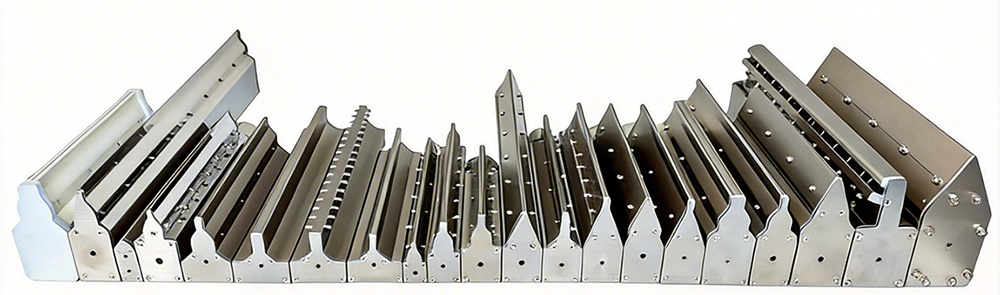
Coverage should include the full carrier width. QXY aluminum alloy air knives are factory calibrated for airflow uniformity of ±5% across the knife length. Standard lengths include 150, 300, 450, 600, 800, and 1000 mm, with custom lengths available. Knives over 600 mm normally use dual inlets to support distribution.
Aluminum alloy slot air knives suit dry pre-cleaning and general post-wash positions with low chemical exposure. Stainless steel can be better near washdown, alkaline cleaners, and corrosive washer environments. PVC may suit some acid or alkaline positions where temperature remains within its material limit.
Blower-driven systems are practical for wide, continuous surfaces and production duty. Compressed air or focused nozzles can target holes and local chip traps, but consumption, air quality, noise, and projectile containment require review. Complex parts may use a mixed system: slot knife for general coverage and focused devices for critical features.
Define the requirement from the next operation. A cosmetic visual check is different from an internal-passage chip limit, leak-test requirement, coating preparation, or precision assembly specification. “Looks dry” does not prove that chips or abrasive fines are absent.
Use representative parts and the hardest approved load. Sample before washing, after rinsing, after air blow-off, and after handling. Methods may include controlled visual inspection, extraction and filter analysis, particle counting by size class, gravimetric debris measurement, borescope inspection, or a validated downstream functional test.
• Inspect the left, center, and right conveyor or basket positions.
• Challenge pockets, blind holes, threaded features, and the lowest part in the load.
• Run oily, dry, and maximum-debris conditions that are allowed by the process.
• Check the enclosure and collection system for escaped chips and mist.
• Repeat after filters and trays have accumulated a normal production load.
Compare the air knife on and off without changing the washer recipe. If chips remain after washing, determine whether they were never detached, were not flushed out, or were redeposited. The correct action depends on that evidence.
Do not use final blow-off as the primary correction for attached burrs, embedded swarf, thick grease, cured compound, magnetic fines held to the surface, or closed cavities with no exit. These conditions need a change in deburring, chemistry, flushing, agitation, part orientation, magnetic control, or feature-specific cleaning.
An air knife is also a poor fit when debris cannot be safely contained or when the part is too light, delicate, or unstable for the required force. In those cases, vacuum extraction, controlled washing, centrifugal drying, vacuum drying, or another process may be more reliable.
QXY Machinery (Shenzhen Qixingyuan Machinery Equipment Co., Ltd.) is a high-tech enterprise integrating R&D, design, production, and sales. Based in Shenzhen, China, the company specializes in industrial drying, dust removal, and water-blowing solutions and has more than 10 years of focused air knife experience.
For deburring and metal-washing lines, relevant QXY products include aluminum alloy slot air knives, stainless steel and PVC designs, tornado air knives, and dual-sided configurations. Custom length, slot width, hole pattern, and inlet arrangements are available to match conveyors, baskets, castings, machined parts, washer environments, and collection zones.
A useful application review includes the deburring method, chip and media type, oil condition, wash and rinse sequence, part and fixture drawings, trapped features, line speed, required cleanliness, air source, drainage, extraction, and downstream process.
→ Contact QXY Machinery to discuss air knife use after metal deburring and washing stages.
Q: Can an air knife remove burrs from metal parts?
A: It can remove detached burr fragments, but it does not replace mechanical, abrasive, thermal, electrochemical, ultrasonic, or high-pressure water deburring for attached burrs.
Q: Should the air knife be installed before or after the washer?
A: A pre-wash knife can remove loose dry chips. A post-rinse knife removes water and loosened debris. Some lines use both, with separate collection and drainage functions.
Q: Why do oily chips remain after air blow-off?
A: Oil creates adhesion and can hold chips to the surface or inside features. Improve degreasing, spray or immersion cleaning, flushing, and oil separation before increasing air velocity.
Q: Can an air knife remove chips from blind holes?
A: Only when the air reaches the chip and the feature has an exit path. Reorient the part, add focused air, or improve washing and flushing for deep or intersecting passages.
Q: What distance and angle should be tested first?
A: For many blower-driven applications, QXY uses 20–50 mm stand-off and a 15°–45° angle as starting ranges. Final settings depend on chip state, water load, geometry, part stability, and containment.
Q: How should metal chips be contained during blow-off?
A: Use an enclosure, guards, extraction or collection, and a defined jet direction. Keep chips away from operators, sensors, moving components, and downstream clean zones.
Q: How is air-knife performance validated after washing?
A: Test representative loads and difficult features, then use the required visual, extraction, particle, gravimetric, borescope, or functional method. Include filter loading and collection performance.
Need a custom air knife solution? Send us your application details, material requirement ,or air source type . Our engineering team will help you select the right model.

Shenzhen Qixingyuan Machinery Equipment Co., LTD.
info@airknifecn.com
Building 8, Wanfeng Third Industrial Zone, Xinqiao Street, Bao'an District, Shenzhen, Guangdong, China


